India Passport Citizenship Row: Government Clarifies Travel Document Legal Status
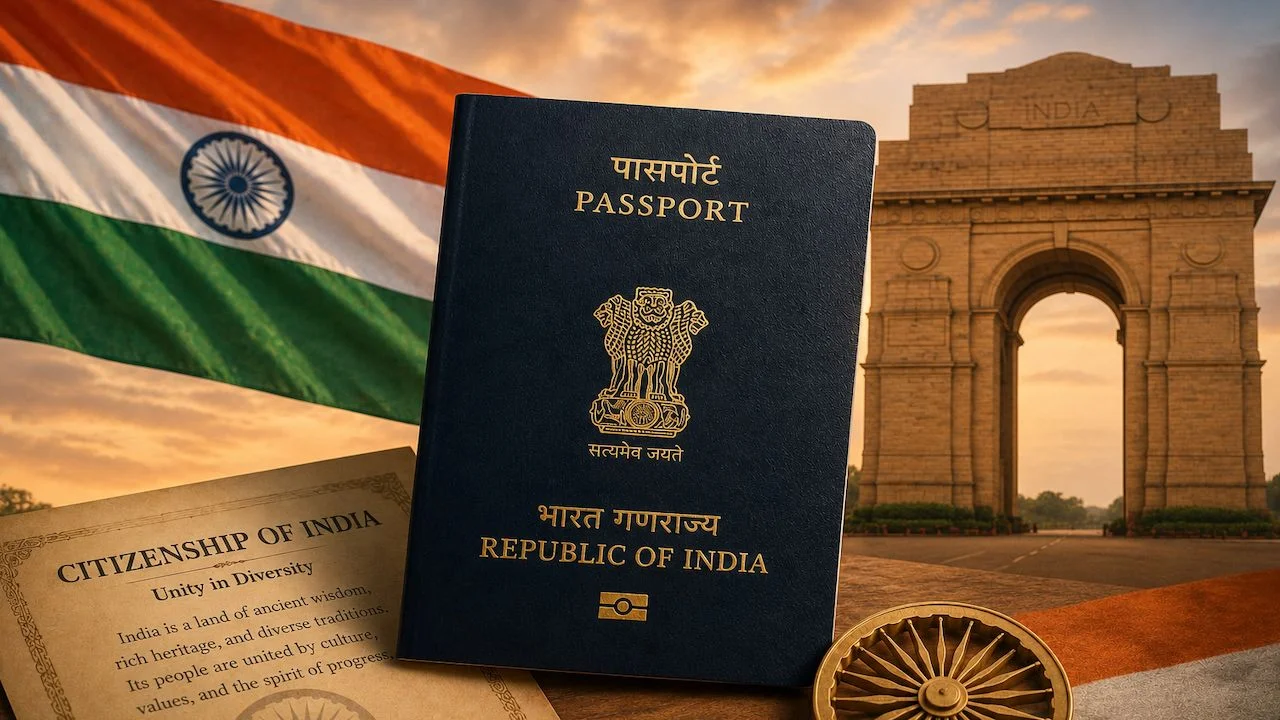
A fierce political debate has emerged across India following clarifications from the Ministry of External Affairs that an Indian passport serves strictly as a travel document rather than definitive proof of citizenship, sparking sharp criticism from opposition parties who allege potential misuse.
Key Highlights
- The central government stated that passports have never legally served as conclusive proof of citizenship under the 1967 Passports Act.
- Opposition leaders accuse the ruling dispensation of creating panic to arbitrarily deny citizenship rights to dissenting citizens.
- The Election Commission confirmed passports remain among the 12 valid identity documents permitted for voter registration.
- Passport issuance requires stringent police verification to verify applicant identity, background, and national security clearance.
A fresh domestic controversy has erupted regarding the legal parameters that establish a person’s national identity. The debate intensified after Ministry of External Affairs officials noted that an Indian passport is technically a travel document and not absolute proof of citizenship.
Government sources clarified that this legal interpretation is not a recent policy shift. Officials emphasized that the status of the document has remained unchanged throughout the 12 years of the Narendra Modi administration, stating that passports have historically never constituted sole proof of citizenship.
To support this stance, authorities highlighted Section 20 of the Passports Act, 1967. This specific provision legally empowers the central government to issue passports and travel papers to individuals who do not hold Indian citizenship.
The statutory text dictates that the central government retains the authority to grant passports or travel credentials to non-citizens. This power can be exercised if the administration deems the issuance necessary to serve the public interest.
Conversely, Section 6(2)(a) of the same 1967 Act mandates a conflicting restriction. It dictates that passport authorities must deny the issuance of a travel document if an applicant lacks recognized Indian citizenship.
This legal distinction triggered a sharp political confrontation. The government maintains that no policy adjustments occurred over the past 12 years, while opposition groups claim the administration is creating a framework to strip citizenship from political opponents.
While state officials cited statutory provisions allowing public-interest passport distribution to non-citizens, Election Commission representatives offered a different perspective. They affirmed that passports remain part of the 12 authorized documents utilized by voters to confirm registration eligibility.
Following the public disclosure of the ministry’s position, the Congress party claimed that the central administration is actively preparing mechanisms to systematically invalidate the citizenship rights of citizens who oppose government policies.
The Congress party intensified its political criticism through statements from its general secretary of organization, KC Venugopal. He asserted that the ruling Bharatiya Janata Party had previously altered voter registries by deleting specific communities to achieve electoral advantages.
Venugopal publically stated on X that the administration thrives on generating anxiety and vulnerability among the populace. He argued that denying the citizenship certification value of passports lays the groundwork for arbitrary rights deprivation.
Defending the external affairs ministry, the BJP stated that no new regulations or legislative amendments have been implemented. The ruling party maintained that officials simply stated a long-established legal reality that a passport alone does not confirm citizenship.
The BJP supported its argument by pointing to the Passports Act, 1967, alongside previous judicial precedents. They specifically cited a 2013 Bombay High Court ruling establishing that citizenship is governed exclusively by the Citizenship Act, 1955.
Amit Malviya, the head of the BJP’s information technology department, accused opposition factions of manipulating established law for political leverage. He characterized the protesting politicians as a collective that habitually refuses to display official documentation.
As public anxiety grew regarding valid proofs of nationality, electoral authorities sought to reassure citizens. They noted that passports remain valid among the 12 accepted identity verifications used during the intensive revision of voter rolls.
During recent Special Intensive Revision operations conducted in Bihar and Assam, election officials consistently accepted passports. The document allows individuals to secure new registrations or maintain existing listings on the national voter roll.
An election official confirmed that passports remain a standard instrument for verifying voter identity, noting that no procedural changes have occurred. Local electoral registration officers review these indicative papers to verify voter eligibility.
The ongoing debate coincides with historical legal observations. During previous judicial proceedings regarding intensive roll revisions, the Supreme Court ruled that Aadhaar cards constitute identity documents rather than definitive proof of citizenship.
On December 20, 2019, the Press Information Bureau published an explanatory document addressing frequent queries about the National Register of Citizens and the Citizenship Amendment Act.
The official guidelines stated that individuals could demonstrate citizenship by presenting records verifying their date and location of birth. However, the administration noted that a final schedule of universally accepted documents remained undecided.
The state informational release clarified that national citizenship determinations are processed under the Citizenship Rules, 2009. These specific regulatory frameworks are directly derived from the foundational Citizenship Act, 1955.
The legal guidelines outline five distinct pathways to acquire Indian citizenship. These established legal routes consist of citizenship by birth, descent, registration, naturalization, or through the incorporation of new territory.
Trinamool Congress MP Mahua Moitra publicly criticized the administration’s stance. She argued via social media that the government’s rhetoric implies citizenship verification is becoming tied to political alignment and religious identity.
Asaduddin Owaisi, the AIMIM chief and Hyderabad MP, questioned the systemic logic of the announcement. He demanded to know what specific documentation is required if passports, birth certificates, Aadhaar cards, and voter IDs are deemed inconclusive.
Owaisi expressed concern that the current administrative trajectory suggests documentation parameters are shrinking. He remarked satirically that political affiliation might eventually become the sole recognized proof of nationality by 2030.
Rajya Sabha member Kapil Sibal also challenged the government’s position on social media. He questioned which documents remain legally viable if local bureaucratic officials can arbitrarily contest an individual’s citizenship status and voting rights.
Prominent writer and lyricist Javed Akhtar described the clarification from the Ministry of External Affairs as entirely illogical.
Akhtar questioned the rationale of classifying a passport solely as a travel document. He argued it is absurd for a ministry to issue highly secure international travel documents without maintaining absolute certainty regarding the recipient’s citizenship.
History of Indian Citizenship Amendments
The legal framework governing Indian nationality has undergone significant evolution since the enactment of the Citizenship Act, 1955. To curb illegal immigration, the parliament passed a critical amendment in 1986 that restricted the unrestricted right to citizenship by birth, requiring at least one parent to be an Indian citizen.
The regulatory framework was modified further through subsequent legislative updates, culminating in the controversial Citizenship Amendment Act of 2019. This latest framework introduced expedited naturalization pathways for persecuted religious minorities migrating from Afghanistan, Pakistan, and Bangladesh, while the overall operational rules continue to rely on the detailed Citizenship Rules of 2009.
FAQs
Why did the government state that an Indian passport is not proof of citizenship?
The Ministry of External Affairs reiterated a long-standing legal position based on the Passports Act, 1967. Under Section 20 of this Act, the central government holds the authority to issue passports or travel documents to non-citizens in the public interest, meaning the possession of the document does not automatically verify citizenship under the Citizenship Act, 1955.
Can you still use a passport to register to vote in India?
Yes. The Election Commission of India confirmed that passports remain on the list of 12 approved supporting documents used to establish identity during the Special Intensive Revision of electoral rolls.
What are the legally recognized ways to obtain Indian citizenship?
According to the Citizenship Rules, 2009, which are based on the Citizenship Act, 1955, there are five recognized methods to acquire citizenship: birth, descent, registration, naturalization, and the incorporation of territory into India.
Does a passport application require police verification if it is only a travel document?
Yes. Despite its designation as a travel document, passport issuance involves rigorous police verification. This security process is mandatory to verify the applicant’s identity, confirm residency address, check for criminal records, and prevent national security risks or fraudulent identity creation.