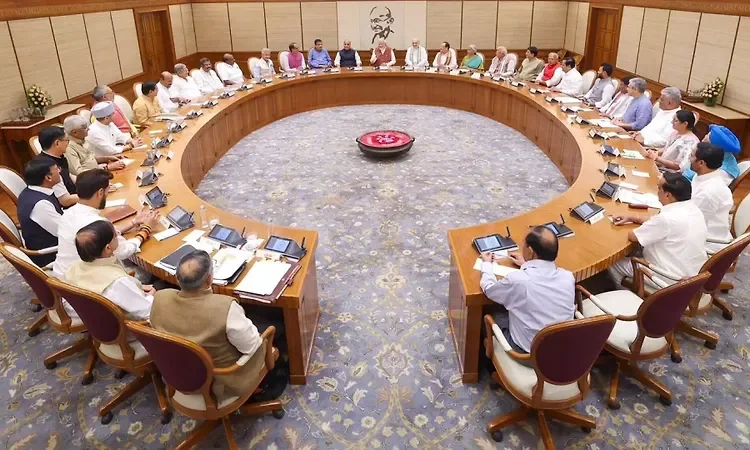
Modi Cabinet Reshuffle Set to Shift Ministers and Induct Fresh Faces
A major restructuring of Prime Minister Narendra Modi’s Union Council of Ministers is imminent, with top leadership indicating changes before the upcoming Monsoon Session of Parliament. This extensive overhaul aims to inject fresh blood into key ministries while balancing crucial regional, caste, and political dynamics across multiple Indian states.
Key Highlights
- A sweeping Union Cabinet reshuffle is anticipated in July 2026 before the parliamentary Monsoon Session begins.
- Union Education Minister Dharmendra Pradhan faces potential portfolio changes following recent national exam controversies.
- Former Reserve Bank of India Governor Shaktikanta Das is being strongly considered as the next Union Finance Minister.
- The ruling BJP will adjust its organizational team in tandem with the ministerial appointments to maintain strategic balance.
Deliberations indicate that the upcoming ministerial shake-up will occur alongside the unveiling of a restructured Bharatiya Janata Party organizational lineup. The newly finalized leadership roster under party president Nitin Nabin is expected to introduce younger leaders into prominent organizational positions.
Reports reveal that the party president conducted introductory consultative meetings with multiple Union ministers of state last week to outline roles. The leadership plans to transfer certain sitting Union ministers into party organizational posts while inducting current party office-bearers into the administration.
Speculation regarding significant portfolio reassignments is mounting, with heavy focus on the future of Union Education Minister Dharmendra Pradhan. His leadership remains uncertain following intense public scrutiny over structural irregularities and paper leaks in national examinations under his ministry.
Insiders suggest that the comprehensive administrative restructuring will take place in July 2026, prior to the scheduled legislative session. The precise timing of the announcement remains contingent upon coordinating with the exceptionally tight diplomatic travel itinerary of the Prime Minister.
Prime Minister Modi concludes an official three-day diplomatic visit to Seychelles on June 29, 2026. His upcoming schedule features strategic state travel to Indonesia, Australia, and New Zealand between July 6 and July 11, 2026, following bilateral talks with Japanese Prime Minister Sanae Takaichi in New Delhi.
Administration leaders strongly advocate for introducing younger personnel into critical ministries to optimize federal governance. Furthermore, the political establishment faces pressing strategic compulsions to balance state representation, local caste alignments, and organizational loyalty across the cabinet.
Two sitting Union ministers, Pankaj Chaudhary and Harsh Malhotra, have assumed leadership roles for party units in Uttar Pradesh and Delhi. The administration will enforce its strict organizational policy, meaning both officials must exit their government posts to prevent dual-role conflicts.
Concurrently, Union ministers George Kurian and Ravneet Singh Bittu concluded their legislative tenures in the Rajya Sabha on June 21, 2026. While Kurian has formally stepped down from his ministerial post, Bittu remains in office to coordinate upcoming state electoral strategies.
Bittu, a former Congress leader and grandson of a former Punjab chief minister, represents an influential community face for the party. Political strategists expect enhanced ministerial representation for Uttar Pradesh, Uttarakhand, and Punjab, where highly competitive assembly elections are scheduled for 2027.
Following substantial electoral victories in West Bengal, several regional lawmakers are positioned to secure promotion into the federal ministry. Additional slots may be allocated to representatives from breakaway factions of rival regional parties that recently allied with the ruling coalition.
A group of 20 breakaway lawmakers merged with an allied national citizens party to reinforce the ruling National Democratic Alliance. Concurrently, 6 dissident regional lawmakers shifted allegiance to the faction led by Maharashtra Deputy Chief Minister Eknath Shinde, securing potential cabinet representation.
Analysts suggest a senior figure from the Shinde-led alliance will secure a cabinet-level appointment during the upcoming expansion. Furthermore, multiple parliamentary defectors who recently exited opposition parties to join the ruling dispensation are being evaluated for junior ministerial roles.
Final appointments for lawmakers from breakaway factions remain subject to official anti-defection rulings by the Lok Sabha Speaker. The pace of political consultations accelerated significantly after Prime Minister Modi held a high-level meeting with President Droupadi Murmu on June 23, 2026.
The political momentum increased further on June 25, 2026, when Union Home Minister Amit Shah held a separate meeting with the President. Rashtrapati Bhavan officials clarified that these encounters were standard courtesy calls rather than extraordinary policy sessions.
Legislative terms for Union ministers Hardeep Singh Puri and BL Verma will conclude this coming November, forcing decisions on renomination. Concurrently, 3 state governors are approaching the end of their official terms between July and September of 2026.
Exiting cabinet ministers may be reassigned to fill these upcoming gubernatorial vacancies across several Indian states. As always, the Prime Minister maintains absolute operational secrecy regarding major structural changes until official announcements are broadcast.
While there has been no official announcement from the government, political observers believe a major Cabinet overhaul could take place, with some ministers getting new responsibilities and others possibly being dropped.
Political analysts expect a thorough administrative transformation that will redistribute critical portfolios while dropping underperforming ministers entirely. Public scrutiny surrounding the Education Ministry has intensified demands for immediate leadership intervention to restore institutional credibility.
Speculation indicates that former central bank head Shaktikanta Das could enter the administration to direct federal fiscal policy. Under this specific transition plan, current Finance Minister Nirmala Sitharaman would transfer to lead the restructured Education Ministry.
Why is Shaktikanta Das being considered?
Shaktikanta Das brings decades of public sector expertise in economic governance, comprehensive taxation systems, and federal financial management. His highly regarded tenure leading the Reserve Bank of India concluded in 2024, earning widespread international acclaim.
An appointment to the treasury would place him among an elite group of financial experts who transitioned from banking leadership to political office. Because he does not hold a legislative seat, he must secure a parliamentary election win within 6 months.
Who could enter the Modi Cabinet?
A select list of prominent regional leaders and experienced administrators are being actively vetted for potential inclusion. The upcoming selection process heavily favors regional representation to maximize performance in critical state elections across northern India.
Portfolios currently held by senior leaders including Nitin Gadkari, Ashwini Vaishnaw, and Manohar Lal Khattar remain subject to review. The administration maintains total silence on the final list, leaving these structural adjustments unconfirmed until official publication.
Future Outlook: Governance Shifts and Electoral Balancing
The impending cabinet reshuffle marks a critical pivot toward long-term governance optimization and electoral preparation for the ruling coalition. By injecting younger leadership into crucial portfolios, the administration aims to counteract policy fatigue and accelerate infrastructure initiatives ahead of major state assembly elections.
Integrating technocrats like Shaktikanta Das signals a renewed focus on fiscal discipline and economic stability, aimed at reassuring global markets. Concurrently, the strategic allocation of ministerial berths to key regional allies ensures coalition stability while strengthening the party’s grassroots footprint in critical battlegrounds like Uttar Pradesh, Punjab, and West Bengal.
FAQs
When is the Modi Cabinet reshuffle expected to take place?
The Union Cabinet reshuffle is highly anticipated to occur in July 2026, right before the Monsoon Session of Parliament begins.
Why is Union Education Minister Dharmendra Pradhan expected to be reassigned?
Dharmendra Pradhan faces potential portfolio reassignment following severe public controversies regarding national examination paper leaks and digital marking irregularities under his ministry.
Who is rumored to become the new Union Finance Minister?
Former Reserve Bank of India Governor Shaktikanta Das is being strongly considered to take over the role of Union Finance Minister.
What happens to ministers who take up organizational roles in the BJP?
In accordance with the ruling party’s strict organizational policy of holding only one post at a time, ministers assigned to lead state party units will step down from their government cabinet positions.


