India’s VOC Port Cuts Carbon Emissions by 45 Percent
India has advanced its maritime sustainability goals through major clean energy and technology installations at the country’s prominent shipping gateways.
Key Highlights
- Net carbon emissions at the facility dropped by 45% over a four-year period.
- Renewable energy sources now account for nearly 94% of equivalent power consumption.
- The location became the first major Indian port to launch a custom generative AI application.
- A collaborative partnership established a new academic framework for maritime logistics education.
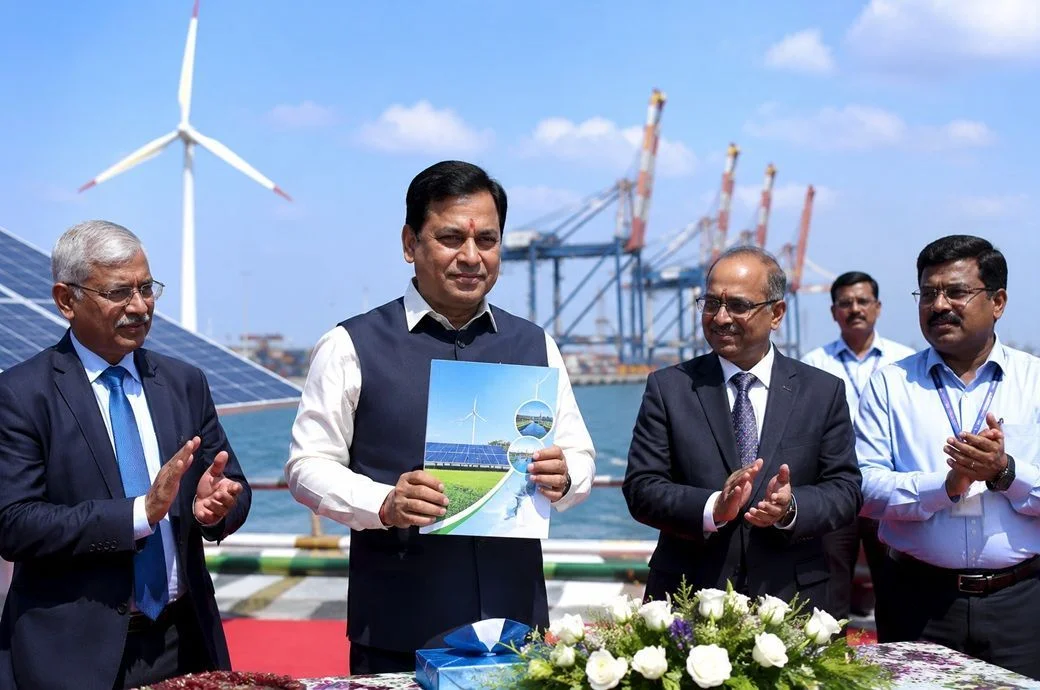
Union Minister of Ports, Shipping and Waterways Sarbananda Sonowal inaugurated multiple sustainable development, educational, and technological systems at the VO Chidambaranar Port Authority in Thoothukudi, Tamil Nadu. The minister simultaneously presented the inaugural sustainability report detailing significant progress in decarbonization and clean energy implementation.
The documentation indicated that green energy integration currently balances close to 94% of total energy needs. Furthermore, aggregate carbon emissions decreased by 45%. The data also demonstrated that carbon output per tonne of handled cargo dropped by almost half within 4 years, establishing the facility as a prime example of domestic port modernization.
Sonowal remarked that the complex serves as an operational benchmark for environmentally responsible maritime infrastructure nationwide by prioritizing green power and advanced technology.
The minister stated that the facility showcases what can be accomplished when maritime logistics expansion integrates with ecological care and community benefits. He noted that achieving a 45% drop in net emissions marks a substantial advancement toward cleaner industrial operations.
The minister additionally introduced an official case study from the Indian Institute of Management Calcutta tracking the facility’s shift toward alternative fuel production. The document examines the systemic transition from traditional freight management to an eco-focused operations model, highlighting investments in automated machinery and India’s debut green hydrogen pilot program at a principal port.
Validating these environmental updates, the Ministry of Ports, Shipping and Waterways announced that the hub secured an official Scope-2 Emission-Free certification during the executive visit.
The port authority concurrently finalized a formal pact with Gati Shakti Vishwavidyalaya to drive joint research and supply chain training. This partnership will establish a dedicated Centre of Excellence in Maritime Logistics and Port Management to bridge industrial needs and academic research.
To conclude the updates, Sonowal rolled out the PortGPT mobile software solution. This deployment marks the initial launch of an enterprise-grade generative artificial intelligence tool across major domestic shipping hubs to streamline operational workflows and information retrieval.
Future Outlook
The successful deployment of green hydrogen infrastructure and automated systems at the Thoothukudi facility lays the groundwork for standardizing zero-emission operations across all major Indian ports by 2030. These technological and ecological frameworks will guide national maritime policy, driving the shipping industry toward complete carbon neutrality while integrating artificial intelligence into daily logistics management.
FAQs
What is the PortGPT application launched at VOC Port?
PortGPT is an enterprise-grade generative artificial intelligence mobile application designed to improve operational workflow, data-driven decision-making, and knowledge management at the port authority. It represents the first deployment of this type of mobile AI technology at a major Indian port.
By how much did the VO Chidambaranar Port Authority reduce its carbon emissions?
The port achieved a 45% reduction in net carbon emissions over a four-year period. Additionally, it successfully halved its carbon intensity per tonne of cargo handled during the same timeframe.
What academic partnership was established during the green initiatives launch?
The VO Chidambaranar Port Authority signed a memorandum of understanding with Gati Shakti Vishwavidyalaya. This collaboration focuses on logistics education, research, and setting up a specialized Centre of Excellence in Maritime Logistics and Port Management.
What percentage of VOC Port’s energy consumption is offset by renewable energy?
Renewable energy installations currently offset approximately 94% of the total energy consumption equivalent at the port, which contributed to the facility earning its Scope-2 Emission-Free certification.