Lauritz Knudsen Powers 50 GW Solar Capacity Globally
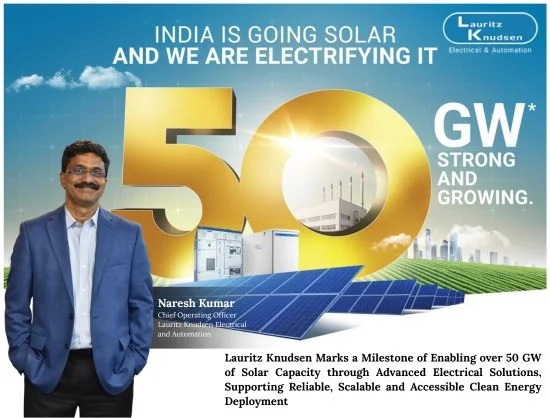
Lauritz Knudsen Electrical and Automation has deployed its electrical and digital technologies to power more than 50 GW of solar energy capacity across India and international markets, driving substantial momentum in global green energy adoption.
Key Highlights
- Achieved a milestone of powering over 50 GW of solar capacity worldwide.
- Supported more than 2,350 solar projects, partnering with 350 EPCs and 300 developers.
- Spearheaded last-mile energy transition across utility, industrial, and residential sectors.
- Aligned operations with national clean energy targets to achieve 500 GW of non-fossil capacity by 2030.
This milestone highlights the company’s dedication to converting solar capacity into accessible power for factories, agricultural sectors, residential homes, and marginalized communities while simultaneously supporting large-scale national decarbonization targets.
The domestic solar expansion is moving beyond centralized utility installations. Sustainable energy increasingly impacts local communities, energizing agricultural pumps via the PM-KUSUM program, backing residential rooftop deployment under PM Surya Ghar, and providing electricity to off-grid areas.
Growth has moved rapidly. India continues to expand its renewable footprint, with solar power now making up nearly 55% of the country’s total renewable capacity, crossing 154 GW. This development moves forward on dual tracks: massive grid-scale utility ventures and localized distributed installations.
The company functions in three primary market verticals: utility-scale power installations, commercial and industrial applications, and residential systems. It supplies advanced alternating current setups, direct current switchgear, intelligent metering, and cloud-enabled tracking infrastructure to ensure operational safety and long-term project viability.
This footprint draws from over 70 years of operations within domestic electrical infrastructure markets. The business has supplied over 2,350 clean energy projects, collaborated with more than 350 engineering, procurement, and construction firms alongside 300 project developers, and upskilled 300 system integrators to cultivate localized technical expertise.
Naresh Kumar, Chief Operating Officer of Lauritz Knudsen Electrical and Automation, stated that true energy transformation occurs when agricultural workers transition away from diesel irrigation or when households secure consistent electricity. He noted the 50 GW mark reflects systemic societal accessibility.
Technological complexity rises alongside aggregate solar volume. Increased power thresholds, changing grid dynamics, and expanding decentralized power frameworks necessitate highly specialized, application-specific electrical engineering systems across the entire power distribution grid.
The enterprise supplies specialized products across the entire green energy cycle, spanning generation, transmission, and final grid integration. Portfolio expansion reflects this technological transition, with robust demand growth in medium-voltage infrastructure, distribution switchgear, software automation, and lifecycle maintenance services.
Surging clean energy deployment simultaneously expands local production capabilities. The domestic manufacturing sector witnessed significant scale expansions from fiscal year 2025 to fiscal year 2026, boosting domestic industrial independence. The company facilitated this trend by delivering robust electrical setups to modern manufacturing units.
As the nation targets 500 GW of non-fossil generation capability by 2030, the strategic priority is shifting from absolute capacity metrics to infrastructure quality, ensuring that clean electricity access remains equitable and robustly distributed across all economic segments.
The ongoing market participation of the firm centers on its foundational objective: engineering the core electrical frameworks required to make solar power consistent, scalable, and readily available across every segment of the domestic macroeconomic growth trajectory.
Future Outlook
India’s clean energy trajectory points toward aggressive infrastructure scaling, backed by manufacturing incentives and a transition toward higher-voltage utility systems. As the nation targets 500 GW of non-fossil capacity by 2030, integration technologies, smart grids, and localized supply chains will dictate the long-term reliability of the grid. Distributed power systems like rooftop solar will continue to bridge the equity gap in remote areas.
FAQs
What milestone did Lauritz Knudsen achieve in 2026?
The company announced that its digital and electrical technologies have successfully powered over 50 GW of solar energy capacity across Indian and international markets.
Which national solar schemes are supported by this technology?
The technology integrates with major decentralized clean energy programs in India, including the PM-KUSUM scheme for agricultural solar irrigation and the PM Surya Ghar initiative for residential rooftop solar deployment.
How much solar power capacity does India currently possess?
India’s total installed solar capacity has surpassed 154 GW, which now constitutes nearly 55% of the nation’s total operational renewable energy capacity.
What specific products does the company supply to the solar sector?
The company delivers advanced alternating current solutions, direct current switchgear, smart metering systems, medium-voltage solutions, and cloud-based remote monitoring software to secure grid integration.