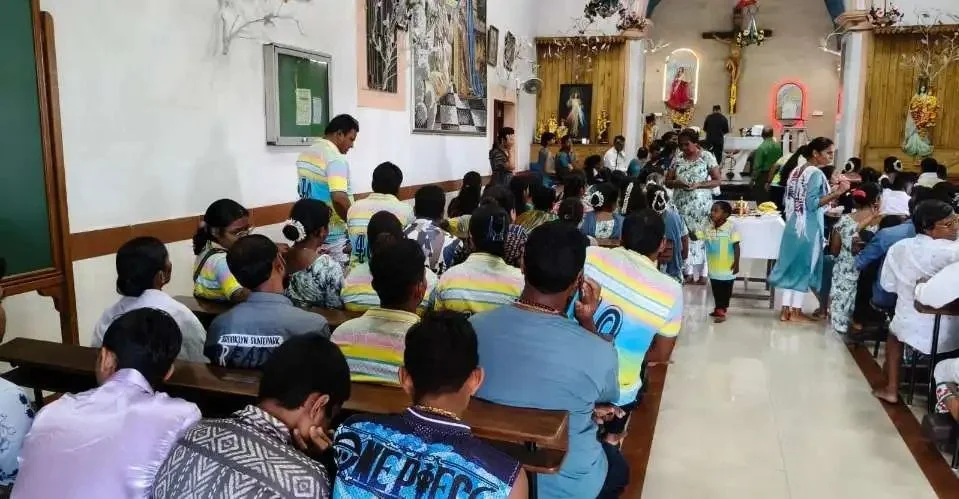
Portuguese-Era Church in Mumbai At Risk From Coastal Road Project
Catholics and heritage conservationists in Mumbai are raising urgent alarms regarding the construction of a new coastal road near a historic Portuguese-era church, demanding that local infrastructure authorities immediately implement protection measures for the ancient monument.
Key Highlights
- Construction activities for the Thane coastal road project are threatening the structural integrity of a 1630 heritage church.
- Heavy excavation machinery is operating just 20 to 25 meters away from the historic site.
- Developers plan to demolish nearly half of the 220 sacred steps leading to the hilltop shrine.
- Activists have petitioned the Archaeological Survey of India to halt operations pending a technical conservation assessment.
The physical stability of the 17th-century Our Lady of Hope Church, situated at Bhayandarpada in Thane, faces severe risk from ongoing excavation and earth-moving operations. These heavy industrial activities are part of the alignment for the proposed Thane coastal road development project.
Parish priest Father Calisto Fernandes confirmed that heavy machinery operations are currently proceeding a mere 20 to 25 meters from the monument. Portuguese Franciscan missionaries constructed the historic sanctuary in 1630, highlighting that engineers could have selected an alternative route to protect the shrine.
The private construction firm managing the infrastructure initiative intends to demolish approximately half of the 220 steps ascending to the hilltop site. Church leadership received a formal notification from the contractor stating the concrete steps and steel railings must be removed for road alignment.
Fernandes countered that the staircase forms an intrinsic element of the protected Indo-Portuguese regional heritage. While the company offered to build a temporary access pathway and a permanent Foot Over Bridge later, the priest noted that no official government correspondence has been received.
The Association of Concerned Christians issued warnings that neglecting the historic building risks destroying an irreplaceable segment of regional cultural history. Melwyn Fernandes, the ecumenical body’s general secretary, noted that generations of faithful have climbed the 220 steps for penance and devotion.
Preserving the centuries-old ascending pathway remains vital for future generations to maintain ancestral traditions. Activist Jyotsna Fernandes added that hundreds of Catholic devotees travel from across the region to the hilltop sanctuary every year on April 26 for the annual parish feast.
The Mumbai-based Watchdog Foundation dispatched an urgent objection letter to the Archaeological Survey of India and the Thane district collector. The group demanded an immediate halt to the earth-moving operations and heavy excavation work occurring near the religious monument.
Foundation trustee Godfrey Pimenta warned that vibrations and soil displacement from the heavy machinery could severely compromise the foundations. We have urged the ASI and district authorities to conduct an immediate site inspection, undertake a structural assessment through conservation experts, verify regulatory clearances, and, if necessary, suspend work pending a technical evaluation, Pimenta stated.
History of Our Lady of Hope Church
The historic Our Lady of Hope Church stands as a premier architectural remnant of the colonial era in the Mumbai Metropolitan Region. Built in 1630 during the height of Portuguese influence in the northern Konkan region, the sanctuary was established by Franciscan missionaries to serve the growing local Christian population. The characteristic hilltop placement and the iconic 220-step stone staircase reflect traditional Indo-Portuguese ecclesiastical architecture, blending European structural designs with local Indian stone-masonry techniques. For nearly four centuries, the site has functioned continuously as a prominent pilgrimage center, surviving geopolitical transitions from Portuguese rule to the British Empire, and finally into modern independent India.
FAQs
When was the Our Lady of Hope Church built?
The historic church was constructed in 1630 by Portuguese Franciscan missionaries who were establishing religious and cultural outposts in the region.
Why is the Thane coastal road project threatening the church?
The proposed infrastructure alignment runs within 20 to 25 meters of the building, utilizing heavy excavation machinery that causes ground vibrations, soil displacement, and structural threats to the ancient foundation.
What portion of the heritage site faces demolition?
The private construction firm plans to remove roughly half of the 220 concrete and steel-railed steps that lead up the hill to the shrine, claiming they overlap with the planned roadway.
What actions are heritage activists taking to protect the monument?
The Watchdog Foundation and the Association of Concerned Christians have petitioned the Archaeological Survey of India and local district collectors to halt the engineering works until independent conservation experts conduct a full structural evaluation.