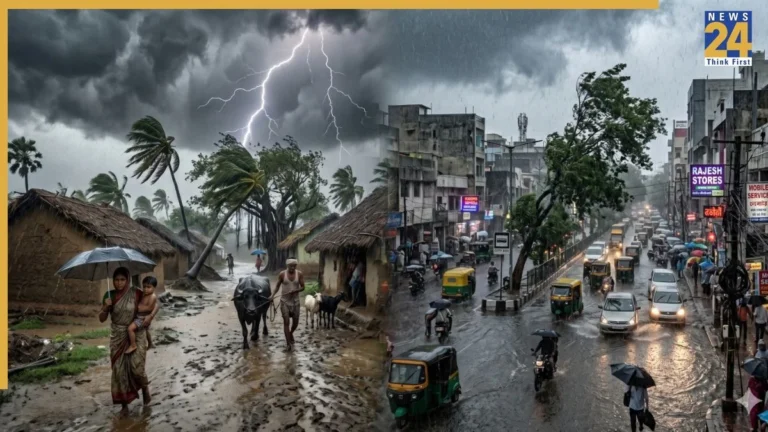
Deficit Mounts as Southwest Monsoon Covers India
The southwest monsoon has advanced across most of India after an extended delay, yet national rainfall remains 42% below long-term averages. Data from the India Meteorological Department indicates the country recorded 68.5mm of precipitation against the normal baseline of 118.5mm since June 4, 2026.
Key Highlights
- National monsoon rainfall is running 42% below historical averages.
- Central India and South Peninsular India face steep deficits of 59% and 43%, respectively.
- Karnataka has witnessed a severe shortage of rainfall, plunging 41% below its seasonal expectations.
- Water scarcity has forced emergency tanker deployments across 122 taluks in Karnataka.
Heavy showers and regional rainfall shortfalls Intense downpours yielded up to 20cm of rain within 24 hours in isolated parts of West Bengal, Maharashtra, and Madhya Pradesh. Sections of Goa, Coastal Karnataka, Telangana, and Assam also secured substantial precipitation. However, severe atmospheric deficits persist across central and southern territories, with Central India recording a 59% shortfall and South Peninsular India missing 43% of its typical rainfall. Meteorologists emphasize that sustained, widespread precipitation is vital to bridge these cumulative gaps.
The regional impact is starkly visible in southwestern India, where Karnataka has witnessed a severe shortage of rainfall during this opening phase. The state registered just 95.2 mm of precipitation against the traditional benchmark of 162.5 mm, culminating in a 41% deficit that threatens agricultural operations.
Regional metropolitan areas are mirroring these dry trends, with Bengaluru securing 66 mm of rain compared to its normal 89 mm target. Coastal ecosystems are experiencing the sharpest localized stress, noting deficits near 50%, while the urban shortfall in Bengaluru settles at 25%.
Experts Blame Weak Weather Systems and El Niño Atmospheric scientists clarify that the sluggish momentum cannot be charged entirely to El Niño phenomena. Instead, they highlight a lack of robust low-pressure systems over the Arabian Sea and the Bay of Bengal, which typically drive moisture into the southern peninsula.
Monsoon advancement slowed as pressure gradients remained weak throughout June. Meteorologists warn that a failure to recover during the critical window of July and August could exacerbate summer temperatures and water scarcity. Thermal stress is already mounting, with temperatures in regions like Kalaburagi hitting 38°C mid-monsoon.
Climatologists warn that anthropogenic warming is compounding the volatility of El Niño, disrupting seasonal predictability and complicating agricultural planning cycles.
Drought Concerns Grow as Government Prepares The prolonged dry spell has sparked widespread domestic anxiety regarding impending drought conditions. State infrastructure is facing immediate strain, with acute drinking water deficits reported across 122 taluks, requiring immediate trucked water interventions for hundreds of settlements. Municipal teams have integrated approximately 800 private borewells to sustain urban and rural supply lines.
Administrative leaders, including Deputy Chief Minister Dr. G. Parameshwara, have instructed ministries to build contingencies for a persistent El Niño architecture. Technical interventions like cloud seeding are largely ruled out by specialists due to inadequate cloud density and systemic regulatory lags.
Resource management experts are urging federal and state bodies to pivot toward structural drought resilience programs, noting that repetitive seasonal failures carry deep socio-economic risks for the agrarian economy.
Future Outlook
The trajectory of the 2026 monsoon hinges entirely on the generation of deep depressions within the Bay of Bengal during July. If these systems fail to materialize, subcontinental water reserves will face unprecedented stress, forcing structural shifts in crop selection and power generation strategies nationwide.
FAQs
What is the current national rainfall deficit in India?
India’s national rainfall is currently running 42% below the long-term average, with the country receiving only 68.5mm of rain compared to the normal expectation of 118.5mm.
Which regions in India are facing the worst monsoon shortfalls?
Central India is experiencing the steepest deficit at 59%, followed closely by South Peninsular India which faces a 43% deficit. Coastal regions of Karnataka have also reported shortfalls approaching 50%.
Why is the southwest monsoon underperforming?
While El Niño plays a role, meteorologists state the primary cause is the absence of strong, sustained low-pressure weather systems over both the Arabian Sea and the Bay of Bengal to drive moisture inland.
How is the water crisis being managed in affected states like Karnataka?
Governments are deploying emergency water tankers to hundreds of villages across 122 affected taluks and have commandeered nearly 800 private borewells to maintain basic drinking water supplies.