UK Foreign Secretary Wraps Up India Visit on Trade and Security
UK Foreign Secretary Yvette Cooper has concluded an official diplomatic tour of India and China, emphasizing international engagement over geopolitical isolation. The high-level visit produced new bilateral agreements on maritime security, artificial intelligence supply chain tools, and substantial research funding to insulate British and Indian markets from economic shocks.
Key Highlights
- Strategic Rejection of Isolationism: Cooper rejected “cancel culture” in foreign policy, advocating for purposeful global engagement to protect British domestic growth and security.
- Maritime Defense Integration: The UK and India co-launched the Regional Maritime Security Centre of Excellence (RMSCE) to secure crucial shipping lanes like the Strait of Hormuz.
- AI Supply Chain Security: A new Global Supply Chain Observatory (GSCO) was unveiled to monitor critical minerals using artificial intelligence tools.
- Academic Funding Commitment: India pledged 1.2 million Euros to establish a joint satellite research campus at IIT Dhanbad alongside the University of Cambridge.
London reports confirm that UK Foreign Secretary Yvette Cooper has finished her official tour of India and China.
Cooper emphasized that the UK must remain deeply involved with major international powers. This positioning ensures Britain stays at the center of critical global policy debates shaping modern international relations.
According to government statements, Cooper asserted that the UK cannot isolate its domestic interests from international challenges by adopting a “cancel culture” approach to foreign policy. She stated that avoiding essential global discussions harms national interests, advocating instead for direct dialogue with vital global partners.
The foreign secretary maintained that the UK must cooperate on mutual priorities while firmly confronting areas of disagreement. This diplomatic framework aligns with Britain’s broader international strategy, which views active and focused global engagement as the optimal mechanism to deliver economic expansion and safety for the British public.
Arriving in New Delhi on Thursday, the foreign secretary advanced initiatives vital to British economic success. She held discussions with Indian officials regarding maritime defense, economic growth, and the protection of supply chains against volatile international market disruptions.
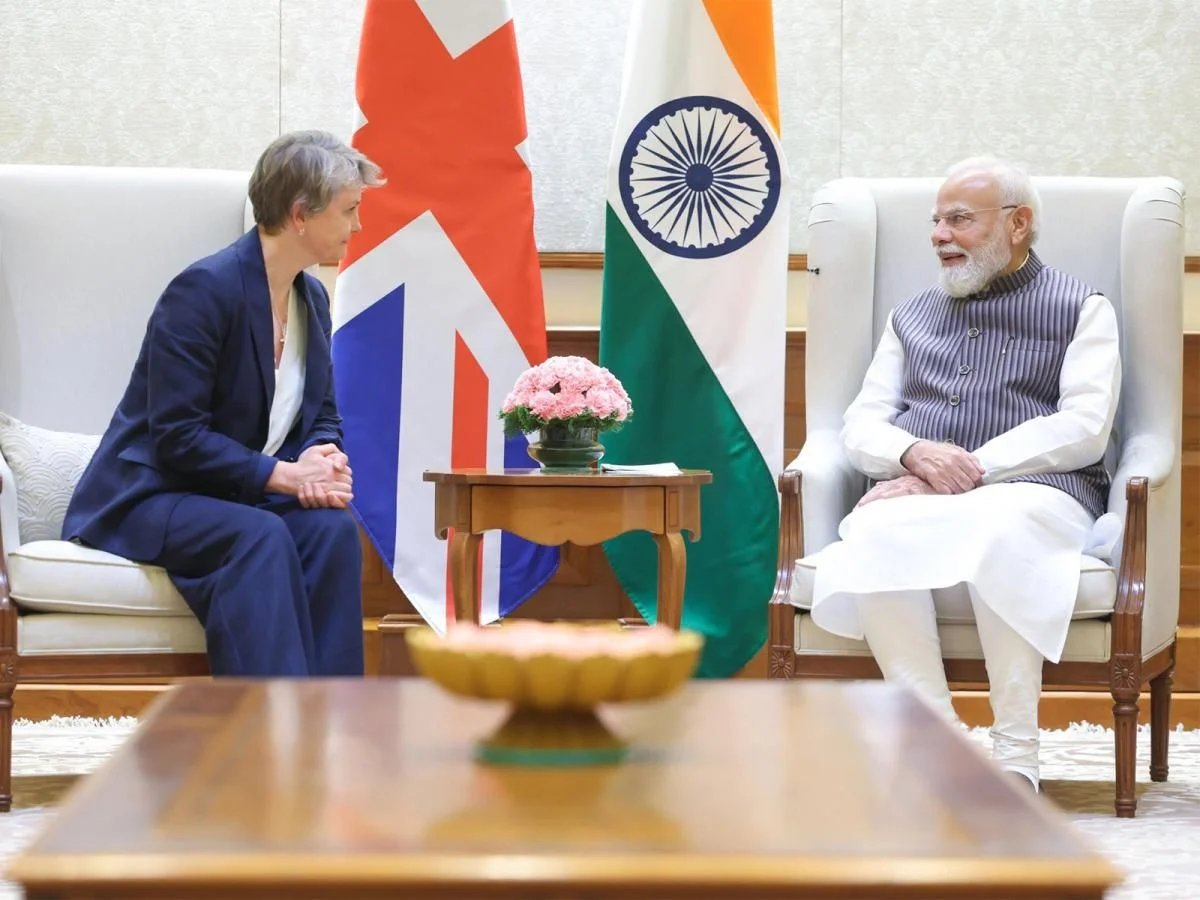
In high-profile meetings with Prime Minister Narendra Modi and External Affairs Minister S Jaishankar, the foreign secretary advanced the framework for deeper bilateral cooperation established under the strategic Vision 2035 roadmap.
Cooper stressed the urgent requirement for joint operations regarding the Strait of Hormuz. The discussions focused on mitigating the severe commercial disruptions that its potential closure poses to international maritime trade.
To address these vulnerabilities, the foreign secretary co-launched the new Regional Maritime Security Centre of Excellence (RMSCE). This institution strengthens British-Indian defense cooperation and builds systemic resilience against international trade disruptions.
Securing access to critical minerals served as a central pillar of the discussions with Indian leadership. Throughout her meetings, the foreign secretary affirmed the UK’s dedication to collaborating with international allies to build diversified and resilient resource supply chains.
Government briefings emphasized that critical minerals remain vital to ongoing and future British industrial prosperity. These resources serve as indispensable raw materials for manufacturing everything from electric vehicles and wind turbines to consumer smartphones.
During a bilateral meeting with G Kishan Reddy, India’s Minister for Coal and Mines, the foreign secretary debuted the Critical Minerals Global Supply Chain Observatory (GSCO). Serving as a primary initiative under the UK-India Technology Security Initiative, this system utilizes a pioneering artificial intelligence tool to track global mineral flows and pinpoint supply vulnerabilities in real time.
To support the infrastructure of the GSCO, the Indian government will allocate 1.2 million Euros in funding. This capital will establish a dedicated satellite observatory campus at the Indian Institute of Technology in Dhanbad, operating in direct partnership with the University of Cambridge.
Future Outlook
The successful deployment of the Global Supply Chain Observatory (GSCO) and the RMSCE maritime center positions the UK-India alliance as a primary defensive framework against future supply chain shocks. As both nations march toward the milestones outlined in Vision 2035, subsequent bilateral efforts are anticipated to focus heavily on integrating artificial intelligence into defense infrastructure and scaling clean energy supply chains. The academic corridor established between IIT Dhanbad and the University of Cambridge is expected to yield critical predictive data, reshaping how democratic nations insulate their manufacturing sectors from resource scarcity.
FAQs
What was the main purpose of UK Foreign Secretary Yvette Cooper’s visit to India?
The visit focused on deepening bilateral cooperation under the Vision 2035 framework. Key objectives included securing international shipping lanes, protecting critical mineral supply chains, and launching joint technological and maritime security initiatives.
What is the Critical Minerals Global Supply Chain Observatory?
The observatory is a landmark artificial intelligence initiative launched under the UK-India Technology Security Initiative. It provides real-time tracking of global critical mineral distributions and uses advanced software to identify supply chain vulnerabilities.
How much funding did India commit to the new joint academic project?
The Indian government committed 1.2 million Euros to establish a satellite observatory campus at the Indian Institute of Technology in Dhanbad, collaborating directly with the University of Cambridge.
Why are the UK and India focusing on the Strait of Hormuz?
The Strait of Hormuz is a vital international shipping corridor. Both nations established the Regional Maritime Security Centre of Excellence to address maritime vulnerabilities and ease the economic impacts that shipping disruptions cause to global trade.