India Nears End of Sixty-Year Maoist Insurgency
A comprehensive, multi-decade security strategy has brought India’s 60-year Maoist insurgency to the brink of total elimination, shifting the targeted regions from armed conflict toward constitutional integration.
Key Highlights
- Left-wing extremism has been restricted from 96 districts in 2010 to just 38 by 2024.
- Operational capacity expanded through 336 new security camps and 76 strategic helipads.
- Mass surrenders crossed 1,225 in 2025 up to September, driven by lucrative rehabilitation programs.
- The targeted neutralization of 18 central committee members successfully fractured the top insurgent leadership.
For nearly six decades, a violent domestic rebellion degraded the core of the democratic republic. Operating from dense forest landscapes, Maoist rebels established an underground administrative system that collected illegal taxes, imposed parallel courts, and launched lethal assaults against state institutions. Left-wing extremism entrenched itself deeply within the country’s central geography as historical counter-insurgency responses regularly proved inadequate or short-lived. That protracted era of internal conflict is reaching its conclusion, bringing the national objective of an insurgency-free India within immediate visibility.
The armed movement previously expanded to a critical threshold. A small violent flashpoint originating in 1967 at Naxalbari, West Bengal, transformed into a sweeping rebellion across the indigenous tribal belts of Andhra Pradesh, Bihar, Odisha, Maharashtra, Chhattisgarh, and Jharkhand. The 2004 merger of radical factions under the unified CPI (Maoist) banner introduced heightened operational coordination and tactical intent. The crisis crested around 2010, when violent incidents impacted 96 separate districts, and 126 administrative zones carried official extremist designations. Approximately 120 million citizens resided under a parallel governance structure enforced by weapons. The insurgent ambition to build an armed corridor spanning nearly 17% of the domestic landmass represented the nation’s premier internal defense threat.
The territorial dominance of the insurgency contracted sharply when political leadership adjusted priorities after 2014, accelerating further after 2019. The federal administration framed the security challenge as an interconnected national defense crisis requiring synchronized cooperation across multiple ministries. The federal home ministry directed this strategic shift, balancing intensive tactical field operations with structured surrender frameworks, while maintaining direct administrative oversight to ensure systemic accountability.
The administrative apparatus moved rapidly to eliminate historical equipment deficits. Delayed military procurement processes were accelerated, and advanced equipment was secured directly from defense stockpiles under specialized federal directives. Field units received high-priority deliveries of tactical footwear, precision sniper platforms, mobile satellite communication terminals, and dedicated medical evacuation aircraft. This urgent logistical support signaled clear institutional backing to the deployment personnel stationed in high-risk zones.
The counter-insurgency architecture relied on two foundational operational components. The first component comprised a structured rehabilitation and surrender program. Senior insurgent commanders who renounced violence received immediate financial transition grants up to 500,000 rupees, a monthly living stipend of 10,000 rupees for 3 years, and dedicated housing and vocational placement assistance. Information regarding these terms spread through tribal communities and local neutral intermediaries, supported by state radio broadcasts transmitting real-world reintegration accounts in regional indigenous dialects.
The second foundational component involved unyielding tactical pressure against remaining insurgent units. Intelligence-led joint operations executed by specialized federal paramilitary forces, elite jungle warfare units, local regional reserve groups, and provincial police successfully fractured the armed network. Long-term metrics indicate that active extremist districts dropped to 38 by 2024. Comparative decadal data reveals that defense personnel casualties declined by 73%, while civilian fatalities dropped by 74%. Operational units neutralized 290 insurgents in 2024, marking a historic annual high, alongside 881 voluntary surrenders and 1,090 legal apprehensions. Voluntary surrenders reached 1,225 during the first nine months of 2025, with a single state registering over 1,000 surrendered cadres within a 12-month span.
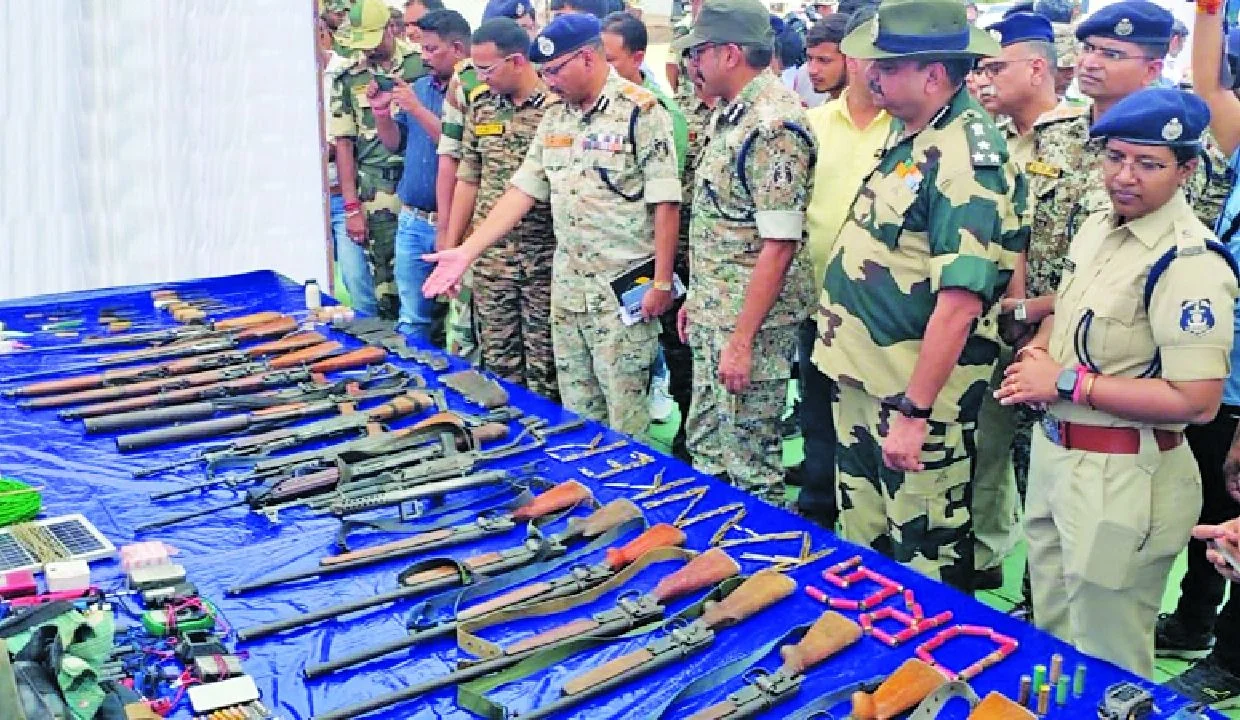
A symbolic mass surrender occurred in Jagdalpur, where more than 200 active insurgents, including high-ranking central committee figures, surrendered collectively while carrying copies of the national legal charter. This transition from illegal weaponry to institutional governance highlights the structural shift within the region.
The operational transition depended directly on the efforts of central paramilitary forces and regional police networks. Specialized jungle combat divisions, indigenous tribal battalions, and elite local units composed partially of rehabilitated former insurgents deployed into dense terrain to establish permanent positions.
Defensive infrastructure grew continuously over a 6-year period, yielding 336 forward operating bases in core insurgent territories and 76 newly constructed aviation pads to facilitate rapid tactical mobility. Unmanned aerial surveillance units now monitor remote interior hills that were previously considered inaccessible to security forces. These strategic outposts restricted insurgent movements while simultaneously anchoring state-led rural development programs, which brought basic banking, primary education, local clinical care, and national health insurance access to regional populations within a 10-kilometer perimeter.
The societal impacts of the transition framework extend beyond administrative statistics. Local women who previously operated in armed forest units now manage civic enterprises serving community members and security personnel. Similarly, rehabilitated combatants integrated into regional defense units now provide security for the exact villages they once disrupted. Every stabilized former insurgent challenges the ideological narrative that the state addresses regional grievances exclusively through militarization.
The high-level command structure of the insurgent organization faced systematic neutralization. Dedicated state intelligence and police directives successfully targeted top-tier leaders, resulting in the elimination or capture of over 18 central committee organizers within a 4-year window, which severely degraded the group’s strategic planning capabilities. Simultaneously, federal financial intelligence and asset enforcement agencies disrupted underground funding channels, successfully freezing the capital flows required to sustain prolonged field operations.
The targeted completion date of March 31, 2026, for neutralizing the internal security threat has been effectively realized. The historic armed corridor has dissolved, while expanding civic infrastructure and sustained administrative governance fill the institutional vacuums that previously allowed extremism to thrive.
Future Outlook
The transition from active conflict to long-term stabilization introduces a critical governance phase focused on economic integration and infrastructure continuity. State agencies are shifting resources from active combat operations toward permanent civil administration, emphasizing highway construction, digital connectivity networks, and secondary education access to prevent ideological regression. Maintaining this hard-won peace will require continuous monitoring of regional borders and the permanent institutionalization of local public services.
FAQs
What led to the sharp decline in India’s Naxal insurgency?
The decline resulted from a coordinated national strategy combining targeted intelligence-led security operations, advanced tactical equipment distribution, rapid infrastructure development, and an attractive financial surrender policy for reforming cadres.
How many districts remain affected by left-wing extremism?
The total number of affected districts dropped significantly from 96 in 2010 down to 38 by 2024, demonstrating a substantial contraction of the insurgent geographic footprint.
What financial assistance is provided to surrendering insurgents?
Surrendering senior cadres receive immediate transition grants up to 500,000 rupees, a monthly stipend of 10,000 rupees for 3 years, and specialized assistance securing long-term housing and employment.
What is the Niyad Nellnar initiative?
It is a targeted local development program operating around forward security camps that introduces vital civic infrastructure, including schools, banking, clinics, and national healthcare coverage, to villages within a 10-kilometer radius.