India Fully Digital Census 2027 Faces Severe Field Hurdles
A massive network of 3.3 million government educators and field workers faces extreme heat, safety risks, and severe digital infrastructure deficits while executing India’s first fully digital population count, threatening critical timelines for the country’s updated welfare and policy planning data.
Key Highlights
- India is conducting its decennial census six years behind schedule due to pandemic delays, relying on outdated 2011 records.
- The first phase involves a 33-question digital survey mapping housing conditions, infrastructure access, and mobile connectivity across 1.4 billion citizens.
- Field enumerators report frequent software crashes, poor rural internet access, and escalating safety concerns, prompting demands for paired deployments.
- Legal resistance from private schools in Uttar Pradesh and Maharashtra has forced municipalities to recruit non-governmental personnel to fill staffing vacancies.
Government school teacher M. Soumina spent a month knocking on doors across a multi-storey residential complex in East Delhi’s Mayur Vihar area each morning.
Despite summer vacations closing her school, Soumina worked as an appointed enumerator for the ongoing national demographic exercise. The operation relies on approximately 33 lakh government teachers and field workers who will spend nearly one year surveying 1.4 billion citizens regarding demographics, housing, and amenities.
Soumina navigated extreme Delhi summer conditions where daily temperatures regularly peak between 40°C and 42°C. She managed to complete a 33-question survey across 150 apartments spanning 17 residential blocks in 26 days.
The daily field visits commenced on May 19, requiring Soumina to log details on a specialized mobile application. Households required geographic mapping and geotagging within the software prior to the question stage.
Soumina carried a smartphone, a black bag, a QR-coded identity card, and a branded white cap for sun protection. Her husband, an employee at a newspaper production facility, accompanied her on the routes to ensure her safety.
Field workers nationwide report matching difficulties including intense heat waves, digital connection failures, and personal security issues. Ground realities and strict administrative mandates hamper data accuracy despite real-time monitoring capabilities, prompting widespread social media complaints from field staff.
A massive exercise
The current data collection falls under the Houselisting and Housing Operations (HLO) phase of the Population Census 2027. The Registrar General and Census Commissioner of India officially authorized this specific questionnaire on January 22.
The 2027 Census introduces several operational updates: it represents the nation’s inaugural digital census, includes distinct caste data categories, and permits self-enumeration. The project missed its original 2021 schedule due to pandemic interruptions, causing a six-year statistical lag that forces agencies to use 2011 data for public welfare allocation.
The HLO stage gathers structural information on housing density, consumer asset ownership, and access to water, electricity, and sanitation networks. Field workers also register verified mobile numbers to establish official communication channels with citizens.
This preliminary phase establishes the framework for the comprehensive Population Enumeration phase scheduled for February 2027. Harsh winter conditions in Ladakh and the mountainous zones of Himachal Pradesh, Uttarakhand, and Jammu and Kashmir require an accelerated completion deadline of September 30, 2026.
The subsequent segment will record individual religious affiliations and detailed caste metrics. Workers receive a fixed honorarium of ₹25,000 upon completing their assignments, with 23 States and Union Territories already concluding their HLO operations.
Meeting strangers
Securing responses from working professionals proved highly difficult during normal daytime hours in urban residential zones.
Many occupants exit for work by 8:30 AM, forcing Soumina to conduct interviews between 7:00 AM and 7:30 AM alongside her husband. Residents displayed mixed reactions, with several requesting alternate times or outright non-participation.
Locked residences required repeated return visits to ensure complete data collection. These follow-ups frequently stretched into evening hours, requiring continued accompaniment by her spouse.
Numerous female field workers, consisting primarily of state school teachers, utilized male family members for security during their tracking routes.
Primary school educator Meenu Verma from Rae Bareli, Uttar Pradesh, completed her 172 household assignments with assistance from her husband and brother-in-law. The team started field travel at 4:00 AM to reach rural assignments by 7:00 AM, noting that heat emptied the villages by midday.
Deserted afternoon streets made knocking on doors difficult for the team. Low community awareness required lengthy preliminary explanations, leading Verma to advocate for dual-worker deployments or male administrative escorts to navigate remote rural properties and hostile encounters.
Legal authorities registered a First Information Report (FIR) on May 12 against an East Delhi resident for harassing a female worker, resulting in a court conviction on June 13. A similar confrontation occurred on April 25 in Bengaluru, resulting in a police complaint after an apartment complex denied entry to an enumerator using abusive language.
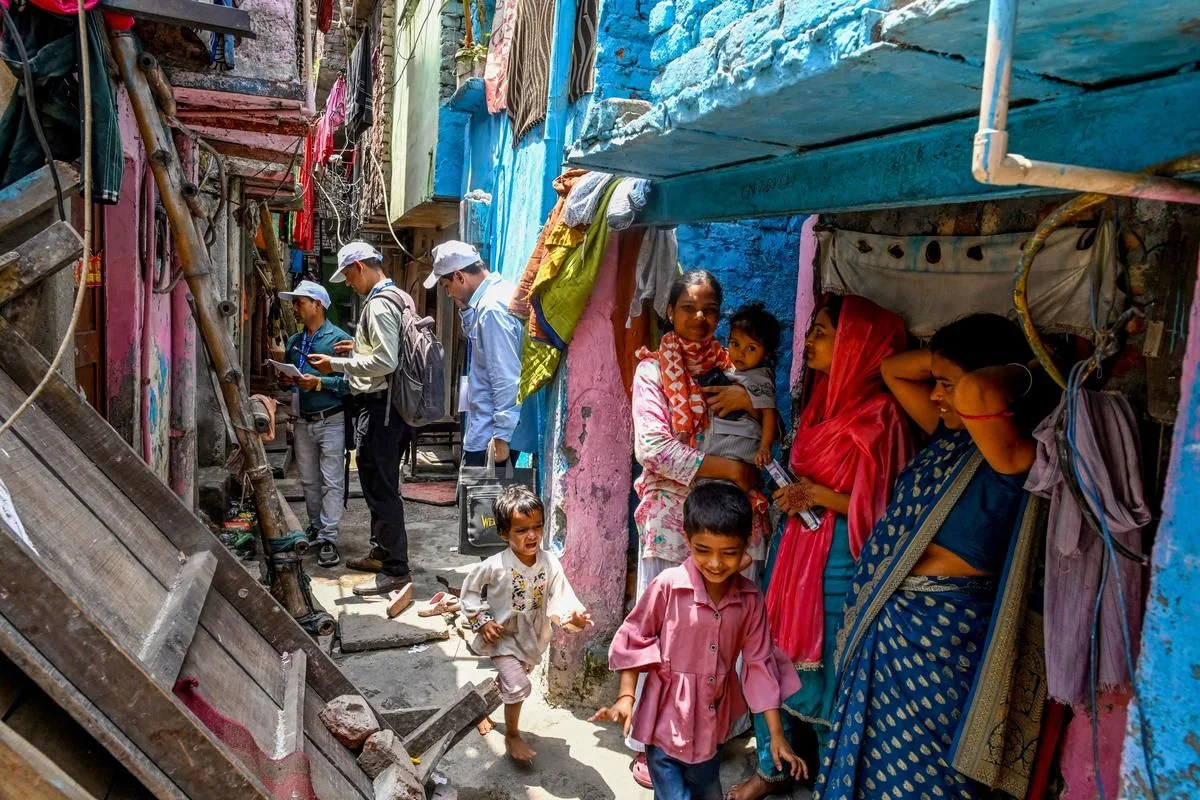
Government Hindi lecturer Dinesh Kumar Dwivedi supervised six field enumerators during the cycle. He noted that collecting family metrics from localized slum clusters proved significantly easier than accessing high-rise apartment complexes.
In Haryana and Delhi, urban field workers encountered direct resistance from high-rise Residents’ Welfare Associations (RWAs). This pushback prompted Gurugram administrators to issue official warnings citing Section 8(2) of the Census Act, 1948, which legally obligates residents to answer official questions.
Dwivedi noted that slum residents initially feared the survey was linked to imminent municipal demolition drives. Clearer explanations regarding public welfare link-ups changed their perspective, prompting residents to present personal documents to verify their eligibility for state assistance.
Reflecting on his experience during the 2011 exercise, Dwivedi recalled the inefficiency of paper registries. He observed that past participants frequently hid consumer assets due to fears of tax audits, a trend that has shifted under the digital model.
The digital divide
Infrastructure disparities across different districts directly altered field efficiency. Urban staff logged metrics directly into mobile devices, whereas rural workers recorded data in paper ledger books for manual upload at home.
According to the National Sample Survey’s 80th round Telecom report from 2025, internet connectivity reached 83.3% of rural homes and 91.6% of urban homes. The underlying study sampled 34,950 households and 1.42 lakh individuals, defining usage as a minimum of one web session within three months.
An enumerator from Uttar Pradesh emphasized that spotty rural networks cause data corruption risks during synchronization. Once an official login is finalized, modifying flawed entries becomes exceptionally difficult under current software constraints.
Staff must maintain the tracking software on personal mobile devices throughout the project duration, despite experiencing frequent application crashes.
The Census 2027 Houselist App shows over 10 lakh downloads on the Google Play Store with a aggregate user score of 2.9. Access remains restricted to authorized personnel, with reviews showing 2,054 one-star ratings against 1,735 five-star ratings out of 4,570 entries.
In Noida’s Sector-6, Charge Officer Indu Prakash Singh established a monitoring headquarters at the Indira Gandhi Cultural Centre. Technical teams tracked progress on digital dashboards to oversee the regional operations.
Singh managed the tracking of 2,309 Houselisting Blocks, with each sector containing 150 to 180 homes housing up to 1,000 residents. The regional phase concluded its run between May 22 and June 20.
Staffing shortages in Uttar Pradesh forced local administrations to draft private school staff into service alongside traditional government employees.
Noida administrators issued mandatory service directives to private institutions to fulfill labor quotas.
However, over 500 private and minority institutions filed successful legal challenges in the Allahabad High Court and Bombay High Court, causing 50% of trained private teachers to withdraw and forcing dependencies on non-governmental organizations.
Future Outlook
The technical and environmental bottlenecks experienced during the HLO phase serve as a critical test for the upcoming Population Enumeration phase in February 2027. As the first census to integrate self-enumeration and comprehensive caste metrics, the Registrar General’s office faces intense pressure to optimize its mobile infrastructure. Resolving the digital divide in rural corridors and establishing firmer security protocols for field workers will determine whether India can successfully replace its outdated 2011 data framework before the next fiscal planning cycle.
FAQs
Why is the current Indian population survey being called the Census 2027?
The national decennial census was originally slated for execution in 2021 but suffered lengthy delays due to the COVID-19 pandemic. Because the field operations shifted significantly, the statistical operation is running six years behind schedule.
What are the main distinct elements of this specific census cycle?
The 2027 demographic exercise represents India’s first completely digital census handled via mobile applications. It also introduces provisions for independent digital self-enumeration and includes comprehensive data collection regarding caste demographics.
What legal obligations do citizens have to provide information to enumerators?
Under Section 8(2) of the Census Act of 1948, all residents are legally obligated to answer authorized census questions to the best of their knowledge. Refusing entry to enumerators or withholding data can result in formal administrative or legal penalties.