House Report Accuses NYC Prosecutors of Shielding Migrants From Deportation
The Republican-led U.S. House Judiciary Committee released an interim report on 26 October 2026 accusing prosecutors across New York City’s five boroughs of tailoring criminal charges and plea agreements to help noncitizen defendants avoid deportation, according to the committee’s findings.
The committee, chaired by Ohio Republican Jim Jordan, based its allegations on internal training documents, prosecutorial guidelines and communications obtained during its congressional investigation. The report claims the practices give foreign nationals more favourable treatment than American citizens facing comparable criminal charges.
Local prosecutors have challenged that characterisation. Manhattan officials said a cited policy had been superseded, while Staten Island prosecutors defended seeking delays in deportation so criminal cases could proceed.
Key Takeaways
- Congressional Republicans allege that prosecutors across all five New York City boroughs consider immigration consequences when negotiating criminal pleas.
- Bronx guidelines reportedly advise prosecutors on limiting details in conviction records that could trigger federal immigration penalties.
- Queens and Manhattan documents describe policies addressing immigration consequences in misdemeanor and felony cases.
- Staten Island prosecutors rejected the allegations and defended completing local criminal proceedings before deportation.
- Congressional figures show extensive refusals of federal immigration detainer requests by New York City agencies.
House Judiciary Committee Details Alleged Plea Deal Practices
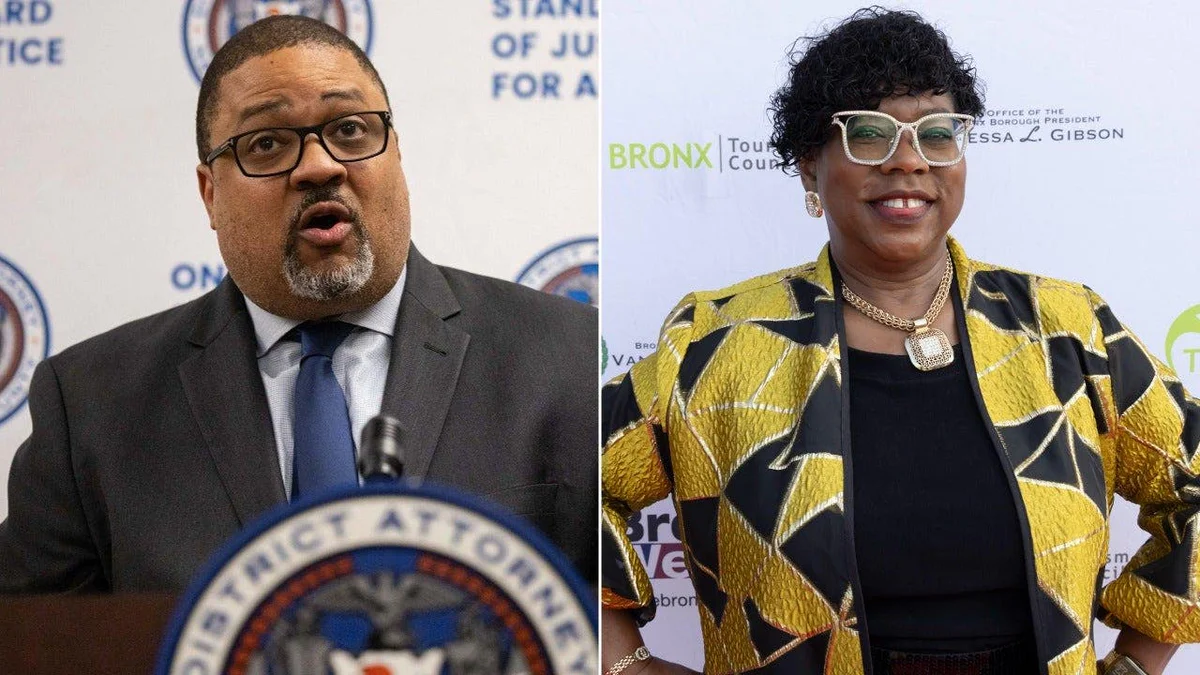
The interim staff report, titled *New York City: The Dangerous Consequences of Sanctuary Policies*, examines the policies of district attorneys Darcel Clark in the Bronx, Melinda Katz in Queens, Alvin Bragg in Manhattan, Eric Gonzalez in Brooklyn and Michael McMahon on Staten Island.
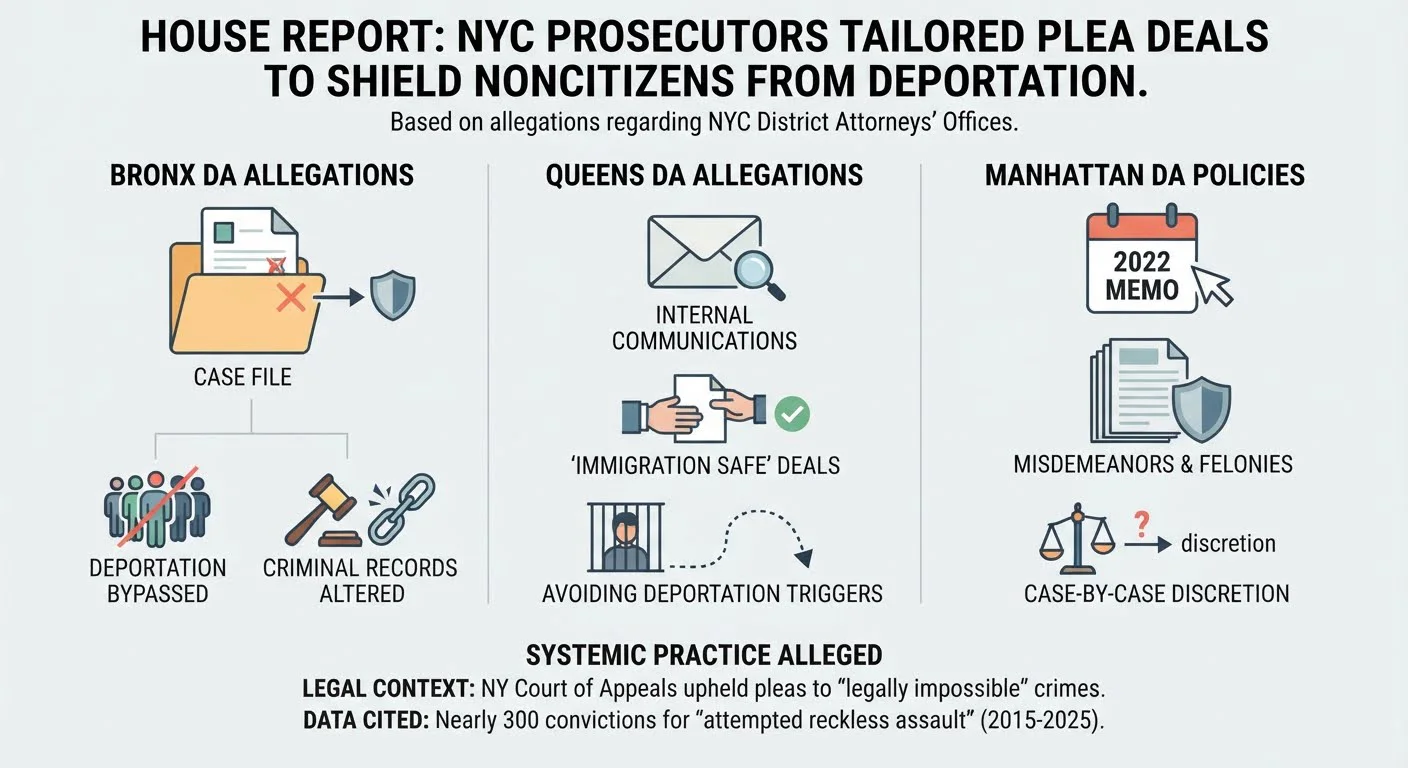
Congressional investigators allege that these offices sometimes negotiate immigration-safe plea agreements designed to reduce the likelihood that criminal convictions will lead to removal proceedings.
The central dispute concerns whether prosecutors are appropriately considering the consequences of criminal convictions or providing preferential treatment based on immigration status.
The committee argues that modifying charges and conviction records can undermine federal immigration enforcement. The district attorneys’ responses and existing New York legal rules, however, raise separate questions about prosecutorial discretion and the legitimacy of negotiated pleas.
Bronx Prosecutors Accused of Omitting Conviction Details
The strongest allegations concern Bronx District Attorney Darcel Clark, who has led the office since 2016.
According to the House report, internal Bronx prosecution guidelines advise attorneys to omit certain details from conviction records when negotiating pleas, including references to firearms, relationships between defendants and victims, and children’s ages.
The committee alleges these practices are intended to reduce the risk of deportation.
The documents refer to “immigration-conscious plea bargaining”, which congressional investigators interpret as an effort to avoid federal immigration consequences under the Immigration and Nationality Act.
The report specifically identifies domestic violence, crimes against children, strangulation and firearms offences among the categories where immigration considerations may influence charging decisions.
For example, the committee alleges that removing information identifying a defendant’s relationship with an alleged domestic violence victim could affect whether a conviction falls within federal deportation provisions.
Similarly, it claims that leaving a minor victim’s precise age out of a conviction record could change how immigration authorities assess certain sexual offences.
These allegations concern the wording of criminal conviction records and negotiated charges. They do not, by themselves, establish that prosecutors falsified evidence or that a court found the practices unlawful.
#
Dispute Over Legally Impossible Criminal Charges
The congressional investigation also criticises pleas to attempted reckless assault, which the committee describes as a legally impossible offence because an attempt ordinarily involves intentional conduct, while recklessness does not.
Investigators argue that such arrangements can produce convictions with different immigration consequences from the charges initially brought against defendants.
However, New York courts permit defendants to plead guilty to hypothetical offences as part of negotiated agreements, a practice upheld by the state’s Court of Appeals.
That distinction matters because the legal validity of a plea under New York criminal procedure is separate from its consequences under federal immigration law.
Federal immigration authorities retain responsibility for applying the relevant deportation provisions, while state prosecutors determine how local criminal charges are resolved.
State conviction records cited in the reporting also show that hypothetical pleas are not unique to one prosecutor’s office.
According to Fox News, data obtained by the Immigrant Defense Project identified 289 attempted reckless assault convictions across New York City between 2015 and 2025, including 50 in the Bronx.
Those figures demonstrate that the particular plea category has been used in multiple cases. They do not independently establish that every conviction was negotiated to prevent deportation.
Queens Guidelines Address Immigration Consequences
The report identifies similar concerns in Queens, where Melinda Katz has served as district attorney since 2020.
Congressional investigators cited a May 2026 email in which a Queens prosecutor described an agreement that allowed a defendant to plead guilty to multiple crimes and serve jail time while limiting immigration consequences.
The communication illustrates how a plea agreement may involve criminal punishment without necessarily producing the immigration outcome associated with a different conviction.
According to the committee, prosecutors in Queens were instructed to “exercise extreme caution” when handling cases involving noncitizen defendants.
The guidelines also encouraged consultation with the office’s immigration specialist before resolving relevant cases.
The congressional report criticises instructions advising prosecutors not to focus exclusively on whether charges carry felony or misdemeanor labels when evaluating immigration consequences.
The committee presents those directions as evidence that immigration status affects plea negotiations. The documents also indicate that criminal charges and immigration outcomes may be assessed separately during prosecutorial decision-making.
Manhattan Policy Updated After Congressional Scrutiny
Manhattan District Attorney Alvin Bragg also faced criticism over instructions issued in January 2022.
According to the congressional findings, that policy encouraged prosecutors to pursue dispositions avoiding immigration consequences for misdemeanors and for felony cases where imprisonment was generally not anticipated.
The Manhattan District Attorney’s Office subsequently described the policy as “outdated” and said it had been revised to give individual prosecutors discretion over case resolutions.
The distinction between the earlier guidance and the office’s current approach is significant because the congressional allegations rely partly on documents issued before the reported update.
The House report also accuses Brooklyn District Attorney Eric Gonzalez of using comparable approaches in cases involving noncitizens.
The accusations against Brooklyn form part of the committee’s broader argument that immigration considerations are embedded in prosecution policies across New York City, rather than being confined to isolated individual cases.
Staten Island Prosecutors Reject House Findings
The sharpest public rebuttal came from the Richmond County District Attorney’s Office, which described the congressional findings as “flagrantly false and patently political.”
The office defended its requests for Immigration and Customs Enforcement, or ICE, to postpone deportations until local criminal proceedings could be completed.
Its position is that prosecuting defendants before removal enables authorities to secure convictions and pursue justice for victims, rather than allowing deportation to interrupt criminal cases.
The Staten Island response also blamed Congress for failing to secure the country’s borders, while arguing that completing prosecutions was necessary to protect local communities.
This introduces a distinction largely absent from the committee’s allegations: delaying deportation to finish a prosecution is not necessarily equivalent to abandoning the criminal case or declining to seek punishment.
Fox News reported that the other district attorney offices named in the investigation and the mayor’s office had not immediately responded to its requests for comment.
NYC Declined Thousands of Federal Immigration Detainers
The congressional investigation also examined New York City’s broader cooperation with federal immigration enforcement.
According to the committee, the NYPD received 20,255 ICE detainer requests between 1 July 2018 and 30 June 2026 and honoured none.
Nearly 10,000 of those requests arrived during the final 12 months of the period, indicating a substantial concentration of federal enforcement requests in the most recent year examined.
The New York City Department of Correction separately received 2,852 immigration detainers during the same reporting period and declined all of them, according to figures cited by congressional investigators.
Detainers are requests from federal immigration authorities asking local agencies to hold individuals so ICE can assume custody.
The figures concern federal custody requests rather than criminal convictions or individual determinations of guilt.
City sanctuary restrictions have limited the circumstances in which municipal agencies cooperate with federal immigration enforcement.
The committee connects those restrictions with the prosecutorial practices described in its report, arguing that the combined policies obstruct federal efforts to remove noncitizens convicted of offences.
However, the detainer statistics alone do not demonstrate that district attorneys changed criminal charges improperly. They measure a different part of the relationship between local law enforcement and federal immigration authorities.
Immigration Policies Become a Wider Congressional Dispute
The report arrives amid Republican efforts to change how states and municipalities cooperate with immigration authorities.
In March 2026, the House Judiciary Committee advanced the Shut Down Sanctuary Policies Act, legislation intended to prevent state and local governments from restricting cooperation with federal immigration enforcement.
The measure had subsequently stalled in the House, according to the reporting accompanying the committee’s latest findings.
New York’s policy dispute also involves decisions by state and municipal leaders about the boundaries of federal immigration enforcement.
The Republican committee cited measures associated with Governor Kathy Hochul, Attorney General Letitia James and New York City Mayor Zohran Mamdani as additional examples of policies it opposes.
Its report describes the disagreements as a public safety issue, while the responses from local prosecutors emphasise their responsibility to bring criminal cases to completion.
Congressional investigators said they intended to continue examining sanctuary jurisdictions, leaving further oversight activity possible even without immediate legislative action.
The unresolved question for lawmakers is whether Congress will pursue changes to local cooperation requirements, rather than merely criticising the way prosecutors exercise discretion under existing criminal law.