Los Alamos and QC Ware Test Quantum Method for Iron Oxides
Researchers from Los Alamos National Laboratory (LANL) and QC Ware have demonstrated a hybrid quantum-classical workflow that achieved chemical accuracy in model calculations of molecular FeO and Fe₂O₂, according to their October 26, 2026, preprint titled *Towards Quantum Computation of Bulk FeO*.
The study examines molecular models as a step towards calculating the electronic properties of bulk iron monoxide, a strongly correlated material that conventional non-spin-polarised density functional theory (DFT) incorrectly describes as metallic.
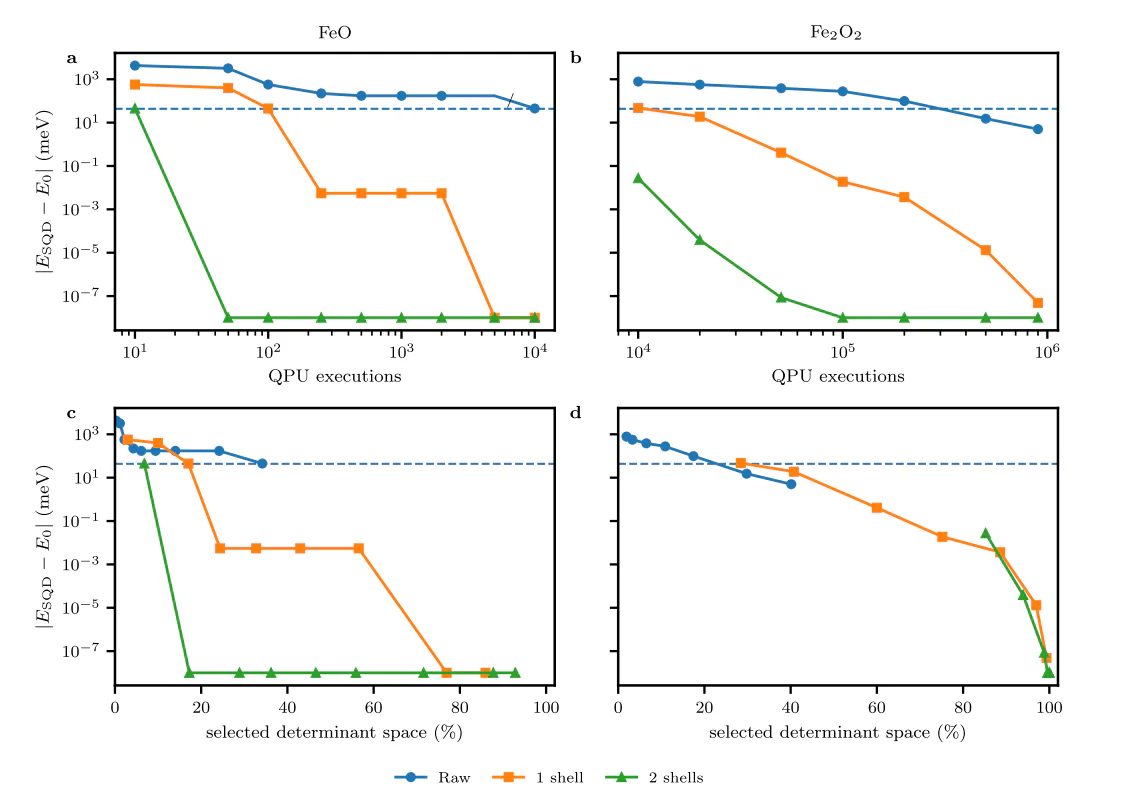
The researchers used IBM Quantum’s ibm_miami processor, running six parallel 16-qubit instances for FeO and three parallel 32-qubit instances for Fe₂O₂. Their approach employed Sample-based Quantum Diagonalization (SQD), combining quantum measurements with classical calculations rather than relying on fully quantum optimisation.
How the Hybrid Method Works
The researchers developed electronic models using localised Wannier functions extracted from DFT calculations. These models represented interactions between iron d orbitals and oxygen p orbitals, allowing the team to examine strongly correlated electronic states.
Circuit parameters were optimised through classical simulations before execution on quantum hardware. The quantum processor then sampled electronic configurations, while classical diagonalisation calculated energies from the resulting configurations.
This arrangement avoided the on-hardware optimisation difficulties associated with Variational Quantum Eigensolver (VQE) calculations, including barren plateaus and challenging nonlinear parameter landscapes.
The team also applied particle-number filtering and expanded the sampled configurations through connected electronic states, improving the accuracy of the final calculations without requiring larger quantum optimisation circuits.
Iron Oxide Calculations Show Improvements
For molecular FeO, the researchers recovered the experimentally observed quintet ground state within a compressed subspace of 184 determinants. The calculation produced an excitation energy of approximately 2,167 cm⁻¹.
The Fe₂O₂ rhombic dimer calculation recovered a nonet ground state, demonstrating that the approach could handle another correlated iron oxide system with a larger electronic active space.
According to the research, standalone VQE calculations did not achieve chemical accuracy for either molecular model. SQD with two connectivity shells recovered the exact ground-state energies of both model Hamiltonians using comparatively limited quantum computing resources.
Why Bulk Iron Oxide Matters
Accurately modelling bulk FeO remains difficult because strong interactions between electrons challenge conventional electronic structure calculations. The material’s behaviour makes it an important test case for computational approaches to correlated solids.
The researchers propose extending their method to periodic FeO calculations by distributing SQD subproblems across different points in the material’s Brillouin zone.
That proposed extension remains distinct from the molecular results already demonstrated. The study establishes a computational approach for investigating strongly correlated materials on existing quantum hardware, rather than confirming that a complete bulk FeO simulation has been achieved.