Global Solar Manufacturing Shifts Toward AI and Smart Automation
The rapid transformation of the global photovoltaic manufacturing industry was the central theme at the SNEC Shanghai 2026 exhibition, where technological innovation shifted focus from raw volume to intelligent production management, automated quality assurance systems, and data-driven factory ecosystems.
Key Highlights
- Next-generation N-type variants and perovskite configurations dominated the manufacturing technology exhibition.
- Artificial intelligence and advanced automation are shifting production priorities toward tracking and long-term hardware reliability.
- Indian regulatory frameworks like the ALMM are shifting from compliance tools to drivers of domestic manufacturing quality.
Que: What were the biggest technology trends and innovations you observed at SNEC 2026?
Ans: The SNEC Shanghai 2026 conference highlighted a definitive migration toward the next era of solar production equipment. Advanced N-type configurations, particularly TOPCon, heterojunction architectures, and back contact designs, took center stage across the event, while tandem arrangements and perovskite alternatives positioned themselves as the front-running technologies for future commercial deployment.
Apart from breakthroughs in cell architecture, the overarching narrative focused on integrating automation, artificial intelligence, and intelligent assembly protocols. Machine-learning vision inspection platforms, cloud-based manufacturing networks, specialized diagnostics, and responsive process control are changing standard manufacturing plants into automated data ecosystems. The sector has pivoted from scaling throughput to optimizing structural integrity, operational yields, component traceability, and extended operating lifespans.
Que: How has the global solar industry evolved compared to previous years?
Ans: Corporate strategies across the marketplace have experienced a fundamental realignment. Instead of measuring success by sheer physical production capacities, market participants are differentiating themselves via advanced technology engineering, optimized floor operations, and baseline assembly excellence.
Industrial producers are channeling capital into automation, digitalisation, and cutting-edge cell production platforms while modifying active assembly lines to squeeze out higher efficiency ratings and minimize operational costs. These investments have created a more mature, research-focused sector where functional performance, environmental sustainability, and smart factory configurations dictate market competitiveness.
Que: What were the key highlights from your discussions with your global partners – Zealwe, Avalon, and Phoenixolar?
Ans: Every international technology associate emphasized a distinct element of the ongoing industrial transformation.
Zealwe directed its focus toward complex photovoltaic module diagnostics, quality control machinery, and technical consultations regarding changing client criteria and emerging geographical market clearings.
Avalon displayed its newest portfolio of solar evaluation simulators, highlighting laboratory setups and active line options designed to raise measurement precision, output stability, and plant productivity. Introducing the specialized mobile lab configuration for steady-state cell assessment highlighted the rising market requirement for adaptable, on-site diagnostics.
Phoenixolar unveiled major engineering developments in production machinery for perovskite configurations, signaling greater market certainty regarding the commercial scalability of these next-generation solar architectures.
Que: What was your biggest takeaway from SNEC Shanghai 2026?
Ans: The main lesson from the event was the astonishing speed at which solar assembly technologies are advancing.
Modern manufacturing breakthroughs extend far past incremental gains in module efficiency ratings. The current push incorporates automation, artificial intelligence, cloud assembly, rigorous quality tracking, and smart factory management systems. Corporate entities that successfully imbed these advanced tools within their current manufacturing footprint will dictate the direction of international solar output.
Que: Which technologies attracted the greatest interest from visitors?
Ans: The highest levels of attendee engagement clustered around engineering systems capable of boosting plant processing speeds, final product quality, and long-term operational durability.
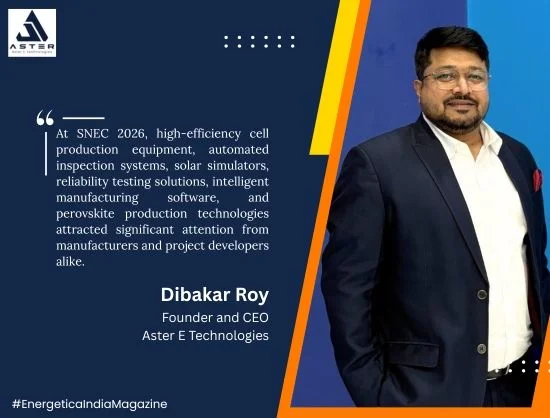
Advanced cell assembly machinery, machine-learning inspection devices, laboratory solar testing simulators, structural reliability diagnostics, smart manufacturing software suites, and perovskite fabrication setups garnered the most attention from industrial producers and asset developers.
Though total attendee representation from the Indian subcontinent fell below initial market projections, the gathering provided essential networking touchpoints with overseas equipment builders, technology developers, and executive leaders from the international photovoltaic sector.
Que: Why are international exhibitions like SNEC important for Aster and India’s renewable energy sector?
Ans: Global trade expositions function as vital hubs where manufacturing science, creative engineering, and commercial capital intersect.
For specialized firms, attending yields critical insight into modern assembly processes, shifting buyer profiles, and global market vectors while cementing industrial alliances with tier-one overseas partners. For the broader domestic infrastructure ecosystem, these international stages compress technology assimilation schedules, foster manufacturing improvements, and support regional goals of building a competitive export hub for clean technology.
As the regional transition toward clean power alternatives accelerates, international engineering alliances, relentless research, and unhindered access to top-tier industrial machinery will remain crucial to writing the upcoming chapter of domestic manufacturing.
Que: How are recent government initiatives shaping India’s solar manufacturing landscape? What role is ALMM playing?
Ans: The domestic solar market continues to secure its position as one of the fastest-accelerating manufacturing arenas worldwide. Comprehensive state policies, including the approved register of models and manufacturers, financial production incentives, residential solar installation drives, and domestic sourcing mandates, are channeling capital across the entire supply chain.
These statutory structures are impelling businesses to construct regional cell and module assembly lines while simultaneously amplifying domestic demand for precise fabrication machinery, complex calibration tools, and strict validation systems.
As regional production output expands, corporate priorities are pivoting toward manufacturing export-grade merchandise that aligns with international performance benchmarks.
Deliberations across the event floors indicate that the approved manufacturer registry has transcended its original role as a basic regulatory hurdle to become an active catalyst for long-term industrial goals.
By locking in consistent market demand for regionally produced solar components, the framework stimulates industrial expansion, draws fresh capital injections, and stabilizes regional component networks. More vital still, it pressures producers to adopt modern assembly methods and tighter quality controls, anchoring a self-sustaining and globally competitive clean-tech production base.
Que: What can India learn from developments in China’s solar manufacturing ecosystem?
Ans: The Chinese market maintains its industrial dominance by marrying massive economies of scale with constant research iterations and swift commercial deployment of new technologies.
A prominent trend visible at the event was the baseline industrial certainty surrounding perovskite layers, tandem cell lines, and upgraded N-type technologies, many of which are moving out of pilot laboratories into full-scale factory integration. The speed at which external competitors scale up unproven technologies while preserving high yield metrics offers vital engineering lessons for the expanding domestic grid sector.
Que: What opportunities do you see for Aster in India’s growing solar market?
Ans: The regional factory expansion creates vast avenues for specialized suppliers to guide local producers toward top-tier manufacturing standards.
As new assembly facilities open under the umbrella of state incentive programs, market demand for complex diagnostics, solar testing simulators, structural stress monitors, and unified factory software will climb. By utilizing its deep ties with tier-one international engineering providers, the enterprise is perfectly structured to assist regional producers in boosting performance parameters, raising product reliability, and achieving global market parity.
Future Outlook
The global solar sector is rapidly moving toward an era where software integration is as vital as hardware chemistry. Over the next few years, factory floors will increasingly rely on automated closed-loop systems where AI algorithms detect cell micro-cracks in real time and immediately adjust laser cutting parameters. This integration of data science with physical photovoltaic manufacturing will determine which regional hubs lead the global energy transition.
FAQs
What were the dominant cell technologies showcased at SNEC Shanghai 2026?
Next-generation N-type photovoltaic variations, specifically TOPCon, heterojunction, and back contact designs, led the exhibition alongside emerging tandem and perovskite configurations.
How is artificial intelligence transforming solar panel production lines?
Artificial intelligence is powering advanced visual inspection platforms, automating quality control diagnostics, and managing integrated process software to maximize manufacturing yields and component traceability.
What role does the Approved List of Models and Manufacturers play in India?
The framework functions as a strategic driver that ensures consistent demand for domestic solar components, encouraging capacity scaling, technology upgrades, and adherence to international quality standards.
Why is the solar industry shifting focus away from raw manufacturing capacity?
Market competition has matured past sheer production volume, forcing companies to differentiate themselves through technology leadership, operational cost efficiencies, and superior long-term product reliability.