Global Network Equipment Regulations
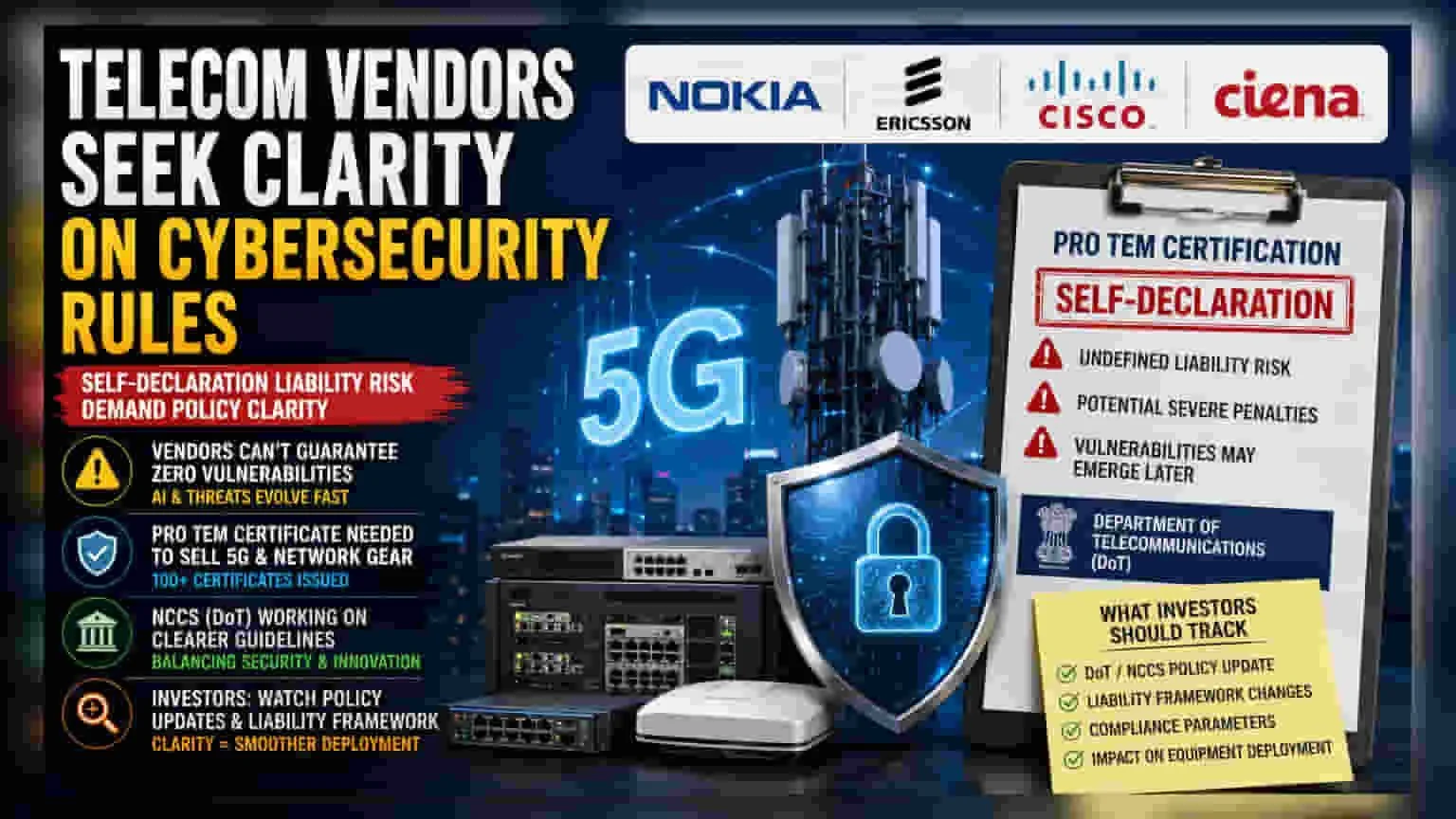
Global telecommunications equipment manufacturers are urging India’s Department of Telecommunications to revise current cybersecurity self-declaration mandates. Companies argue that guaranteeing hardware remains entirely free of vulnerabilities is technically impossible, exposing vendors to severe liability risks as the market transitions toward mandatory testing frameworks.
Key Highlights
- International equipment providers seek immediate clarity from the Indian government regarding temporary security certification rules.
- Manufacturers state that absolute immunity from software or hardware vulnerabilities remains technically impossible amid evolving threats.
- Over 100 temporary certificates have been approved via self-declaration to maintain network rollouts.
- The government is actively reviewing vendor feedback to draft updated, practical compliance guidelines.
Major international telecommunications equipment providers have requested that the Department of Telecommunications refine its existing framework for cybersecurity self-declarations. Equipment suppliers express concern that assuring infrastructure is permanently free of security flaws is a technical impossibility, creating substantial liability exposure. These discussions arrive during a regulatory shift toward a compulsory testing system for the network infrastructure industry.
Prominent international hardware suppliers, including Nokia, Ericsson, Cisco, and Ciena, have contacted the Department of Telecommunications (DoT) to secure explicit definitions for cybersecurity compliance mandates. The main point of contention involves the current obligation for suppliers to self-certify that their equipment contains zero security flaws to obtain short-term approval, known as a Pro Tem certificate. This specific authorization is mandatory for enterprises to distribute and install 5G infrastructure, routing systems, and diverse network hardware across the Indian marketplace.
The Core Security Challenge
Suppliers contend that the existing self-certification model introduces an unquantified and substantial legal liability. In an environment shaped by sophisticated artificial intelligence and rapidly altering digital threats, enterprises state that no producer can guarantee a product will stay completely secure over an indefinite period. If a security defect surfaces in an instrument following its official certification, the current regulatory structure leaves suppliers vulnerable to legal penalties. Corporate leadership teams have stressed that these fines could be severe, acting as a direct disincentive for enterprises providing domestic digital infrastructure.
Why This Matters for the Industry
The Pro Tem certification program functions as an interim solution while the administration develops a comprehensive, compulsory testing and verification system for all network infrastructure hardware. Although this temporary arrangement has preserved market operations, permitting more than 100 certificates to be granted based on corporate self-declarations, the underlying legal uncertainty creates operational friction. For the network hardware market, this extends beyond basic compliance; it represents a major friction point between national security requirements and the actual constraints of software and hardware engineering.
Regulatory Outlook
The National Centre for Communication Security (NCCS), operating under the DoT administrative umbrella, has reportedly acknowledged these industry anxieties. Government representatives have indicated that authorities are drafting updated policy directives to address the real-world operational limitations experienced by technology suppliers. This regulatory adjustment aims to harmonize national security objectives with shifting technological realities without disrupting the inflow of vital network infrastructure components.
What Investors Should Track
The critical factor for market participants to observe is the forthcoming policy revision from the DoT and the NCCS. Financial stakeholders must monitor potential structural updates to the liability system, particularly whether the administration establishes an explicit list of compliance metrics or abandons the open-ended self-certification strategy entirely. Extended delays in finalizing these operational rules or strict application of the current penalty mechanisms could hamper business operations for international technology suppliers. Conversely, a transparent policy environment will mitigate operational risks and facilitate efficient hardware installation across Indian communication networks.
Future Outlook
The upcoming finalization of the mandatory testing and certification regime by the NCCS will dictate the long-term operational framework for global tech firms in India. As India expands its digital footprint, regulatory bodies face the complex task of enforcing strict national security defenses without isolating major international technology providers. The resolution of this liability dispute will likely establish a global precedent for how governments manage supply chain security in partnership with private infrastructure vendors.
FAQs
What is a Pro Tem certificate in the Indian telecom sector?
A Pro Tem certificate is a temporary security clearance granted by the Department of Telecommunications based on vendor self-declarations. It allows global telecom equipment manufacturers to sell and deploy 5G gear, routers, and network devices in India while the government finalizes a permanent testing framework.
Why are telecom equipment manufacturers concerned about current cybersecurity guidelines?
Manufacturers are concerned because current guidelines require them to guarantee that their hardware is permanently free of vulnerabilities. Given the continuous evolution of cyber threats, vendors argue that such absolute guarantees are technically impossible and expose them to open-ended liability risks and severe penalties.
Which major companies are seeking clarity from the Department of Telecommunications?
Leading global telecom equipment manufacturers, including Nokia, Ericsson, Cisco, and Ciena, have approached the government seeking clearer regulatory guidelines regarding the self-declaration policy.
How many Pro Tem certificates have been issued under the current self-declaration framework?
More than 100 Pro Tem certificates have been issued to various telecom vendors, allowing business operations and 5G network deployments to continue during this regulatory transition period.