Indian Political Leaders Adopt Distinct Postures on Yoga Day 2026
Indian politicians displayed unique tactical maneuvers mirroring yogic disciplines during the International Day of Yoga 2026 on Sunday, June 21, 2026, as major demonstrations occurred nationwide alongside intense structural shifts in state governance.
Key Highlights
- Political leaders across India adopted symbolic postures reflecting their current electoral strategies and challenges.
- The ruling party celebrated recent state triumphs while navigating minor internal voting friction.
- Multiple opposition figures shifted to defensive or highly flexible structural alignments following notable losses.
- Voters remain the ultimate arbiters, capable of altering political balances instantly during elections.
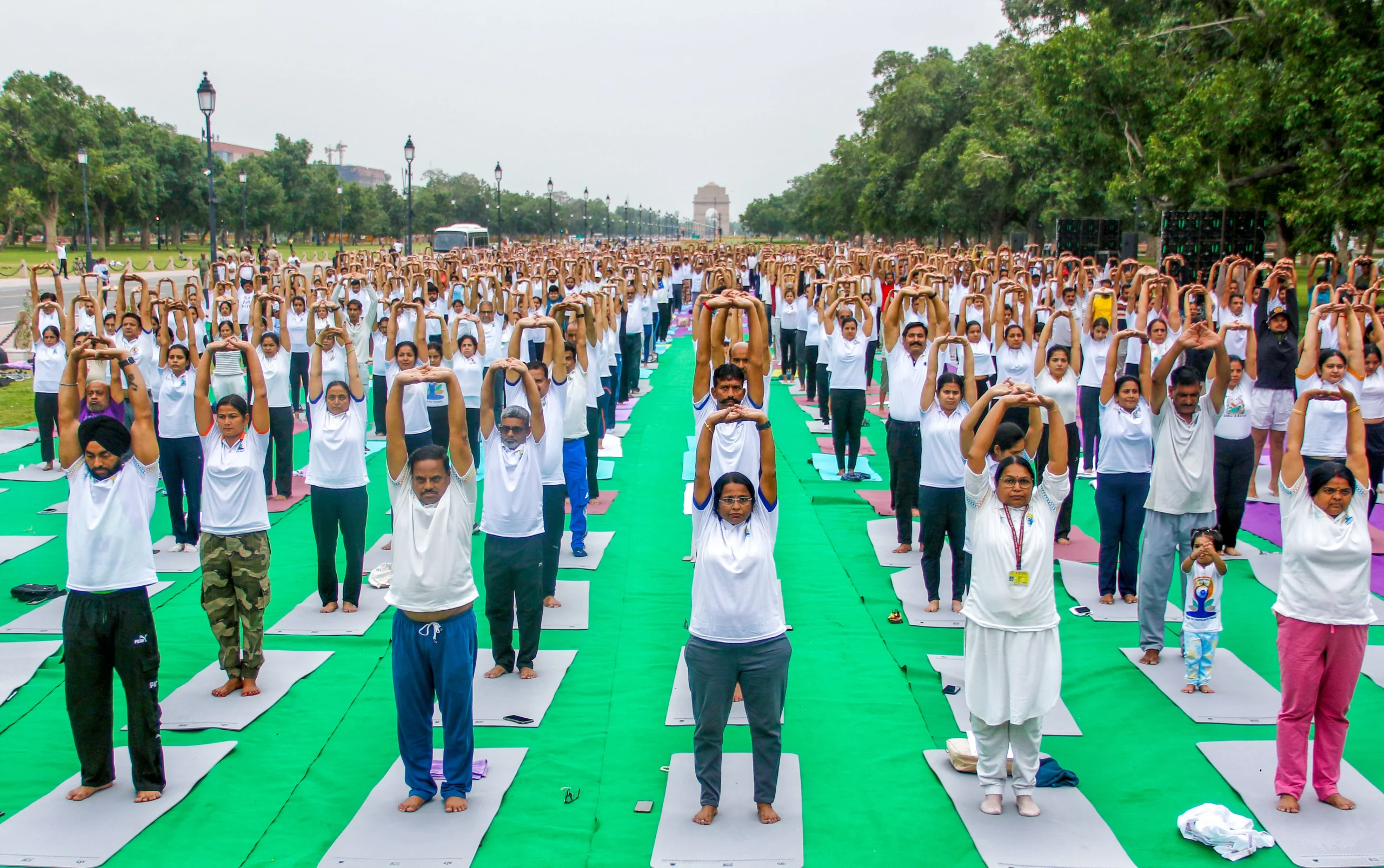
New Delhi: Yoga enthusiasts perform yoga exercise during the International Day of Yoga 2026 celebrations at Kartavya Path in New Delhi on Sunday, June 21, 2026.
The annual exercise rituals have concluded and public images are distributed. Observation of the national event raises questions regarding whether elected officials require instructional training, given that many have executed complex behavioral maneuvers for decades.
Domestic governance increasingly replicates an extensive training seminar where individual factions display a signature physical stance.
The governing administration has perfected what can be identified as the Victory Asana.
This complex stance demands that participants exhibit supreme athletic confidence regardless of external conditions. Success at the ballot box has established a powerful nationwide footprint, leaving citizens largely satisfied.
The ultimate validation of this stance is maintaining identical poise after executing it for over a decade. This administration does so continuously at federal and state tiers.
The most recent demonstration occurred in West Bengal, where a highly competitive electoral contest was secured using exceptional legislative accuracy. This strategy integrated several demanding maneuvers performed in an flawless sequence.
The governing faction typically exercises caution when executing these complex positions. Minimal disruptions still emerge, as observed in the Karnataka MLC balloting where particular representatives executed cross-votes.
The opposition alignment specializes in a contrasting methodology known as the Eternal Protest Pose.
The operational parameters are uncomplicated. If the administration shifts left, voice objection, and if it shifts right, voice objection. Should it remain static, object by declaring an absolute inability to advance.
The goal centers on maintaining uniformity through institutional dissent. A small number of political actors have pursued this specific discipline with immense focus.
This prominent figure has emerged as the principal architect of a highly stressful stance in modern statecraft: the Eternal Discontent Asana.
For multiple years, he has demonstrated continuous dissatisfaction irrespective of shifting legislative dynamics. If the administration reports national advancement, the metrics are challenged.
If policies are rescinded, the reversal faces condemnation. Even during periods of administrative stillness, stagnation becomes the core focus of public disapproval.
This specific routine is maintained across successive electoral cycles with incredible endurance. Within this particular philosophy, satisfaction is never the objective; rather, the continuous delivery of critique remains paramount.
The strategist must convince the electorate of his status as the preferred alternative to Prime Minister Narendra Modi. He must simultaneously inspire organizational workers regarding future victories and guarantee alliance members his capacity to govern.
While certain figures remain dedicated to continuous dissatisfaction, alternative opposition leaders attempt comparable positions with a distinct variation. These actors seek federal cooperation while retaining local dominance.
Preserving equilibrium under these demanding conditions requires exceptional organizational skill.
This leader has refined a technique known as the Coalition Contortion Asana, functioning as an expansive institutional reach.
Doctrinal boundaries are extended far past traditional limitations without causing structural separation. Previous adversaries convert into contemporary partners, while current allies transform into impending contract negotiations.
Traditional physical discipline emphasizes total flexibility, and multiparty governance relies heavily on this trait.
This strategist previously executed a high-velocity routine. For multiple terms, he appeared active across every sector, organizing campaigns, administering policy, leading demonstrations, and managing public legal disputes.
Following recent ballot losses, he has transitioned into a demanding alternative methodology termed Strategic Meditation.
The primary test involves remaining politically impactful while reducing public communication. Anyone attempting silent reflection recognizes the inherent difficulties of the practice.
Concurrently, this regional leader has emerged as the unexpected representative of the Defiant Reality Asana. This stance balances institutional acceptance against active resistance, maintained even as foundational support shifts.
For an extended duration, her local authority seemed entirely absolute. Through successive electoral challenges, she convinced organizational loyalists that regional governance centered on her persona.
The situation transformed in 2026 when her regional administration collapsed. Her political organization encountered its most severe historical reversal, culminating in the loss of her personal legislative seat.
Statecraft frequently tests those who display excessive complacency in an established status. Her immediate objective avoids confronting external rivals, focusing instead on restoring morale among supporters unaccustomed to defeat.
Her national coalition partner has become the prominent practitioner of the Shrinking Circle Asana.
This position involves leaders maintaining ownership claims over historical legacies even as institutional assets, representatives, emblems, and organizational banners migrate elsewhere.
His institutional trajectory over recent periods resembles an extended seminar on recovering balance after successive disruptions. His regional coalition fractured, and the organizational identity faced deep legal disputes.
Currently, his parliamentary peers have selected separate institutional paths. He remains restricted within an unauthentic philosophical stance, claiming representation over a traditional legacy.
Viewed collectively, the opposition faction’s ultimate contribution to governance routines is the broad coalition breathing exercise.
The sequence initiates with a deep inspiration of organizational unity. Participants then suspend their breath throughout complex candidate seat-sharing discussions.
A prolonged expiration occurs when organizational friction manifests. This operational cycle recurs ahead of every primary ballot.
The governing alliance has established its own distinct respiratory methodology: drawing in electoral successes and emitting confidence in massive volume.
On specific occasions, excessive certainty is displayed, prompting public discourse regarding electoral cycles scheduled years in the future.
The most striking element of domestic governance is that all participants believe they follow separate structural theories while executing nearly identical physical adjustments.
Throughout these maneuvers, ordinary citizens quietly manage their daily routines. Every electoral cycle, they demonstrate who commands true authority through the Voter Asana.
The electorate alone retains the power to remove foundational support and displace any political leader instantly.
Future Outlook
As India advances past the 2026 regional contests, the political architecture is moving toward unprecedented polarization ahead of future federal cycles. The collapse of long-standing state strongholds indicates that traditional regional dominance is fading in favor of highly volatile voter behavior. Factions utilizing flexible alliance structures will likely face pressure to solidify their ideological stances, while governing bodies must balance bureaucratic confidence against grassroots economic realities to prevent sudden equilibrium shifts.
FAQs
What is the primary focus of the political commentary regarding Yoga Day 2026?
The commentary uses yoga vocabulary as a satirical metaphor to analyze the strategic maneuvers, alliance shifts, and survival techniques employed by India’s ruling and opposition political parties during the 2026 political cycle.
Which political events in 2026 are highlighted in the text?
The text highlights the collapse of the Trinamool Congress administration in West Bengal, the loss of Mamata Banerjee’s legislative seat, internal cross-voting during the Karnataka MLC elections, and the ongoing structural disintegration faced by Uddhav Thackeray’s faction.
How does the article characterize the role of the Indian voter?
The voter is characterized as the ultimate master of political balance, possessing the singular capability to completely overturn an administration or unseat powerful leaders through the ballot box.