PM Modi Targets Congress Over Maoist Violence, Details Tribal Development
Prime Minister Narendra Modi criticized past Congress-led administrations on Monday for their inability to curb Maoist violence despite referencing the Constitution. He simultaneously underscored the profound infrastructure and socio-economic turnaround achieved in tribal belts heavily impacted by Left-Wing Extremism under his current governance model.
Key Highlights
- PM Modi condemned the 2004 to 2014 UPA era for over 17,010 violent incidents.
- More than 12,000 kilometers of roadways were constructed in extremist zones.
- The administration deployed 25 workers under 200 security personnel per site.
- Over 1.5 million youths joined the debut edition of the Bastar Olympics.
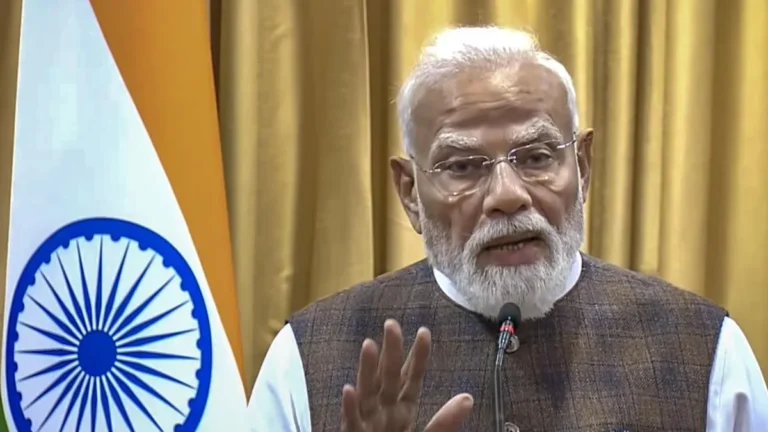
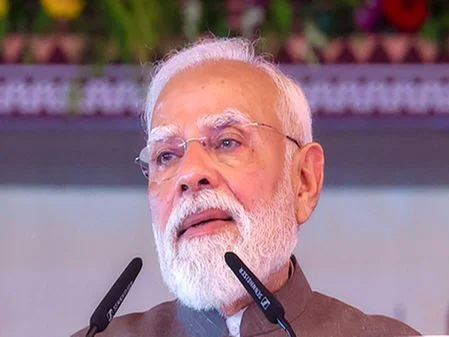
Prime Minister Narendra Modi outlined on Monday the complete shift occurring within tribal communities historically devastated by Left-Wing Extremism, attributing the change to focused regional development. He simultaneously criticized previous Congress-led regimes for failing to neutralize Maoist insurgents while continuously referencing constitutional principles.
During a specialized broadcast on Republic TV, the Prime Minister stated that India has cemented its status as a trusted international power. He noted that global dignitaries now universally identify the “Nation First” doctrine as the core driver pushing the country’s domestic advancement forward.
The Prime Minister directed substantial narrative focus toward Left-Wing Extremism, categorizing the aggressive containment of internal militancy as a premier milestone of his executive tenure.
He remarked that these particular tribal zones, which support immense populations, endured systemic abandonment by prior leaders, forcing citizens to live under constant intimidation without access to foundational public utilities.
According to the Prime Minister, even entering the early decades of the 21st century, state transit vehicles and administrative staff faced total access blockades across numerous remote settlements due to entrenched Maoist blockades.
PM Modi drew an explicit performance comparison pointing directly back to the governance window spanning from 2004 to 2014, during which the Congress-led UPA coalition retained central power.
Throughout that specific 10-year sequence, unchecked Maoist operations sparked greater than 17,010 separate violent encounters, leading to more than 7,000 casualties, the Prime Minister stated.
He further noted that despite the clear and catastrophic scale of the regional crisis, the political leadership of that era failed to execute definitive counter-measures.
Directly targeting the primary opposition party, PM Modi remarked that when those leaders held institutional power and tribal zones faced relentless slaughter, they frequently cited the Constitution without executing its actual legal power.
The Prime Minister asserted that the Congress leadership constantly leveraged constitutional rhetoric while completely lacking the necessary political determination to dismantle Left-Wing Extremism, allowing the insurgency to paralyze communities for generations.
By contrast, PM Modi explained that his team’s calculated, multi-tiered campaign, which explicitly pairs high-intensity security operations with massive civil infrastructure funding, has successfully altered the regional dynamic.
The entire nation is currently witnessing the systematic eradication of Naxalism across its final strongholds, the Prime Minister declared during the interview.
He announced that over the course of the last 12 years, his administration successfully built more than 12,000 kilometers of structural roadways cutting directly through designated extremist corridors.
To guarantee the uninterrupted completion of critical logistical routes, development agencies systematically paired 25 civilian construction laborers with a protective shield of roughly 200 armed security personnel, he revealed.
Additionally, the Prime Minister stated that approximately 45,000 telecommunication towers were erected to link previously isolated border regions to modern digital networks.
Greater than 1,800 brick-and-mortar financial branches have launched across high-risk districts, supplemented by 75,000 mobile banking agents and 6,000 newly established postal stations, he explained.
According to PM Modi, these deliberate financial and communications networks have finally relocated fundamental state governance directly to the doorsteps of historically marginalized populations.
He also emphasized critical social safety nets, highlighting the distribution of statutory food ration documentation to wilderness inhabitants who had remained entirely cut off under prior security breakdowns.
The Prime Minister expressed immense satisfaction regarding the institutionalization of the localized Bastar Olympics, noting that over 1.5 million young athletes participated during the inaugural sporting edition.
He added that enrollment reached approximately 400,000 participants during the subsequent competitive cycle, illustrating a profound shift toward community engagement.
This athletic initiative stands as a clear indicator of returning normalcy, renewed communal aspiration, and constructive youth focus inside landscapes previously dominated by insurgent networks, he stated.
PM Modi maintained that the concrete transformations stemming from these sustained interventions remain indisputable, even if the immense logistical challenges behind them frequently escape mainstream acknowledgment.
He reiterated that every single policy blueprint, legislative action, and domestic program advanced by his cabinet is fundamentally anchored by a commitment to prioritizing national advancement above all else.
The Prime Minister noted that foundational initiatives like Make in India, alongside localized consumer awareness campaigns, achieved success due to an elevated global reputation and a shared domestic drive for widespread economic prosperity.
He concluded that these physical and economic transformations have successfully restored fundamental civic trust among ordinary villagers residing deep within historical conflict zones.
Reflecting upon his formal state visits to France, PM Modi recalled touring specialized entrepreneurial pavilions alongside the French President, which were managed directly by orphans and widows.
He noted that these specific displays highlighted inventive grassroots Indian programs that continue to command significant admiration from international observers.
The Prime Minister voiced total certainty that India’s ongoing developmental trajectory, fueled entirely by the “Nation First” operating philosophy, is currently establishing unprecedented benchmarks across the global stage.
PM Modi concluded his address by reaffirming an absolute personal dedication to forging a highly resilient, advanced, and self-reliant nation through unrelenting structural modernization and strictly equitable governance.
His detailed commentary on Republic TV cast light on an undeniable transition from structural neglect to modern industrial development, while underscoring a firm executive vow to eliminate remaining insurgent remnants.
Historical Context
The Left-Wing Extremism conflict in India, often referred to as the Naxalite-Maoist insurgency, began in 1967 in the village of Naxalbari, West Bengal. For decades, the conflict stretched across an area known as the “Red Corridor,” impacting internal security and economic development across multiple states, including Chhattisgarh, Jharkhand, and Odisha. Prior strategies often vacillated between purely military crackdowns and sporadic peace talks, frequently leaving remote tribal populations isolated from the core Indian economy. The shift toward a unified security-and-development doctrine over the past decade marks a deliberate departure from older containment policies.
FAQs
What is Left-Wing Extremism in India?
Left-Wing Extremism, frequently termed Naxalism or Maoism, refers to an armed insurgent movement led by radical underground factions. These groups operate primarily within dense forest regions and tribal belts, seeking to overthrow institutional state governance through guerrilla warfare tactics.
How many kilometers of roads were built in affected areas?
The government has constructed more than 12,000 kilometers of roads inside extremist-affected zones over the past 12 years. This infrastructure strategy aims to improve accessibility for security forces and integrate remote tribal villages with local markets.
What statistics did PM Modi cite regarding past Maoist violence?
PM Modi stated that during the UPA governance period between 2004 and 2014, the country suffered more than 17,010 distinct incidents of Maoist violence. These insurgent activities resulted in over 7,000 fatalities during that 10-year window.
What are the Bastar Olympics?
The Bastar Olympics are a specialized regional sports initiative designed to engage tribal youths living inside historical insurgent strongholds. The inaugural edition attracted more than 1.5 million participants, while the second iteration saw around 400,000 young athletes compete.