Jai Prakash Narain Bird Sanctuary and Ramsar Convention Overview
The Jai Prakash Narain Bird Sanctuary, an ecologically vital oxbow lake in Uttar Pradesh, serves as a critical wintering habitat for migratory birds. This protected area, alongside the global framework provided by the Ramsar Convention, highlights the international efforts required to conserve rich avifaunal biodiversity and protect vulnerable wetland ecosystems worldwide.
Key Highlights
- The sanctuary originates from a natural, perennial oxbow lake formed by an isolated river meander in Ballia, Uttar Pradesh.
- The wetland expands from 3,432 hectares to 25,000 hectares during the monsoon season, aiding groundwater recharge.
- It serves as a crucial habitat for vulnerable species, including the fishing cat and specific threatened fish.
- The Ramsar Convention, ratified by India in 1982, guides the global conservation and wise use of these ecosystems.
About Jai Prakash Narain Bird Sanctuary (Surha Tal)
This ecosystem functions as a natural, perennial oxbow lake, which represents a specific U-shaped waterbody generated when a broad river meander becomes isolated.
The geographic location sits within the Ballia district of Uttar Pradesh.
Regarding its origin, the site was consolidated in 1991 using land sections drawing from 45 distinct villages under the name Surha Tal. Authorities renamed the protected zone in 2002 to celebrate the legacy of political leader and activist Jai Prakash Narayan.
The spatial footprint covers approximately 3,432 hectares, though the surface area surges to roughly 25,000 hectares when monsoon rains arrive.
The ecological significance manifests through several core environmental contributions:
The region maintains a rich avifaunal biodiversity, acting as an indispensable vital wintering ground for migratory birds navigating the extensive Central Asian Flyway.
Prominent aquatic residents feature notable fish include the vulnerable Wallago attu and Bagarius bagarius.
Furthermore, this abundance of fish attracts the vulnerable fishing cat (Prionailurus viverrinus) to the local habitat.
The water body serves as a major source of irrigation and groundwater recharge for the surrounding agricultural landscape.
Finally, the lake holds deep historical, cultural, and religious value for the regional community.
About Ramsar Convention
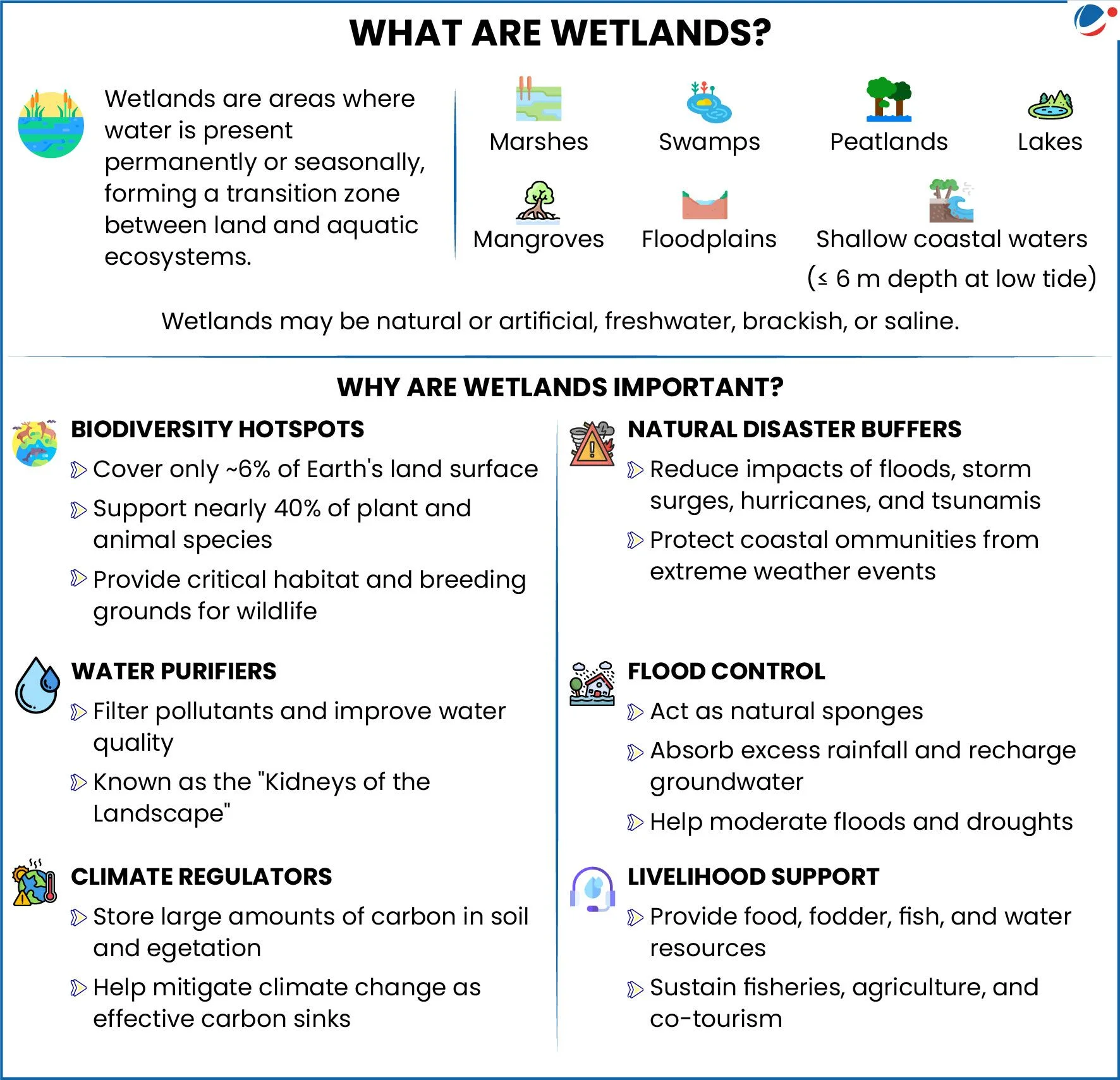
This global framework operates as the intergovernmental treaty that provides the framework for the conservation and wise use of wetlands and their resources.
Diplomats adopted the accord within the Iranian municipality of Ramsar in 1971, and the regulations officially came into force in 1975. Showing its domestic commitment, India ratified the Convention in 1982.
The mandate functions through Three Pillars:
The first focuses on the conservation of wetlands of international importance.
The second demands the wise use of all wetlands located within member territories.
The third enforces international cooperation regarding transboundary water systems and shared migratory species.
To secure formal listing, a specific wetland environment must meet at least one of nine criteria managed by the governing body.
History of Surha Tal and Global Wetland Frameworks
The evolution of Surha Tal from a local community water source into a formally recognized sanctuary highlights the growing intersection of regional conservation and international standards. Originally consolidated from 45 rural villages in 1991, the sanctuary underscores India’s domestic legislative efforts to protect critical inland waters.
Concurrently, the application of global treaties like the Ramsar Convention, established in 1971, has elevated the importance of preserving these unique oxbow ecosystems. By linking local habitats to international flyways, modern conservation efforts ensure that regional sanctuaries receive structured management aligned with global biological benchmarks.
FAQs
What type of wetland is the Jai Prakash Narain Bird Sanctuary?
The sanctuary is a natural, perennial oxbow lake, which is a unique U-shaped body of water created when a wide river meander is naturally cut off from the main stream.
Where is the Surha Tal sanctuary located and when was it renamed?
The sanctuary is located in the Ballia district of Uttar Pradesh, India. Initially established as Surha Tal in 1991, it was renamed in 2002 to honor the activist and political leader Jai Prakash Narayan.
Which threatened animal species rely on this specific sanctuary?
The sanctuary hosts vulnerable fish species, specifically Wallago attu and Bagarius bagarius. The presence of these fish supplies a steady food source that attracts the vulnerable fishing cat, Prionailurus viverrinus.
When did India join the Ramsar Convention?
India officially ratified the Ramsar Convention in 1982, committing to the treaty’s pillars of wetland conservation, wise resource use, and international cooperation for migratory species.