India’s Elephant Protection Expands Forest Carbon Reserves by 38%
Safeguarding endangered Asiatic elephants indirectly secures India’s forests as powerful carbon sinks. A new scientific study reveals that while expanding habitat reserves significantly boosts carbon storage, long-term climate mitigation requires structural improvements in forest management, corridor restoration, and habitat quality rather than simple administrative declarations.
Key Highlights
- India’s elephant reserve network expanded from 18,297 sq. km. to 80,777 sq. km. between 1992 and 2025.
- Estimated carbon storage within these protected zones surged by 38%, driven primarily by enhanced habitat preservation.
- The Asiatic elephant population saw a marginal 6.7% increase, though a newer census methodology notes a recent decline.
- Policy integration can help India achieve its international climate target of 2.5 to 3 billion tons of additional CO2 equivalent sink by 2030.
Researchers emphasize that elephants function as crucial ecosystem engineers. They remain ecologically vital to forest health despite making up a limited portion of total faunal biomass.
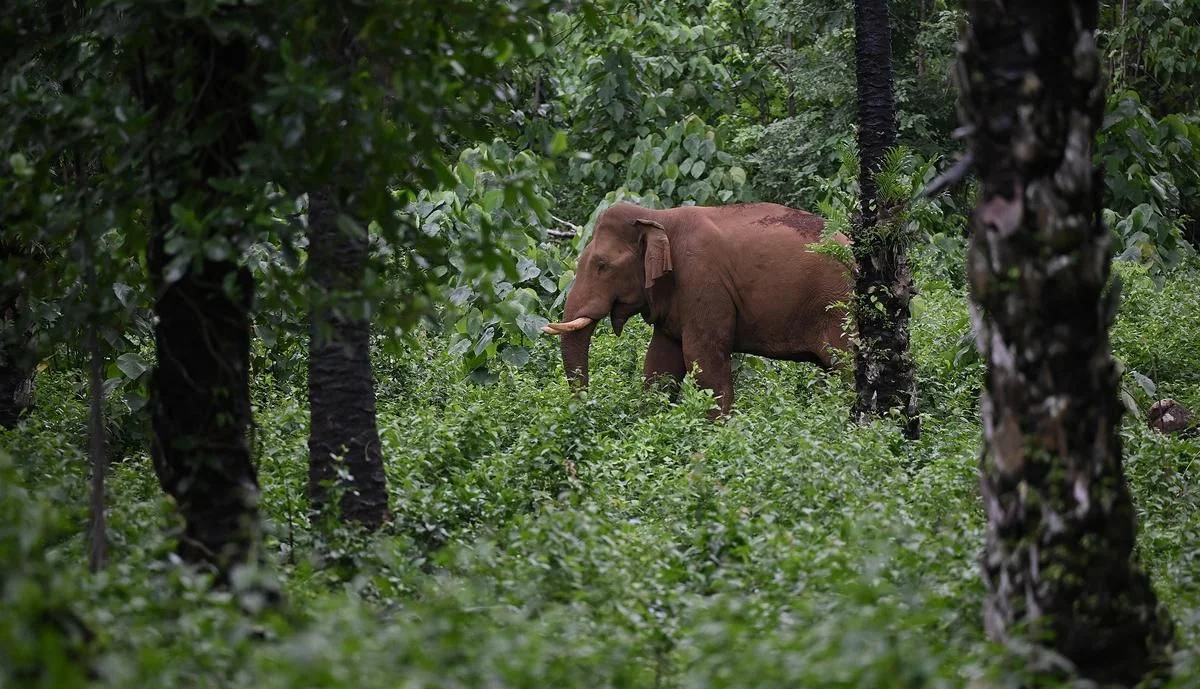
Protecting the endangered Asiatic elephant (Elephas maximus indicus) serves an indirect but critical role in maintaining the integrity of India’s woodlands as robust carbon stores.
However, the research cautions that long-term carbon stabilization cannot be guaranteed solely by establishing more elephant reserves. Success depends on upgrading habitat quality, reviving migration corridors, and reinforcing overall forest administration.
Carbon stabilization represents a critical process for extracting greenhouse gases and curbing climate change. It captures atmospheric carbon and locks it into durable, solid forms within soil or organic vegetation, preventing decay and atmospheric release.
Published in the Journal of Threatened Taxa, the study evaluated the connection between elephant conservation, reserve expansion, and wildlife-linked carbon stock growth in India from 1992 to 2025. The research was authored by Tarun Kathula and Tanu Jindal of Amity University, Noida.
Data shows India’s elephant reserve network grew from 18,297 sq. km. across 3 reserves to 80,777 sq. km. spanning 33 reserves. Concurrently, the elephant population rose by roughly 6.7% from the 25,604 individuals estimated during 1992–93.
Despite this modest growth in animal numbers, the calculated carbon stored inside these reserves jumped by 38%.
This carbon increase does not imply that elephants directly generate more forest biomass. Instead, the authors noted that it highlights enhanced protection and reduced degradation of pre-existing forest carbon stocks.
The analysis attributes roughly 95% of the carbon storage growth to the expansion of safeguarded forest boundaries. Even so, elephant reserves lack the uniform legal protection given to official national parks or tiger reserves.
The paper identified a weak statistical correlation between the creation of new reserves and actual elephant population growth. This indicates that bureaucratic designations fail to protect the species if habitats face fragmentation or inadequate management.
Furthermore, a concerning trend emerged under a new census framework called the Synchronised All-India Elephant Estimate (SAIEE) 2021–25. The data shows a drop in elephant numbers even as reserve areas stabilized.
The SAIEE tally recorded 22,446 elephants, marking a drop of 4,065 individuals compared to the 2017 survey. However, wildlife officials noted that these two distinct counting methodologies are not directly comparable.
The authors stated that the findings underscore how conservation-led land-use stabilization aids climate mitigation, while advising caution when interpreting direct wildlife-to-carbon equations.
Similar ecological dynamics occur in African savannahs, where mega-herbivore management strategies boosted vegetation carbon stocks by 20% to 30%. The researchers stated this regional consistency proves that mega-fauna protection inherently complements global forest-carbon objectives.
Incorporating these findings into national policy could fortify India’s pledge to build a 2.5 to 3 billion tCO2 equivalent additional carbon sink by 2030. Integrating wildlife conservation into REDD+ frameworks could generate ecosystem credits alongside biodiversity benefits.
Future Outlook
The integration of wildlife preservation into broader climate frameworks offers a strategic pathway for India’s environmental policy. Utilizing the REDD+ architecture allows policymakers to transform traditional wildlife boundaries into verifiable carbon-offset zones. This shift could attract international green finance, funding localized habitat restoration and community-led anti-poaching initiatives. Securing migratory corridors will remain essential to reducing human-elephant conflict and ensuring that forest carbon stocks remain contiguous and resilient against climate pressures.
FAQs
What is the connection between elephant conservation and carbon storage?
Protecting elephant habitats restricts deforestation and land degradation, which preserves the existing forest biomass. This protection allows the ecosystem to lock away atmospheric carbon efficiently, acting as a natural buffer against climate change.
How much did India’s elephant reserve network grow between 1992 and 2025?
India’s elephant reserve network expanded significantly from 18,297 sq. km. across 3 reserves to 80,777 sq. km. covering 33 designated reserves. This geographical expansion accounts for most of the recorded increases in localized forest carbon storage.
Why did the recent elephant census show a decline in numbers?
The Synchronised All-India Elephant Estimate (SAIEE) recorded 22,446 elephants, which is 4,065 fewer than the 2017 figures. However, experts state that this shift reflects a change in census methodology rather than a definitive population crash, meaning the two metrics should not be directly compared.
What is carbon stabilization in forest ecosystems?
Carbon stabilization is the process where atmospheric carbon dioxide is captured by trees and plants and stored securely within organic matter and soil. This prevents the carbon from degrading or escaping back into the atmosphere as a greenhouse gas.