Global E-Waste Reaches 62 Million Tonnes as Recycling Gap Widens
The intensifying global electronic waste crisis has reached critical proportions, with surging technology consumption significantly outbalancing international recycling capabilities. As electronic scrap volumes climb across major commercial centers, the demand for certified, secure, and environmentally responsible disposal systems has escalated into a core corporate operational priority.
Key Highlights
- Global electronic waste generation reached 62 million tonnes in 2022, driven by rapid digital transformation.
- Only 22.3% of worldwide electronic waste was documented as formally collected and recycled.
- Unrecycled technological assets result in severe environmental hazards and the loss of precious trace minerals.
- S&D Recycler is scaling its compliant ITAD network across India and international markets to counter the crisis.
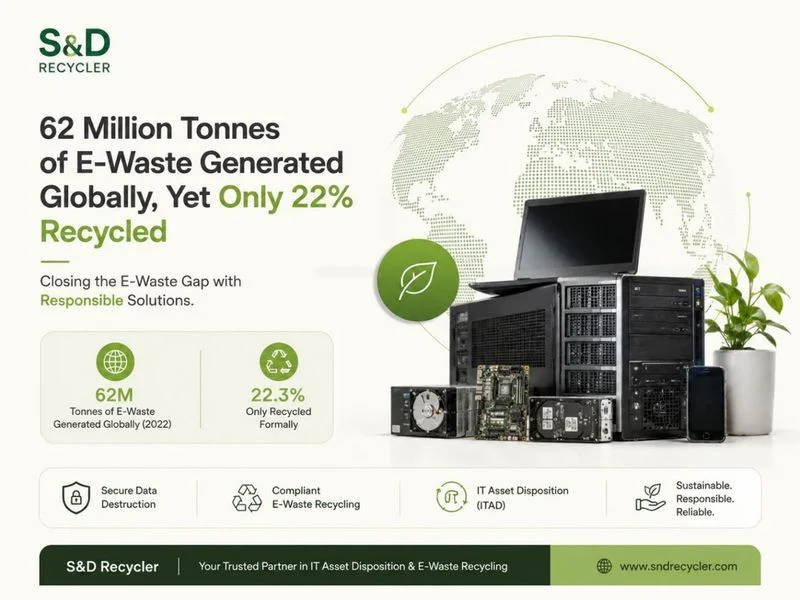
The international electronic waste crisis continues to deepen. According to recent international estimates, the world generated approximately 62 million tonnes of electronic waste in 2022, yet only 22.3% of it was formally collected and recycled. The remaining waste stream, comprising discarded computers, servers, hard drives, mobile devices, and other electronics, often ends up in landfills, informal recycling networks, or unmanaged disposal channels, creating significant environmental, health, and data security concerns.
The consequences extend beyond pollution. Valuable materials such as gold, copper, silver, and rare earth elements embedded within discarded electronics are lost when e-waste is not processed through authorized e waste recycling systems. Industry experts warn that the gap between e-waste generation and formal recycling is widening as organizations continue to accelerate technology upgrades and digital transformation initiatives.
Against this backdrop, India is witnessing a growing demand for structured, compliant, and secure e-waste management solutions. Organizations across major business hubs including Delhi, Noida, Mumbai, Pune, Bangalore, Chennai, and Hyderabad are increasingly looking for reliable partners capable of handling end-of-life IT assets while ensuring environmental responsibility and data protection.
S&D Recycler has emerged as one of the companies addressing this challenge through a nationwide e-waste recycling and IT Asset Disposition (ITAD) network. Serving businesses, educational institutions, healthcare organizations, and government bodies, the company specializes in secure data destruction, certified IT asset disposal, and responsible recycling practices that help divert electronic waste from informal channels into the formal recycling ecosystem.
As one of the growing ITAD companies in India, S&D Recycler focuses on secure asset lifecycle management, helping organizations dispose of obsolete electronics responsibly while protecting sensitive business data. Operating under recognized compliance frameworks, the company ensures that end-of-life electronic assets are processed through environmentally responsible methods while supporting regulatory compliance and sustainability objectives.
Commenting on the growing challenge, Rohan Shrivastav, CEO of S&D Recycler, said, “The e-waste problem is no longer a future concern; it is a present-day responsibility for every organization. Millions of devices are reaching end-of-life each year, and the way they are disposed of has implications not only for the environment but also for data security and resource conservation. Our objective is to make compliant e waste recycling and secure IT asset disposition accessible, scalable, and straightforward for organizations across India.”
Beyond recycling, the company advocates a broader shift in perception, viewing e-waste as a recoverable resource rather than a disposal problem. Through CPCB-compliant recycling processes, material recovery initiatives, and the responsible handling of reusable electronics, S&D Recycler is contributing to a more circular approach to technology consumption.
In addition to its growing presence across India, the company supports clients with operations and asset recovery requirements across international markets including Germany, Australia, Malaysia, Japan, Hong Kong, and broader European regions, reflecting the increasingly global nature of technology asset management and sustainability initiatives.
As global e-waste volumes continue to rise, industry stakeholders believe that increasing participation in formal e waste recycling ecosystems will be essential. Companies such as S&D Recycler are playing a crucial role in helping bridge the gap between electronic consumption and responsible disposal, ensuring that sustainability, compliance, data security, and responsible resource recovery remain at the forefront of India’s digital future.
Future Outlook
The trajectory of electronic waste management hinges on integrating localized regulatory compliance with multinational asset recovery infrastructure. As global device consumption trends upward, the scaling of formal ITAD networks will determine whether obsolete hardware remains a severe ecological liability or transitions successfully into a sustainable stream of reclaimed commodities.
FAQs
What total volume of electronic waste is generated worldwide?
Global estimates indicate that the world generated 62 million tonnes of electronic waste in 2022, a figure that continues to rise as corporate digital transformation and consumer technology consumption accelerate.
What percentage of global e-waste is formally recycled?
Only 22.3% of the world’s electronic waste was formally collected and recycled according to recent international records, leaving the vast majority to enter informal channels or landfills.
Why is informal electronic waste disposal problematic?
Informal disposal causes significant environmental and health pollution, creates severe data security vulnerabilities for organizations, and results in the permanent loss of valuable components like gold, silver, copper, and rare earth elements.
How do formal ITAD services protect corporate data?
Certified IT Asset Disposition companies utilize specialized, secure data destruction and compliance frameworks to safely eliminate sensitive corporate information from hardware before processing or recycling the physical components.