India Competitive Exam Crisis and Rising Student Protests
A convergence of systemic education failures, rampant examination paper leaks, and hyper-competitive pressures is driving Indian youth into a severe mental health crisis. Escalating administrative failures have ignited massive street demonstrations, challenging state institutions as millions of graduates face intense economic anxiety and diminishing job prospects.
Key Highlights
- Millions of Indian graduates face severe anxiety and a 0.01% success rate in hyper-competitive public examinations.
- A legacy of systemic flaws is underscored by 41 documented examination paper leaks across 15 states over five years.
- Public fury has sparked student-led street protests in New Delhi demanding the immediate resignation of the education minister.
- Structural shifts toward privatization and outdated curricula exacerbate the ongoing employment gridlock for 1.07 crore annual graduates.
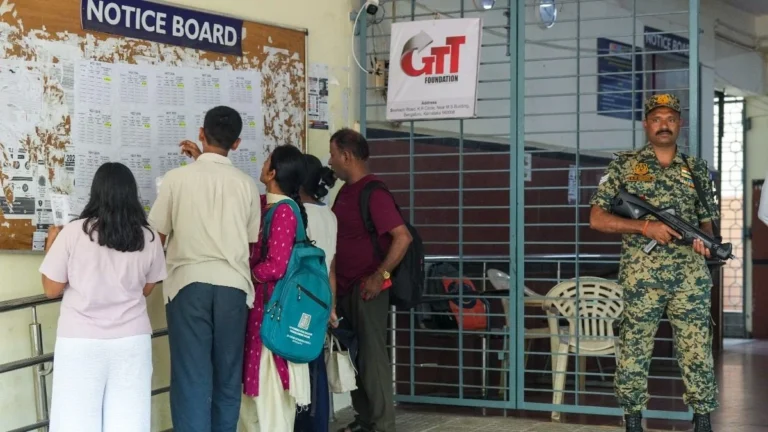
In cramped, minimalist rooms across India, groups of three to four candidates endure collective isolation to prepare for government employment. Surrounded by fragmented study materials, regional maps, and multiple question banks targeting quantitative aptitude and general knowledge, these individuals adhere to rigid schedules.
Wall-mounted motivational maxims outline their singular definition of achievement: securing a public sector position. This pursuit requires outperforming hundreds of thousands of competing applicants per attempt.
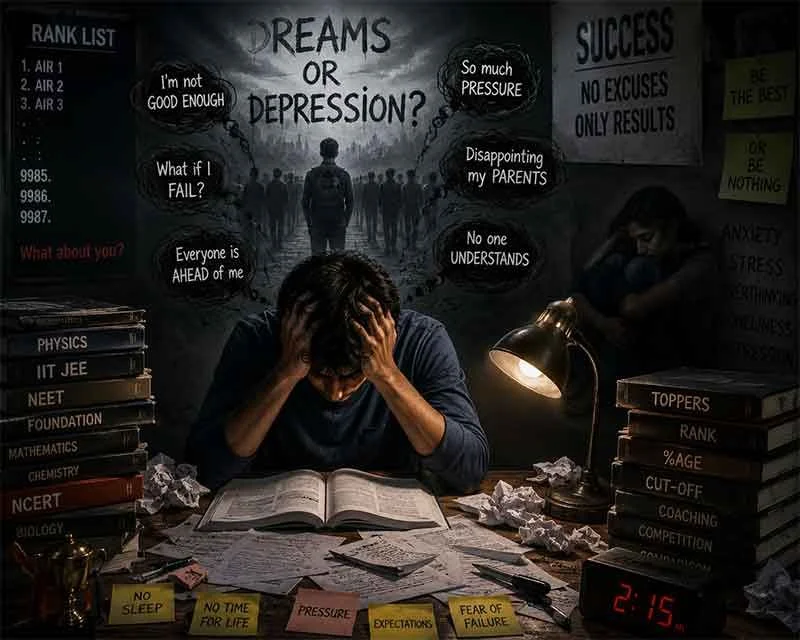
Having dedicated three years to this regimen, these aspirants face depleting optimism, financial vulnerability, and acute psychological panic regarding potential failure. Returning home without securing a position remains an unviable option for them.
Simultaneously, in private residential spaces, candidates like Aditi study late into the night for their second attempt at the National Eligibility cum Entrance Test. Surrounded by advanced textbooks in biology, chemistry, and physics, she battles profound professional self-doubt.
Her digital devices offer no reprieve, continuously displaying updates regarding widespread examination malpractice and structural uncertainty. The compromised integrity of national tests darkens the prospects of the student community.
In Bengaluru, an engineering graduate lives in shared quarters while working as a digital delivery courier. Despite holding a technical degree, he remains locked out of formal employment markets.
With applicant pools regularly drawing hundreds of thousands of candidates, individual selection probabilities plummet to approximately 0.01%. Macroeconomic fluctuations, corporate downsizings, and automated workspace technologies have fundamentally disrupted corporate recruitment paradigms.
Consequently, temporary gig employment serves as the final financial safety net for qualified professionals. These parallel realities highlight deep structural issues within the domestic instruction model.
The current situation prompts fundamental inquiries regarding the authentic objective of instruction within the nation. Data from the 2021-22 AISHE report indicates that Indian institutions graduate 1.07 crore individuals annually across diverse academic disciplines.
This demographic volume exceeds the total population of multiple sovereign island nations. Each credential represents substantial personal ambition and the expectation of utilizing specialized collegiate training in the workforce.
However, public discourse frequently focuses on aggregate employment deficits without addressing the underlying institutional decay. The current crisis stems primarily from structural deficiencies within the academic framework.
An examination of the structural mechanics clarifies the situation.
System and Education
Annually, between 4 crore and 6 crore candidates participate in various centralized evaluations. The National Eligibility cum Entrance Test, Joint Entrance Examination, and Civil Services Examination draw the highest volumes of applicants.
Millions of individual ambitions are decided during brief two to three-hour examination windows. These high-stakes evaluations hold immense power over individual destinies.
The rapid inflation of applicant pools is driven by specific socioeconomic factors. Historically, standardized medical admissions were fragmented before the institutionalization of the unified national system.
Prior to 2013, individual states and elite medical academies administered independent entrance criteria, alongside the central pre-medical test managed by the CBSE. The introduction of a unified national testing mandate in 2013 consolidated these pathways.
Despite initial regulatory disputes, all medical institutions transitioned entirely to this single framework by 2020. Consequently, applicant volume surged from an initial 6 lakh to 7 lakh candidates to a staggering 22 lakh, representing a threefold expansion.
Engineering enrollment metrics reflect a similar trajectory. In the 1990s, preliminary engineering evaluations attracted 2 lakh to 3 lakh candidates; today, combined engineering entrance exams draw 15 lakh to 17 lakh aspirants annually.
This exponential growth is driven by the pursuit of long-term professional security and elevated societal standing. Securing these credentials ensures career stability and distinct social prestige.
While a segment of applicants pursues these disciplines out of genuine academic interest, the majority experience severe institutional coercion and psychological distress. This rigid framework creates an inescapable cycle for young citizens.
The Story Of Success and Marketing
Domestic culture exhibits an intense preoccupation with exceptional individual achievements. External familial expectations routinely pressure youth to secure foreign corporate placements following graduation from premier technical institutes.
Consequently, institutional branding dictates personal worth. Engineering degrees are viewed primarily as instruments for upward financial mobility rather than professional disciplines, while medical qualifications serve as tools for social validation.
Commercial marketing operations systematically capitalize on these aspirations. Annually, more than 2 lakh candidates relocate to specialized preparatory hubs like Kota.
Promotional campaigns heavily feature successful alumni to attract new client cohorts. Academic enterprises routinely utilize deceptive metrics like a 99% selection rate alongside private university assertions of a 100% placement guarantee.
These institutions prioritize corporate profitability and marketing efficacy over holistic learning. This commercialization deepens the systemic crisis.
Paper Leak and Government
Independent journalistic reviews conducted by The Indian Express uncovered 41 verified instances of examination paper compromises across 15 federal states during a five-year timeframe. These systemic breaches directly disrupted the lives of 1.4 crore registered candidates.
These recurrent security failures represent a fundamental breakdown of regulatory oversight. Institutional analysis must focus on the structural factors enabling these chronic vulnerabilities rather than isolated technical glitches.
Even the highest-tier state evaluations remain vulnerable, leaving the expanding student population highly disillusioned. Accountability for these infrastructural failures rests directly with state administrators.
However, state mechanisms are frequently compromised by internal corruption and institutional scandals. The administration of public testing has transformed into a highly lucrative shadow economy.
Simultaneously, public educational assets are systematically dismantled in favor of private entities charging high annual fees of 2 lakh to 3 lakh. This trend reflects a clear political devaluation of affordable public instruction.
While the nation possesses an immense youth demographic, the underlying instructional methodologies remain obsolete. Curricula are outdated and lack practical application.
The current framework functions as a hyper-competitive elimination process rather than an authentic learning platform. True education must prioritize knowledge acquisition, personal aptitude, and genuine economic opportunity.
The state must provide viable pathways aligned with student interests rather than forcing them into standardized professional pipelines. Without these structural reforms, the academic system will continue to operate merely as an impersonal factory.
Future Outlook
The intensifying student protests in New Delhi signal a critical shift in India’s youth demographics. The emergence of groups like the Cockroach Janta Party (CJP), which uses satirical political demonstrations near Parliament, highlights growing youth organization against state administrative failures.
As public frustration over paper leaks mounts, the government faces increasing pressure to reform the National Testing Agency (NTA). The future stability of India’s education sector depends on implementing digitized security protocols, updating university curricula to match an AI-driven job market, and reducing the economic reliance on private coaching hubs.
FAQs
Why are Indian students protesting near Parliament?
Students and youth activists are protesting to demand the resignation of Education Minister Dharmendra Pradhan. The demonstrations follow repeated question paper leaks and allegations of systemic mismanagement in major public examinations.
How many students are affected by exam paper leaks in India?
An investigation found 41 documented exam paper leaks across 15 states over a five-year period. These institutional security failures have directly impacted approximately 1.4 crore candidates.
What is the success rate for applicants in major Indian exams?
Due to extreme competition and millions of applicants, the selection rate for premier positions and institutional seats drops to approximately 0.01% for candidates in highly contested fields.
How much has applicant volume grown for the NEET exam?
Following the consolidation of medical entrance exams into a single national system, applicant numbers rose from an initial 6 lakh to 7 lakh to over 22 lakh candidates annually.