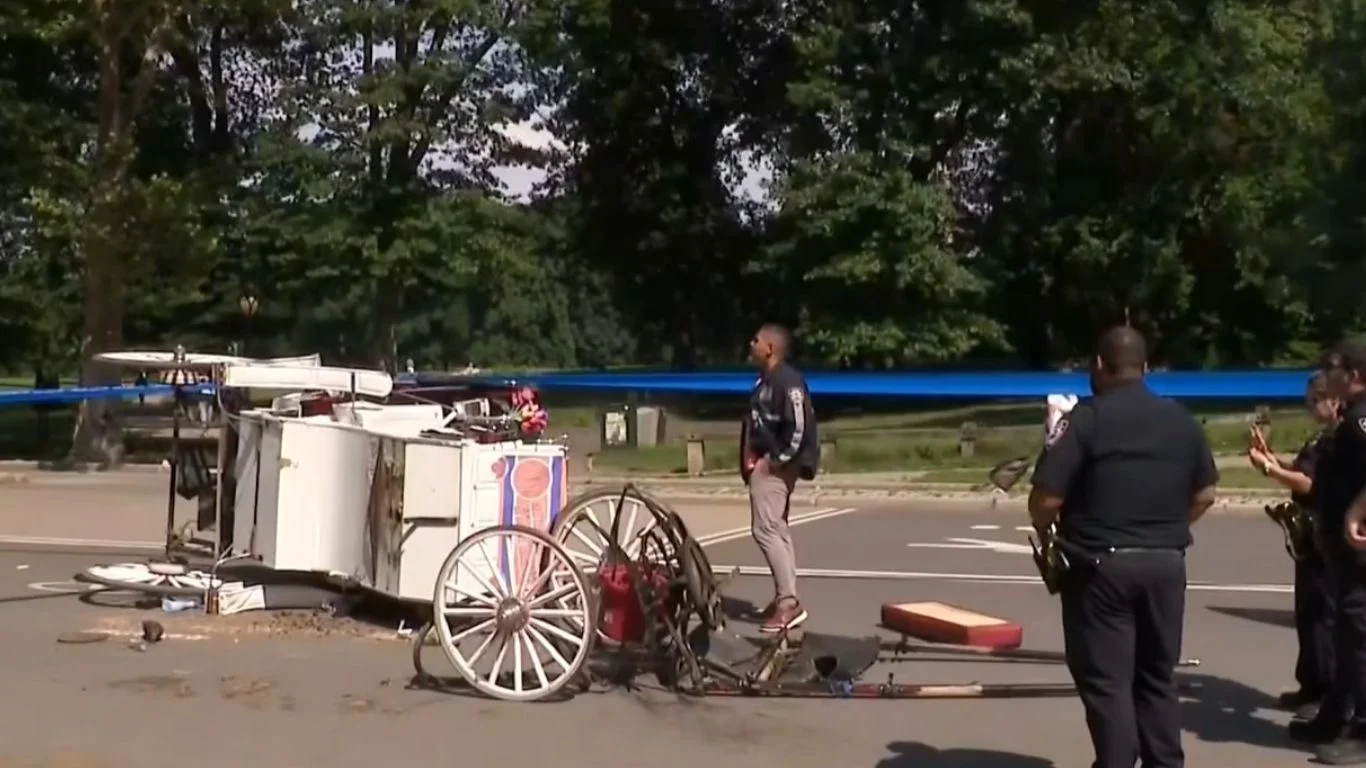
Indian Tourist Dies in Central Park Carriage Crash
An 18-year-old tourist from India died following a horse-drawn carriage accident in New York City’s Central Park on Wednesday afternoon. The fatal incident has renewed intense scrutiny over the safety of the carriage industry, prompting local lawmakers and animal rights advocates to demand an immediate end to the historic trade.
Key Highlights
- Romanch Mahajan, an 18-year-old visitor from India, suffered fatal head injuries after leaping from a runaway carriage to assist his mother.
- The incident occurred at Cherry Hill around 2:47 p.m. on June 17, 2026, after the carriage horse became startled and bolted.
- The Transport Workers Union Local 100 confirmed the driver was suspended for leaving the horse unattended to take a photograph.
- The tragedy has amplified political pressure on the New York City Council to pass Ryder’s Law and phase out horse-drawn operations.
NEW YORK — An 18-year-old tourist visiting from India died following a horse-drawn carriage accident in New York City’s Central Park, authorities stated. The tragedy has reignited intense anxieties surrounding the operational safety of carriage rides and triggered immediate demands to dismantle the highly contested industry.
Law enforcement officials confirmed the young man was riding inside a horse-drawn carriage alongside three family members when the crisis unfolded. Reports indicate the carriage operator stepped away from the animal to photograph the group. Moments later, the horse unexpectedly bolted. The runaway animal accelerated rapidly down West Drive, striking an adjacent carriage and causing the vehicle to overturn near Tavern on the Green. Emergency footage captured the horse collapsing onto the pavement shortly after the impact.
First responders arrived at Cherry Hill near 72nd Street and West Side Drive following a 911 call at 2:47 p.m. Paramedics transported the critically injured teenager to NewYork-Presbyterian Weill Cornell Medical Center. Physicians later pronounced him dead. The remaining three passengers avoided severe trauma and declined emergency medical treatment. The fatal collision stunned onlookers in the landmark park while escalating the political friction surrounding urban carriage operations.
Alexander Kemp, vice president of Transport Workers Union Local 100, openly condemned the driver’s conduct. He emphasized that carriage operators are strictly prohibited from leaving their animals unconstrained.
“It appears the driver was at least at arm’s length from his horse,” Kemp stated to local media outlets.
Kemp asserted that operators must maintain physical command of their horses at all times, adding that the union fully endorses a comprehensive investigation. While police investigators have withheld specific diagnostic details, municipal officials are actively analyzing the precise chain of events. The fatal crash occurred just days after another high-profile carriage horse casualty in the park. Last week, a horse named Deniz died after consuming a toxic plant, according to preliminary veterinary autopsy data.
Consequently, animal protection organizations have mobilized fresh campaigns against the horse-drawn transit trade. For decades, advocates have maintained that congested urban environments subject these animals to severe stress and physical danger. Although horse-drawn carriages persist as a lucrative tourist staple within Central Park, critics argue the commercial practice has no place in modern municipal infrastructure.
New York Mayor Zohran Mamdani voiced explicit support for banning horse-drawn carriages from the park entirely. His executive stance aligns directly with grassroots activists lobbying City Hall to phase out commercial licenses. In the wake of Wednesday’s fatality, a coalition of local lawmakers also demanded immediate legislative intervention.
New York City Council Member Shahana Hanif characterized the consecutive park incidents as deeply tragic. She noted the events underscore systemic public safety hazards affecting both human passengers and the animals.
“These incidents are not isolated,” Hanif published on X.
Hanif urged the city administration to expedite Ryder’s Law, a pending legislative framework designed to eliminate horse-drawn carriage operations across New York City. The statute would block the city from distributing new operating permits and mandate a total phase-out of existing carriage businesses over a two-year period.
Proponents of the ban assert the policy shift will safeguard the public while eliminating institutional animal exploitation. The proposed bill additionally outlines job transition resources to help displaced workers secure alternative employment. Meanwhile, Council Member Harvey Epstein expressed profound horror over the teenager’s death, emphasizing that the industry carries an undeniable history of human and animal casualties.
“Time and again, we are seeing both horses and people suffer the consequences of an industry that poses serious risks to public safety and animal welfare,” Epstein declared in an official statement.
Investigation and Family Account
New details from the victim’s family revealed that the teenager, identified as Romanch Mahajan, was attempting to rescue his mother when he sustained fatal injuries. The Mahajan family was taking a scenic ride through the park when the 7-year-old horse, named Sampson, grew startled. As the vehicle careened out of control, Romanch’s mother, Priya Mahajan, fell from the cabin.
According to his father, Deepak Mahajan, the teenager deliberately leaped from the moving vehicle to protect her, shouting for his mother before striking the ground and suffering severe head trauma.
The Transport Workers Union Local 100, which represents hundreds of local carriage drivers, revealed that Sampson had only been working in the park for six weeks. The union confirmed the carriage owner has placed the driver on suspension and intends to permanently retire the horse from commercial service.
Concurrently, Ashley Byrne, director of People for the Ethical Treatment of Animals, called on Health Committee Chair Lynn Schulman and Speaker Julie Menin to immediately pass Ryder’s Law, citing a history of carriage collapses and dangerous street roll-overs.
History of Carriage Controversies
The legislative push to ban horse carriages in New York City is anchored by Ryder’s Law, a bill drafted after a carriage horse named Ryder collapsed on a scorching asphalt street during a heatwave in 2022. The image of the dying animal sparked global outrage and solidified a political movement to replace the traditional carriages with electric vintage vehicles.
Historical data from animal advocacy groups shows a persistent pattern of urban carriage accidents in New York City, including a similar vehicle rollover in May 2026. Activists argue that mixing large, easily spooked animals with heavy pedestrian traffic and motor vehicles creates an unmanageable public safety threat.
FAQs
Who was the victim of the Central Park carriage accident?
The victim was Romanch Mahajan, an 18-year-old tourist from India who was visiting New York City with his parents.
Why did the horse carriage crash happen?
The carriage horse became startled and bolted down West Drive while the driver was away from the reins taking a photograph. The vehicle then struck another carriage and flipped over.
What is Ryder’s Law?
Ryder’s Law is a proposed New York City Council bill aimed at phasing out horse-drawn carriages over a two-year period, stopping new licenses, and transitioning workers into alternative industries.
What happened to the driver and horse involved in the incident?
The driver was suspended by the carriage owner pending an official investigation, and the 7-year-old horse, Sampson, has been retired from commercial service.