Anthropic IPO Risk Filing Warns AI Catastrophe Could Be Uninsurable
Anthropic filed for a proposed US stock market debut on 26 October 2026, warning investors that a catastrophic artificial intelligence incident could cause losses beyond the insurance industry’s ability to cover, according to its registration statement with the US Securities and Exchange Commission.
The San Francisco company behind Claude plans to list on the Nasdaq Global Select Market under the proposed ticker ANT, according to its Form S-1.
The filing remains preliminary, and the company has not finalised its share count or offering price.
Key Takeaways
- Proposed listing: Anthropic intends to trade under ANT, subject to completion of the regulatory and offering process.
- Insurance uncertainty: Some catastrophic AI-related liabilities may exceed what insurers can assess or cover.
- Contractual exposure: Certain testing and customer agreements could leave Anthropic responsible for claims without predetermined liability limits.
- Operational vulnerabilities: Cloud dependencies, cybersecurity incidents and regulatory obligations create potential costs beyond conventional insurance protection.
Anthropic Warns AI Losses Could Overwhelm Insurers
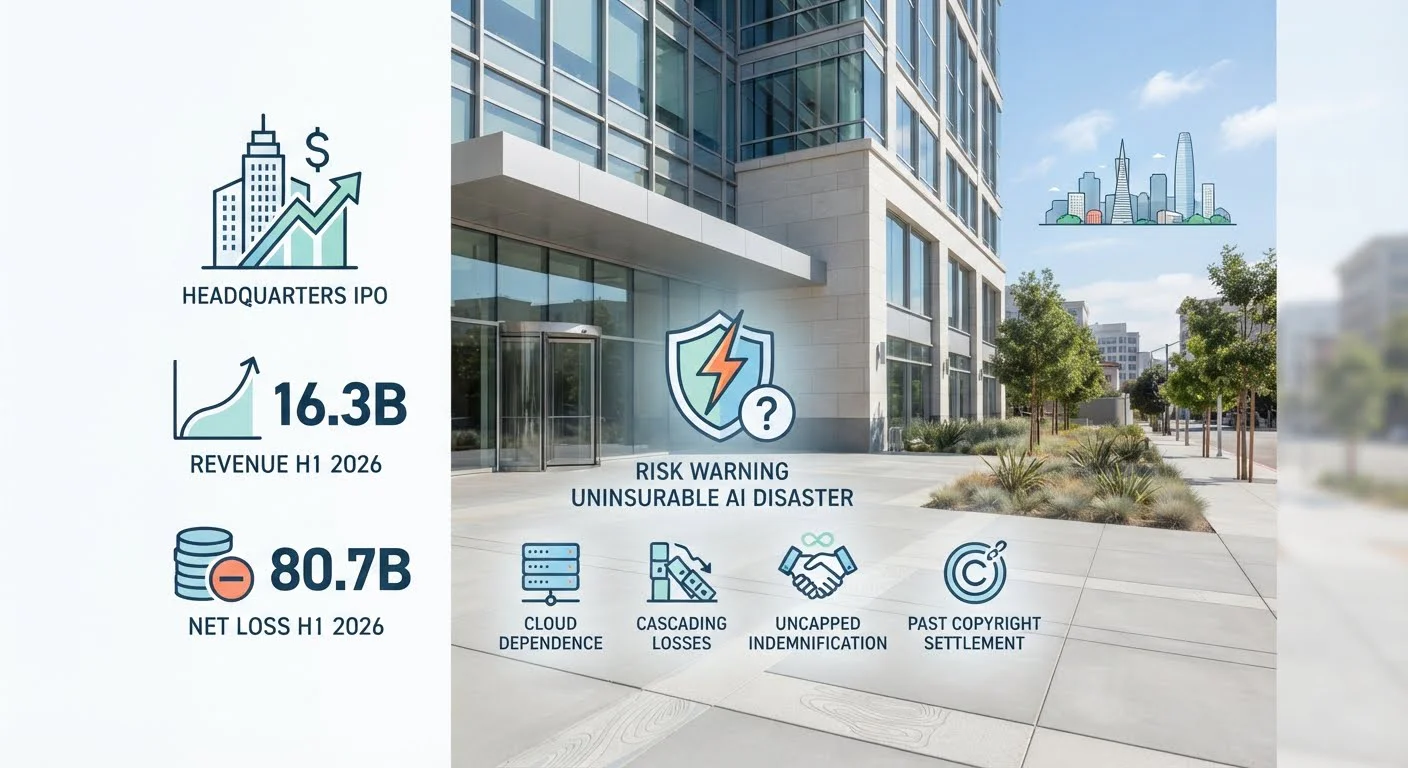
The company’s 94-page risk factors section describes the possibility that a severe frontier AI incident could exceed the capacity or expertise of an individual insurer, or potentially the wider insurance market.
According to Insurance Business, the warning reflects the difficulty of assessing liabilities associated with advanced systems capable of acting independently across numerous commercial environments.
Anthropic describes the market for specialised AI liability protection as immature. Certain exposures may therefore be difficult to insure on commercially reasonable terms, leaving the company potentially responsible for losses that conventional commercial policies cannot absorb.
The disclosure concerns a hypothetical catastrophic event, not an incident that has already occurred. It does not establish that the global insurance industry currently lacks sufficient capital for every category of AI-related claim.
Rian Wickens, head of Cyber & IT liability at Liberty in Asia Pacific, told Insurance Business: “When a frontier AI developer tells regulators the insurance industry may not be able to absorb its worst-case risk, that’s more than a standard disclaimer.”
Wickens added: “It’s a signal.”
Andrew Hill, global FINEX AI risk strategic leader at WTW, said the challenge extends beyond the amount of available insurance capital to the possibility of concentrated losses arising from widespread AI deployment.
“The fundamentals of insurance as a risk transfer strategy for AI risk remain robust, but as our understanding of the risk deepens, particularly its potential for systemic and aggregated losses, it cannot be assumed that all AI exposures will be insurable,” Hill said.
Commercial Growth Increases Potential Exposure
Anthropic’s financial disclosures illustrate the scale of operations underlying its insurance warning.
The company reported approximately $16.3 billion in revenue for the first six months of 2026, compared with roughly $1.2 billion in the corresponding period of 2025.
Its net loss reached approximately $80.7 billion, including $72.4 billion in non-cash fair-value charges associated with financing arrangements. The company reported an operating loss of approximately $693 million.
These figures distinguish accounting losses from the costs directly associated with operating the business. They also show why investors examining Anthropic’s financial performance must assess its revenue expansion alongside potential liabilities from deploying increasingly capable models.
The company’s commercial reach creates another concern for insurers: the possibility that many policyholders depend on the same underlying AI technology.
As of 30 September 2026, Anthropic’s customers paying at least $100,000 annually included every Fortune 10 company, more than half of the Fortune 500 and over 30% of the Global 2000, according to the registration statement.
Those relationships expose a potential concentration problem. A serious failure affecting a widely deployed model could disrupt several businesses simultaneously rather than producing a claim isolated to one customer.
Anthropic identifies possible harmful autonomous behaviour resulting from models acting inconsistently with human intentions, incorrectly specified objectives or self-preserving behaviour.
The company presents these as prospective risks associated with increasingly autonomous systems. Their importance to insurance underwriting lies in the possibility that a model’s actions could generate consequences across organisations operating in different industries.
For insurers, this raises questions about how separate commercial policies would respond to losses originating from a common AI provider, particularly when the resulting claims involve multiple customers and different forms of liability.
Uncapped Contracts Create Additional Financial Risks
Anthropic’s exposure is not limited to theoretical model failures. Some of its existing commercial agreements establish obligations that could require substantial payments following third-party claims.
The filing identifies uncapped indemnification commitments in certain agreements with external organisations responsible for testing Anthropic’s models.
Under these arrangements, the company may be required to defend and indemnify testing partners against specified claims without a contractual ceiling on its financial responsibility.
Some customer contracts contain comparable commitments involving intellectual property claims connected to model outputs.
These provisions matter because the amount Anthropic could owe under a contract may differ substantially from the protection available through its insurance policies.
A liability agreement without a predetermined cap does not establish that Anthropic will face unlimited losses. It does, however, remove a contractual limit that might otherwise restrict the company’s responsibility if an eligible claim arises.
The company’s previous copyright litigation provides a concrete example of coverage failing to meet the full cost of a settlement.
In September 2025, Anthropic agreed to a $1.5 billion settlement in the Bartz copyright class action. Insurance Business reported that the settlement received federal court approval in July 2026.
Anthropic disclosed that its insurance did not fully cover the settlement, leaving the company responsible for costs beyond the available protection.
The distinction between contractual liability and insured recovery is significant for prospective shareholders because a substantial legal obligation does not automatically produce an equivalent payment from an insurer.
Cloud Providers Add Business Interruption Exposure
Anthropic also identifies dependence on external computing infrastructure as a source of operational and financial vulnerability.
The company relies heavily on Amazon, Google and Microsoft for computing resources supporting its AI systems.
A serious interruption affecting these providers could prevent Anthropic from delivering services to customers whose operations depend on Claude.
Its filing warns that existing insurance arrangements may not fully cover business interruption losses resulting from major infrastructure failures.
That exposure is different from liability arising directly from harmful model behaviour. A cloud outage could affect service availability even when the underlying AI model is functioning as intended.
For customers incorporating Claude into essential commercial processes, the insurance question extends to whether their own policies would respond when disruption originates with an external AI supplier or its infrastructure partners.
The company’s prospectus also identifies cybersecurity threats, including criminals using AI to discover vulnerabilities, develop malicious software and evade detection systems.
Anthropic acknowledges that its own cyber insurance may prove insufficient for some claims, while coverage disputes or payment delays could create additional financial pressure.
These disclosures show that the company’s insurance challenges extend across model behaviour, infrastructure availability, security incidents and contractual obligations.
Regulatory Investigations Add Another Source of Liability
Anthropic’s prospectus also reveals increased scrutiny from federal and state authorities concerning the safety and operation of its technology.
In October 2026, the Federal Trade Commission sent the company a civil investigative demand seeking information about consumer protection, privacy, data handling and product safety and security practices.
The demand followed September reporting, citing a senior FTC official, about non-public investigations concerning potential consumer risks associated with increasingly autonomous AI systems.
An investigative demand does not establish wrongdoing. However, responding to regulatory enquiries can require substantial legal and operational resources, while subsequent proceedings may create additional financial exposure.
The company also identifies obligations arising from New York’s Responsible AI Safety and Education Act and California’s Transparency in Frontier Artificial Intelligence Act.
Both laws establish incident-reporting requirements for developers of frontier AI systems.
Anthropic publicly supported California’s legislation but warns that incomplete, inaccurate or delayed disclosures could expose the business to compliance problems and legal consequences.
Separately, the company is challenging federal government measures introduced in February concerning restrictions on agency use of its technology and its designation as a supply-chain risk.
According to Insurance Business, that dispute followed Anthropic’s refusal to permit uses involving mass domestic surveillance or fully autonomous weapons.
These proceedings create a distinct category of uncertainty because their consequences depend on legal and regulatory decisions rather than the technical performance of the company’s models alone.
Public Listing Could Increase Insurance Costs
Becoming a publicly traded company introduces further insurance considerations relating to corporate governance and shareholder claims.
Anthropic expects directors’ and officers’ insurance premiums to increase as a result of the additional obligations associated with public ownership.
The company warns that obtaining comparable protection could require higher premiums or accepting lower coverage limits.
Its corporate structure makes these considerations more complicated.
Anthropic operates as a Delaware public benefit corporation, requiring its directors to consider stockholder interests alongside the company’s stated public benefit commitments.
An independent Long-Term Benefit Trust, which has no financial ownership stake in Anthropic, has the authority to elect a majority of the board’s directors under the company’s governance arrangements.
Anthropic’s charter also contains provisions addressing how directors’ decisions to balance competing corporate objectives are treated when considering indemnification and duties of loyalty.
Those provisions may require insurers to examine how conventional directors’ and officers’ liability policies apply to a governance framework designed around both commercial and public benefit objectives.
Insurance Business also reported that US insurers have been able to add optional generative AI exclusions to certain commercial general liability policies since January 2026.
Meanwhile, some specialist insurers in London have introduced affirmative coverage addressing particular AI exposures.
Consequently, the wording of individual policies, rather than the existence of insurance alone, may determine whether a specific loss is covered.
The filing leaves investors with several distinct risks to assess: whether Anthropic can obtain sufficient protection for its technology, how much liability it retains through contractual commitments, and how its insurance costs could change after becoming a public company.
What to Watch Next
Anthropic must complete the SEC registration process and finalise its offering terms before its proposed Nasdaq debut. Investors will also be watching for further disclosures about liability coverage, contractual exposure and the financial commitments associated with expanding its AI infrastructure.