
Dan Crenshaw Challenges Musk Over Ukraine Starlink Restrictions
WASHINGTON, Oct. 26, 2026. Texas Republican Representative Dan Crenshaw has challenged Elon Musk’s explanation for restricting Ukraine’s access to Starlink satellite communications, arguing that Ukrainian drone strikes against Russian forces are part of defending the country against invasion.
The disagreement followed disruptions affecting Starlink and Starshield, SpaceX’s military communications system. Ukraine’s government said operating speeds had returned to normal after the restrictions, but questions remained about who authorised changes affecting the military network.
Crenshaw Challenges Musk’s Defensive Distinction
Speaking on Bloomberg This Weekend on October 25, Crenshaw, a member of the House Intelligence Committee, rejected Musk’s argument that Ukraine had violated Starlink’s terms of service by using the civilian network for offensive military operations.
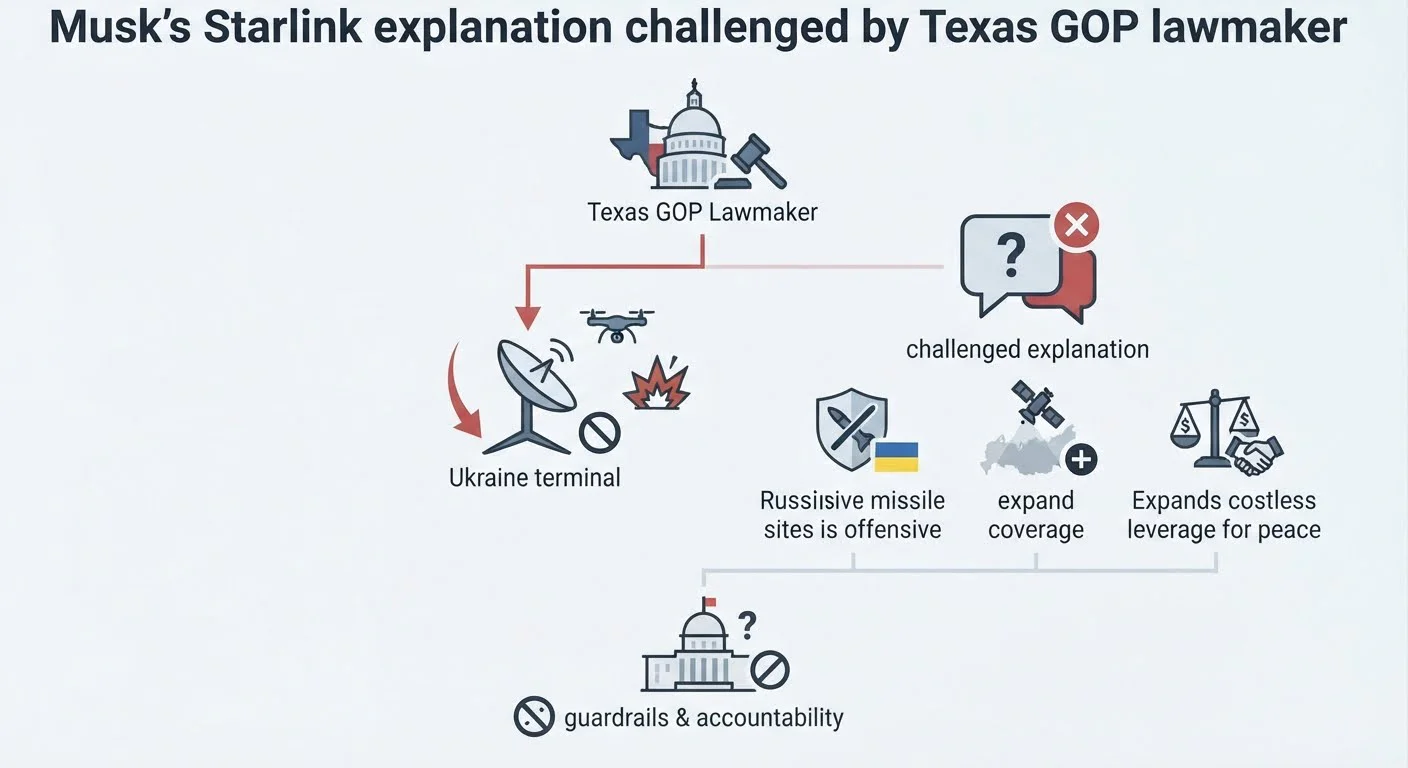
Musk had accused Ukrainian forces of conducting “offensive drone strikes to kill people” using Starlink. He said SpaceX had closed a loophole allowing such operations, maintaining that the civilian service was not intended to support offensive attacks.
Crenshaw challenged the distinction between offensive and defensive operations when a country is resisting an invasion.
“What do you think defending your country is? Of course these drones have been used to kill people,” Crenshaw said during the interview.
The Texas lawmaker argued that Ukrainian forces must be able to strike Russian military equipment threatening their territory. His position directly challenged Musk’s interpretation of how a civilian satellite network should be used during wartime.
Crenshaw Calls For Starlink Coverage Over Russia
Beyond restoring existing capabilities, Crenshaw urged Musk to extend Starlink coverage into Russian territory, allowing Ukrainian drones to maintain satellite connections while targeting mobile missile launchers before they could fire.
The proposal would expand the operational reach of Ukrainian-made drones, which depend on reliable communications for certain missions. Crenshaw specifically pointed to Russian missile systems used to attack Ukrainian civilian infrastructure.
He argued that helping Ukraine destroy those launchers could reduce civilian casualties and strengthen Kyiv’s position in negotiations with Russian President Vladimir Putin.
Crenshaw described expanded coverage as a “costless” strategic measure, suggesting that greater Ukrainian military capability could reduce the need for additional American financial assistance.
Those potential savings remain the lawmaker’s assessment rather than a verified budget estimate. No specific reduction in US spending has been established from the proposed expansion.
Starlink And Starshield Restrictions Explained
The disagreement emerged after both commercial Starlink terminals and Starshield experienced reduced operating speeds, disrupting communications used by Ukrainian forces.
Musk acknowledged restrictions affecting the civilian Starlink service and attributed them to Ukraine’s alleged violation of its terms of service.
He distinguished that network from Starshield, saying the military system was controlled by the US government and that decisions about its use belonged to American authorities.
That distinction is significant because the reported disruption affected both systems. Musk’s explanation of commercial Starlink restrictions did not establish who authorised every change affecting Starshield.
Ukraine’s Defence Ministry subsequently confirmed that operating speeds had returned to normal following the disruption. The restoration addressed the immediate connectivity problem without resolving the disagreement over permitted military uses.
Dependence On A Single Provider Raises Concerns
Crenshaw also raised concerns about Ukraine’s extensive reliance on SpaceX technology for battlefield communications.
His criticism extended beyond Musk’s individual decision to the risks created when a country’s military capabilities depend heavily on infrastructure supplied by one commercial company.
Starlink connections support communications between Ukrainian units, while satellite-enabled systems also contribute to drone operations and military coordination.
The restrictions illustrated how decisions about access to privately operated technology can affect military activities even when the equipment is being used by a government defending its territory.
Crenshaw’s concern was the lack of readily available alternatives capable of providing comparable communications services if existing connections were restricted.
North Carolina Republican Senator Thom Tillis has also called for “guardrails and accountability” governing relationships between the federal government and private technology suppliers involved in defence operations.
The wider debate concerns how governments can retain dependable access to essential communications while contractors maintain restrictions on the services they provide.
What Happens After [Service Restoration
Although Ukraine](https://www.staradvertiser.com/2026/10/26/breaking-news/musks-starlink-explanation-challenged-by-texas-gop-lawmaker/) reported that satellite operating speeds had recovered, the underlying disagreement remains unresolved.
Crenshaw wants SpaceX to go beyond restoring existing access by enabling Ukrainian drones to operate over Russian territory against missile launchers. Musk has defended restrictions on the civilian network while distinguishing Starshield’s military role.
The competing positions leave separate questions about commercial service rules, government authority and battlefield requirements.
Restored connectivity does not establish whether the requested geographical expansion will take place. Nor does it settle which restrictions could apply to future Ukrainian operations using either system.
The dispute has therefore moved beyond a temporary communications disruption. It now centres on the extent to which private satellite providers and government authorities determine how technology essential to Ukraine’s defence can be used during the continuing war with Russia.