Jets’ Joe Tippmann Allows 3 Sacks as Pass Blocking Slumps
New York Jets right guard Joe Tippmann allowed three sacks and six pressures during Weeks 5-7 of the 2026 NFL season, according to Pro Football Focus figures reported by Jets X-Factor on 27 October, despite earning the highest run-blocking grade among guards during that stretch.
The decline has become a concern for the 2-5 Jets, who signed Tippmann to a four-year contract extension during the off-season. His contrasting performances have exposed a problem on an offensive line already dealing with injuries and inconsistent blocking.
Connor Long’s analysis identified Tippmann’s difficulty protecting quarterback Geno Smith as a significant concern. Although the guard has improved his effectiveness in the running game, his recent pass-protection grades place him among the weaker performers at his position.
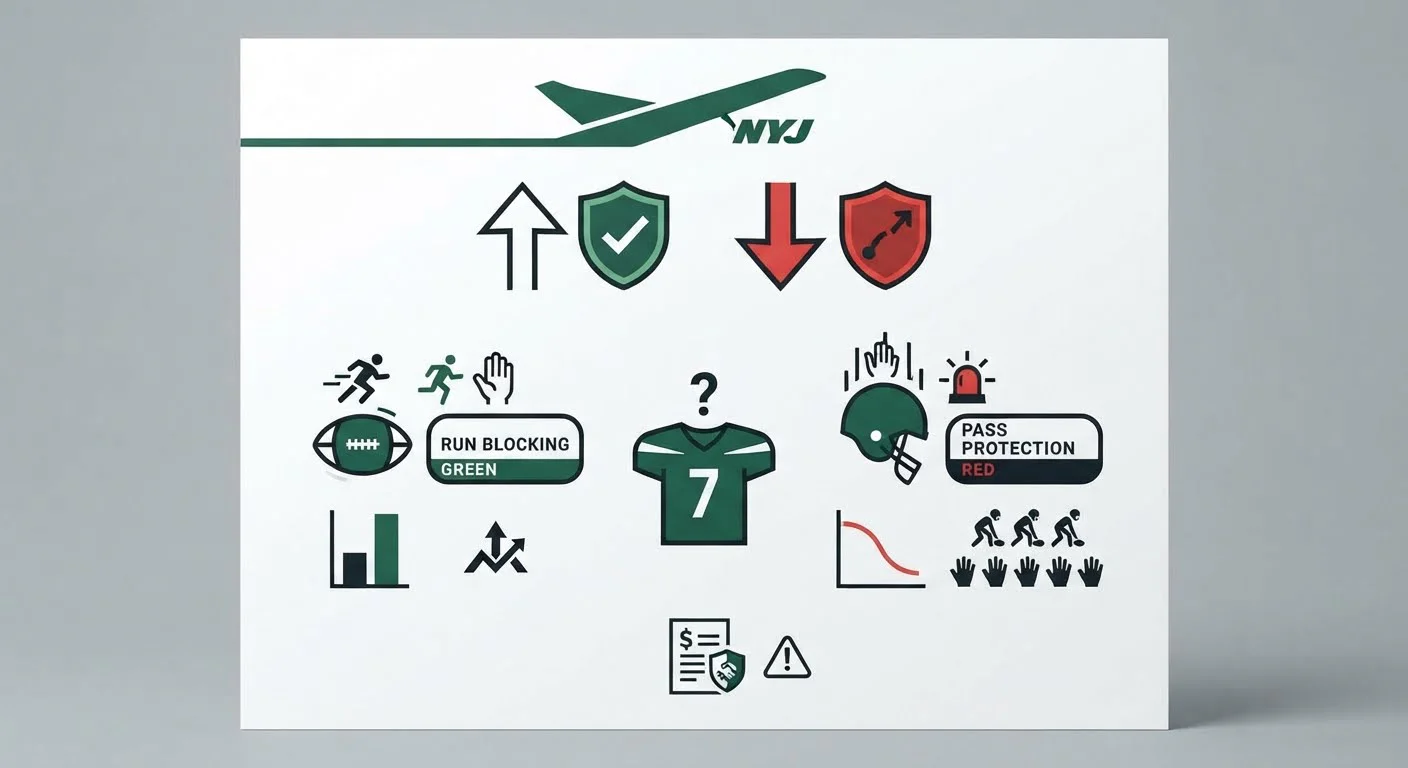
Tippmann’s Pass Blocking Falls as Run Blocking Improves
Tippmann began the season with encouraging pass-protection performances after establishing himself at right guard last year. During the opening four weeks, his 72.3 pass-blocking grade ranked 15th among 59 qualifying guards who had played at least 100 snaps.
That early performance contrasted sharply with his subsequent form. Over the following three games, his pass-blocking grade fell to 48.0, ranking 53rd among 61 guards.
The difference represents a 24.3-point decline in his PFF pass-blocking grade. These grades are third-party evaluations of player performance rather than official NFL statistics.
Yet his work in the running game moved in the opposite direction. His run-blocking score improved by 22.5 points between the two periods, helping raise his overall grade despite the deterioration in pass protection.
#
Joe Tippmann’s PFF Grades: Weeks 1-4 vs Weeks 5-7
| Performance Metric | Weeks 1-4 | Weeks 5-7 |
|—|—|—|
| Overall PFF grade | 72.4 (T-14th of 59) | 85.3 (2nd of 61) |
| Pass-blocking grade | 72.3 (15th) | 48.0 (53rd) |
| Run-blocking grade | 68.6 (24th) | 91.1 (1st) |
| Sacks allowed | 0 | 3 (tied for most) |
| Pressures allowed | 3 (43rd-most) | 6 (12th-most) |
Source: Pro Football Focus figures reported by Connor Long, Jets X-Factor, 27 October 2026. The periods cover different numbers of games, and the totals should not be treated as equal-duration rates.
The figures reveal why Tippmann’s overall grade alone does not explain his performance. His 85.3 overall grade ranks near the top of his position for the later period, but the separate blocking categories show substantially different results.
Long also reported that Tippmann committed a holding penalty in pass protection during his recent struggles. The penalty adds another concern beyond the pressure and sack totals.
Jets’ Offensive Line Struggles Extend Beyond Tippmann
Tippmann’s difficulties have developed alongside problems across New York’s offensive line, rather than in isolation.
Left guard Dylan Parham has been sidelined since suffering an injury in Week 3. Long described Parham as one of the unit’s strongest early performers, making his absence especially significant for an interior line seeking consistency.
Replacement Jordan Meredith has struggled to provide the same level of play, according to the analysis. At centre, Josh Myers has also faced criticism for his performances, with his place in the starting line-up coming under scrutiny.
Left tackle Olu Fashanu has encountered his own pass-protection difficulties. That leaves the Jets managing concerns at several positions rather than addressing a single underperforming guard.
One recurring problem identified by Long is the unit’s handling of defensive blitzes and stunts.
Blitzes can introduce additional pass rushers, while stunts involve defenders changing their rushing paths to challenge blockers’ assignments. Both require offensive linemen to identify pressure and coordinate their responses.
When those exchanges are handled poorly, defenders can find openings before the quarterback has finished preparing to throw.
The distinction matters for Tippmann because correcting his individual pass-blocking technique would address only part of the wider problem. The surrounding linemen must also execute their assignments when defenders change positions or attack gaps between blockers.
Geno Smith’s Passing Style Adds Pressure
The Jets’ passing approach places additional demands on their blockers.
In a separate Jets X-Factor analysis published on 27 October, Michael Nania reported that quarterback Geno Smith released the ball within 2.5 seconds on just 34.2% of his dropbacks.
That was the fourth-lowest quick-release rate among qualifying quarterbacks with at least 150 dropbacks.
Across the most recent four-week period examined by Nania, Smith’s quick-release rate declined to 33.7%, ranking third-lowest among qualifiers.
Those figures help explain why sustained pass protection matters for New York. With fewer quick throws, blockers are more frequently required to maintain protection while passing plays develop.
Nania’s analysis also highlighted how interior pressure can affect the quarterback even when the rest of the offensive line holds its assignments.
A defender reaching Smith through the middle can restrict his ability to step forward into a throw. That makes coordinated protection from the centre and both guards particularly important for an offence that does not consistently get the ball away quickly.
The figures do not establish that Tippmann alone is responsible for the quarterback’s difficulties. They show how the guard’s recent performance fits into the broader protection demands facing New York.
Armand Membou Provides a Positive Contrast
Not every member of the Jets’ offensive line has experienced the same decline.
Right tackle Armand Membou has improved after a difficult opening three games, according to Nania’s assessment.
Membou, the seventh overall selection in the 2025 NFL draft, entered his second professional season after showing promise as a rookie.
During Weeks 4-7, the 22-year-old earned a 77.3 overall PFF grade, ranking third among right tackles behind Indianapolis’ Bernhard Raimann and Tennessee’s JC Latham.
His run-blocking grade reached 78.1, the highest at his position over that period.
The improvement is notable because Nania identified run-blocking consistency as an area where Membou had previously needed development.
His pass-protection record provides another useful comparison. Over the same four games, Membou surrendered eight pressures, including two quarterback hits and one sack.
Nania argued that the tackle’s results should be considered alongside Smith’s relatively low quick-release rate, which can require offensive linemen to sustain their blocks longer.
Membou’s development demonstrates that progress is possible within the same offensive system, even as other positions experience difficulties.
Tippmann’s Contract Raises Expectations
The Jets’ commitment to Tippmann gives his performances additional significance.
His four-year extension followed earlier stretches of promising play and reflected the organisation’s expectation that he could become a dependable part of its offensive line.
Tippmann also holds an offensive captaincy, giving him a leadership position within a unit that has struggled to perform consistently.
The extension does not mean that a difficult three-game period defines his longer-term ability. His earlier pass-blocking performances provide evidence that he has previously played at a higher level in that area.
For New York, the immediate challenge is improving protection without losing the run-blocking strength that has emerged in recent weeks.
The contrast between Tippmann’s two blocking grades leaves the Jets with a specific performance problem to address, while the difficulties at neighbouring positions make a coordinated improvement across the offensive line equally important.