India Mandaviya Mandates Doping Education For National And Khelo India Athletes
Union Sports Minister Mansukh Mandaviya announced compulsory anti-doping education for all athletes competing in the National Games and Khelo India tournaments. The initiative aims to wipe out accidental doping violations and instill clean sporting values across the domestic athletics ecosystem through aggressive grassroot awareness campaigns.
Key Highlights
- Mandatory training sessions established for National Games and Khelo India participants.
- Regional language expansion announced for the official ‘Know Your Medicine’ application.
- International sample testing targeted to scale up at India’s primary WADA-accredited facility.
- Grassroot outreach initiatives ordered to expand into schools, colleges, and rural sports centers.
Union Minister of Youth Affairs and Sports Mansukh Mandaviya on Thursday, June 25, 2026, announced a series of strategic initiatives designed to reinforce the anti-doping framework of India. The policy overhaul introduces compulsory anti-doping education modules for every athlete competing in upcoming National Games and Khelo India events.
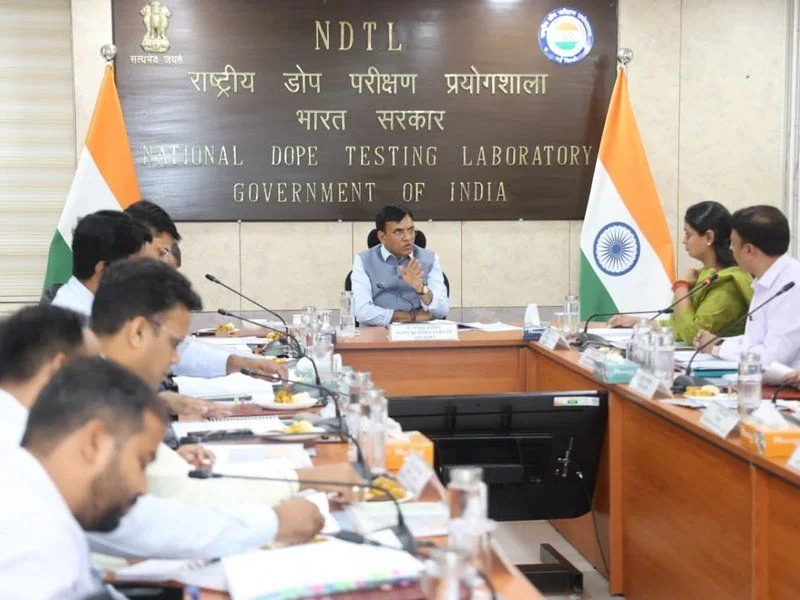
The policy rollout was confirmed during an official executive evaluation of the National Dope Testing Laboratory (NDTL) in New Delhi. The ministerial delegation scrutinized the overall administrative functioning, analytical capabilities, and the upcoming developmental roadmap of the WADA-accredited research facility.
Emphasizing the core philosophy of driving prevention through early education and systemic awareness, Mandaviya specified that competitors entering National Games and Khelo India fields must undergo verified anti-doping instructional blocks.
The Minister highlighted the critical necessity of introducing comprehensive clean sport ethics early in developmental careers. This foundational approach aims to safeguard emerging competitors from face-to-face friction with inadvertent infractions involving prohibited substances.
To maximize accessibility to vital medical data, Mandaviya unveiled plans to translate and launch the ‘Know Your Medicine’ mobile application across multiple regional Indian languages.
Deploying pharmaceutical data in indigenous languages ensures that regional athletes, coaching staff, and medical personnel can accurately identify banned components, thereby driving informed decision-making before administering any treatment.
The Sports Minister additionally directed the National Dope Testing Laboratory to aggressively scale its global footprint by embedding its diagnostic services deeper into international anti-doping operational frameworks.
Mandaviya asserted that strategic efforts must be deployed to boost the volume of biological samples received from international competitors for analytical processing at the New Delhi installation.
He noted that the advancing scientific capabilities and strict regulatory compliance of the NDTL position the institution uniquely to serve as a high-tier contributor within the global clean sports landscape.
Addressing systemic challenges across regional athletic structures, Mandaviya recognized that illicit performance enhancement remains an existential threat, demanding that aggressive grassroots education run parallel to traditional regulatory enforcement. The promotional drives will expand into villages, secondary schools, universities, and regional athletic academies.
The Minister observed that penal measures and athletic bans alone cannot permanently neutralize the threat, emphasizing the need for an expansive national movement championing clean competitors and equitable sportsmanship.
As the sole World Anti-Doping Agency accredited facility in the nation, the NDTL remains the operational anchor of the domestic anti-doping matrix. The center has consistently scaled up its chemical analytical infrastructure, engineering talent, and diagnostic volume while funding advanced research.
The complex has successfully managed regulatory testing for elite global tournaments, deployed cutting-edge Dried Blood Spot (DBS) methodologies, and synthesized unique baseline reference materials, substantially raising national analytical integrity and upholding fair play.
The high-level strategy session included Bihar Industries and Sports Minister Shreyasi Singh, Sports Secretary Hari Ranjan Rao, executive representatives from National Sports Federations, domestic scientists, and NDTL Director and CEO P. L. Sahu.
Future Outlook
The Ministry of Youth Affairs and Sports intends to build a decentralized anti-doping vigilance system over the next three years. By digitizing substance databases in local dialects and embedding compliance certifications directly into national tournament registration portals, India aims to lower positive test rates among junior divisions by 2028. Enhanced sample processing from foreign federations will additionally position the NDTL as South Asia’s primary analytical hub.
FAQs
Which athletes must undergo compulsory anti-doping education under the new mandate?
All domestic sportspersons participating in the National Games and Khelo India competitive events are now legally required to clear the newly established anti-doping educational sessions.
How is the ‘Know Your Medicine’ application being upgraded?
The mobile application is being re-engineered to support multiple regional Indian languages, allowing athletes and trainers from diverse linguistic backgrounds to cross-verify local medications against banned substance lists.
What international upgrades are planned for the National Dope Testing Laboratory?
The central government is expanding the international sample-testing footprint of the NDTL, allowing the WADA-accredited facility to handle higher volumes of diagnostic testing for global athletic federations.