Utah Primary Elections 2026: Incumbents Face Tough Intraparty Battles GOP incumbents face fierce primary challenges as a…
Utah Primary Elections 2026: Incumbents Face Tough Intraparty Battles GOP incumbents face fierce primary challenges as a newly redrawn majority-blue congressional district sparks a highly competitive Democratic race in Utah. Utah primary elections utah-primary-elections-gop-incumbents-challenges Utah primary, 2026 election, Republican primary, Democratic primary, mail-in ballots, Utah County elections, Stuart Adams politics
A high-stakes primary election cycle concludes in Utah on Tuesday evening, establishing the major party nominees for the upcoming November 3, 2026 general election. The ballot features prominent Republican congressional incumbents fighting intraparty challengers, alongside a crowded Democratic field contending for a newly redrawn, voter-favorable district. State and local election administrators report significant logistical shifts under recently enacted statutes, directly impacting ballot submission deadlines and voter turnout dynamics across the state.
Key Highlights
- Ballot-in-Hand Rule: A new legislative mandate invalidates any mail-in ballot not physically received by county clerks by 8 p.m. on Election Day, ending Utah’s previous postmark-based system.
- Sparsely Attended Primaries: Statewide voter turnout hovered at 19.4% by Monday, though localized interest pushed Salt Lake County participation up to 26%.
- Legislative Leadership Threatened: Longtime State Senate President Stuart Adams faces his first primary challenge in over a decade following public controversy over a data center project.
- Utah County Clerk Contretemps: Incumbent Aaron Davidson faces intense criticism over operational management and a controversial, short-lived administrative appointment.
Tuesday evening marks the end of a primary election season in Utah that will determine which candidates represent their political parties in this fall’s general election.
A pair of incumbent Republicans in Congress are hoping to fend off challengers from within their own party on Tuesday night, while four Democrats are vying for the party’s nomination in the newly redrawn 1st Congressional District.
Several state lawmakers and local officials are also looking to survive intraparty challenges and advance to the general election on Nov. 3.
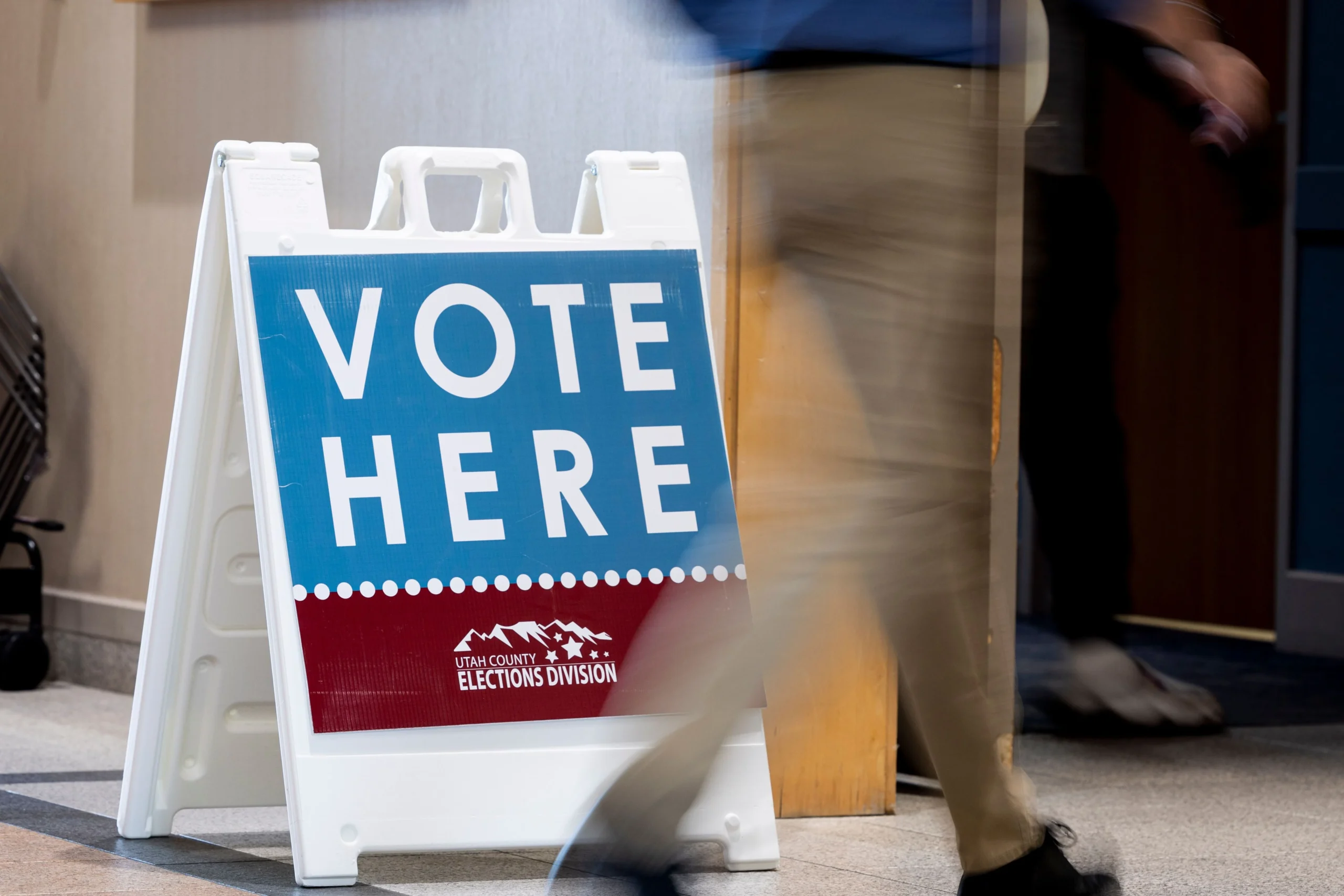
Recent changes to Utah election law require that mail-in ballots arrive at the county clerk’s office by 8 p.m. on Tuesday. That means voters who have not already returned a mail-in ballot will need to place their ballot in a drop box or vote in person for their vote to be counted.
Drop boxes and polling locations can be found at vote.utah.gov.
Congressional races
Three of Utah’s four congressional seats have competitive primaries on Tuesday — Republican primaries in the 2nd and 3rd Districts and a Democratic primary in the 1st District. Rep. Mike Kennedy, R-Utah, does not face a Republican primary challenger and will advance straight to the general election.
Utah’s new 1st Congressional District is projected to give Democrats in the Beehive State a favorable district for the first time in years. Unsurprisingly, the new seat drew a multitude of suitors.
Four Democrats remain in the race that has seen its share of scandal, but only one will advance to the general election against Republican Riley Owen.
Former Congressman Ben McAdams is seeking to return to Washington after losing his reelection bid in 2020. Liban Mohamed won the party’s nominating convention in April, and state Sen. Nate Blouin and attorney Michael Farrell both qualified for the primary ballot by collecting signatures.
On the Republican side, incumbent Reps. Blake Moore and Celeste Maloy are fending off primary challenges in the 2nd and 3rd Congressional Districts, respectively. State Rep. Karianne Lisonbee has made her opposition to Utah’s Proposition 4 a key part of her campaign against Moore, while former state Rep. Phil Lyman has made transparency his top issue in trying to unseat Maloy.
Both incumbents have touted their record and experience in Congress, where Moore serves as a member of the GOP conference leadership and Maloy serves on a powerful spending committee.
State legislative races
Several incumbent state lawmakers are also facing competitive primaries, most notably Senate President Stuart Adams, R-Layton, who is being challenged in a primary for the first time in more than a decade. Stephanie Hollist, a Fruit Heights attorney, and Braden Hess, an attorney and realtor from Kaysville, are both hoping to help unseat the longtime Senate president in Utah’s Senate District 7.
Adams’ role in advancing a controversial data center project in Box Elder County has become a flashpoint in the race in recent months since it was made public, and both opponents have seized on the issue to make their case.
Adams has since softened his support for the project and called for a reduction in its size.
Another powerful state senator is fighting to retain his seat in Senate District 18, despite a challenge from a first-term state representative. State Sen. Dan McCay, R-Riverton, lost to Rep. Doug Fiefia, R-Herriman, in the GOP convention in April and came within just two votes of being eliminated altogether.
Finally, Rep. Trevor Lee, R-Layton, also faces a tough primary fight against Davis County Commissioner Bob Stevenson. Like McCay, Lee lost to his challenger during the convention but got enough support to force a primary.
But Lee has previously performed well with the delegates, and this year’s convention signals the race for House District 16 could be competitive this year.
Utah County races
In Utah County, two county commission seats are up for grabs after Brandon Gordon and Amelia Powers Gardner announced they would not be running for reelection.
For Seat A, political newcomer, former firefighter and nurse anesthetist Brent V. Bowles faces off with seasoned politician Michelle Kaufusi.
Kaufusi was the first female mayor of Provo, serving from 2018 to 2025 before narrowly losing to Marsha Judkins in last year’s municipal election.
Kaufusi’s deputy mayor from her time in Provo, Isaac Paxman, is gunning for Seat B. He is running against former Orem City Councilman David Spencer and former undercover agent and law enforcement official Carolina Herrin.
The county clerk race is also hotly contested this year. Newcomer Corey Astill is hoping to usurp incumbent Aaron Davidson, who he claims has had a tenure marked by “operational election failures.”
Davidson recently faced backlash after appointing a 23-year-old conservative influencer, Kai Schwemmer, as his chief deputy clerk. He adjusted the role a week later to be a confidential administrative associate in response to the public outcry for Schwemmer’s lack of election administration experience and history of alleged antisemitic and sexist remarks on social media.
Future Outlook
The outcome of Tuesday’s primaries will fundamentally alter the partisan and ideological composition of Utah’s delegation for the general election. While statewide primary turnout remained low at 19.4%, the structural shifts in voting laws mean that future state campaigns must recalibrate their voter-mobilization strategies entirely around getting physical ballots to clerks early. The intensely watched 1st Congressional District will serve as a critical baseline to measure Democratic structural strength in a historically red state. Concurrently, the results inside the state legislature will determine whether the conservative establishment retains its grip on leadership or cedes ground to insurgent populist challengers.
FAQs
What time do polling places close on Utah’s primary election day?
In-person polling locations and official ballot drop boxes close promptly at 8 p.m. on Election Day. Eligible voters standing in line at an official polling place by the 8 p.m. deadline are legally permitted to cast their ballots.
Can I still mail my Utah primary ballot on Election Day?
No, it is too late to return a ballot via the postal service. A legislative change transformed Utah into a ballot-in-hand state, meaning mail-in ballots must physically arrive at the county clerk’s office by 8 p.m. on Election Day to be counted, regardless of postmark date.
What are the identification requirements for voting in person?
Registered voters planning to vote in person must present one valid form of government-issued photo identification, such as a driver’s license or state ID card. Unregistered citizens casting provisional ballots must supply two separate forms of identification to verify identity and residency.