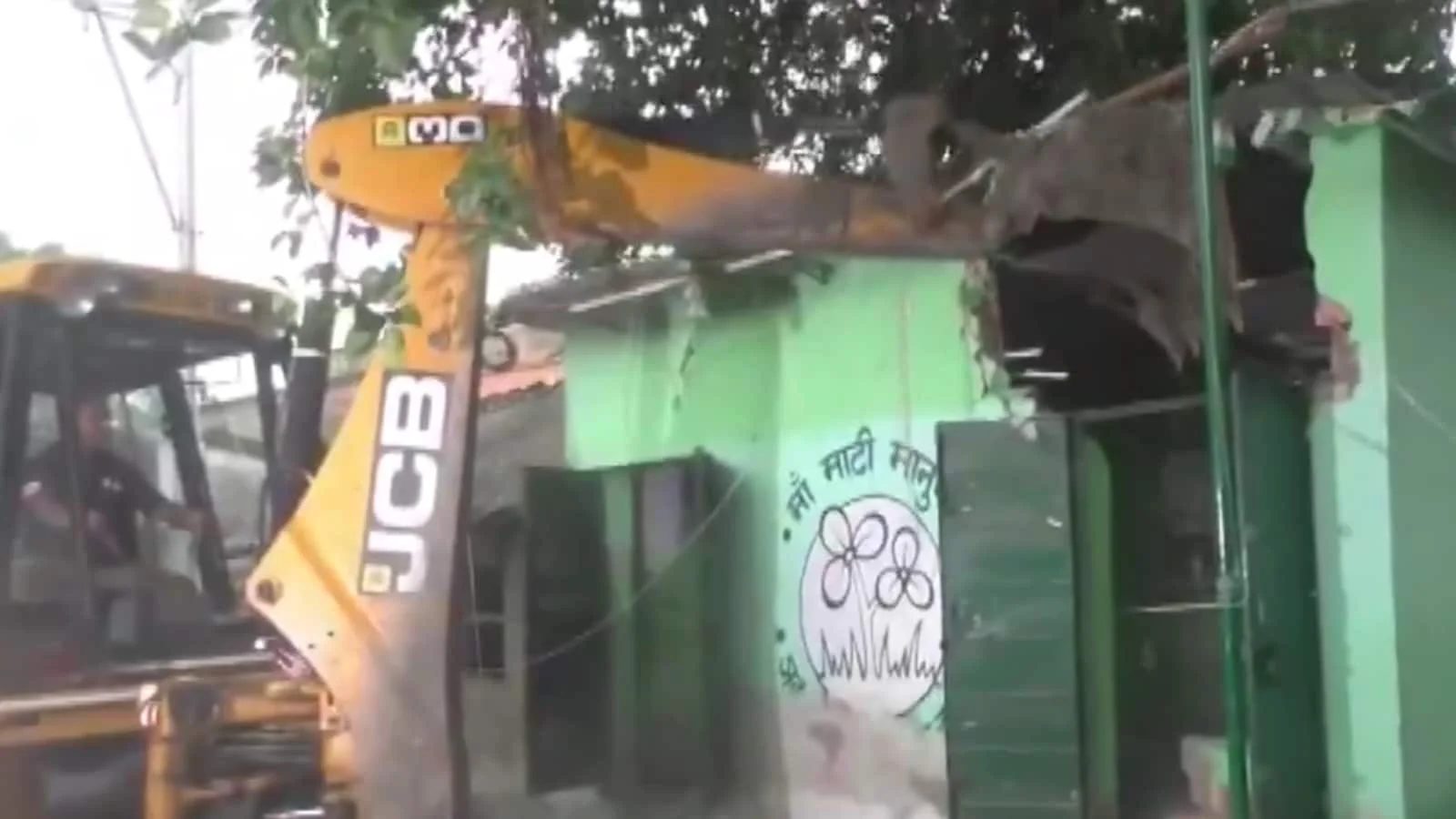
West Bengal Authorities Demolish TMC Office in Barrackpore Over Illegal Construction
Government administration teams in West Bengal demolished an unauthorized Trinamool Congress party office in Barrackpore on June 23, 2026. Officials executed the operation using heavy machinery after confirming the structure violated municipal building regulations, marks a continuing crackdown on public land encroachments.
Key Highlights
- Authorities used earthmovers to raze the illegal Trinamool Congress structure under official supervision.
- The operation follows a similar high-profile demolition of another ruling party office in Titagarh on May 30, 2026.
- Law enforcement and civic bodies have intensified state-wide enforcement actions against unauthorized commercial and political structures.
A structural setup belonging to the Trinamool Congress in the Barrackpore area of North 24 Parganas district was pulled down by civic administrators following formal complaints regarding its unlawful construction.
Social media platforms circulated video footage capturing the exact moment of the demolition. The digital recording documents an earthmover dismantling the concrete party outpost while administrative personnel actively managed the site operations. Local authorities confirmed the enforcement action aligned directly with an ongoing policy targeting undocumented urban developments.
BJP Steps Up Crackdown On Illegal Encroachments
This administrative measure occurred just weeks after a separate ruling party facility was leveled by a bulldozer in the Titagarh locality of North 24 Parganas on May 30, 2026. The BJP-led government in West Bengal has stepped up its crackdown on alleged illegal encroachments on public land, prompting municipal teams to clear multiple retail properties adjacent to that specific political hub during late May. Those particular setups, positioned inside Ward No. 12 under the jurisdiction of the Titagarh Municipality, were systematically flattened by heavy machinery while police teams and emergency fire services secured the perimeter.
Media updates indicated that the specific party hub was under the management of a regional political figure named Inam Khan. Law enforcement personnel placed Khan under arrest on the identical day the demolition took place. Government inspectors stated that the political workspace and neighboring commercial stalls served as bases for illicit regional activities. The removal formed a component of a much wider regulatory framework targeting public land usage across the state territories.
Earlier, on May 27, 2026, state departments initiated a massive clearance campaign outside the busy Howrah railway terminal. Municipal teams deployed bulldozers to strip away temporary vending stations and unapproved physical setups along the primary transit corridor linking the local Ganga ghat directly to the transit hub. The clearance initiative involved synchronized efforts from the Railway Protection Force, the Government Railway Police, senior railway administrators, and the Howrah City Police department, who placed a dense security cordon to preserve public order.
Preceding that event, on May 24, 2026, the Kolkata Municipal Corporation executed a widespread structural removal drive aimed at suspected unapproved building projects inside the Tiljala, Kasba, and Beleghata neighborhoods. Municipal supervisors, supported by large contingents of civil police units, dismantled multiple frameworks found to be constructed in direct contradiction to established city planning codes.
History of West Bengal Anti-Encroachment Drives
Public land management and illegal urban developments have long been focal points of administrative friction in West Bengal. Historically, civic bodies faced resistance when clearing unauthorized market stalls and political outposts due to local patron-client networks.
However, the summer of 2026 marked a tactical shift as multi-agency task forces, blending railway police, municipal corporations, and state law enforcement, began executing coordinated clean-up operations. This synchronized methodology aims to reclaim vital transport pathways like the Howrah transit corridors and regulate structural compliance within municipal jurisdictions across the North 24 Parganas region.
FAQs
Why was the TMC office in Barrackpore demolished?
The local administration demolished the structure because it was identified as an illegal construction built in violation of municipal public land regulations.
When did the Barrackpore demolition take place?
The enforcement operation and subsequent demolition of the party office occurred on June 23, 2026.
What other areas have been targeted in this West Bengal enforcement drive?
The anti-encroachment campaign has actively targeted unapproved structures in Titagarh, areas surrounding the Howrah railway station, and several Kolkata neighborhoods including Tiljala, Kasba, and Beleghata.
Who managed the political office that was demolished in Titagarh in May 2026?
The Titagarh facility was operated by a local political figure named Inam Khan, who was taken into custody by law enforcement on the same day as the structural removal.