India Space Economy to Reach 45 Billion Dollars by 2036 India’s space economy is projected to hit $45 billion within a decade, driven by aggressive reforms, surging biotech sectors, and historic employment-linked incentives. India space economy growth india-space-biotech-economy-growth India space economy, biotech sector, Gaganyaan mission, PM-VBRY, Union Minister Jitendra Singh, Narendra Modi science
India Space Economy to Reach 45 Billion Dollars by 2036 India’s space economy is projected to hit $45 billion within a decade, driven by aggressive reforms, surging biotech sectors, and historic employment-linked incentives. India space economy growth india-space-biotech-economy-growth India space economy, biotech sector, Gaganyaan mission, PM-VBRY, Union Minister Jitendra Singh, Narendra Modi science
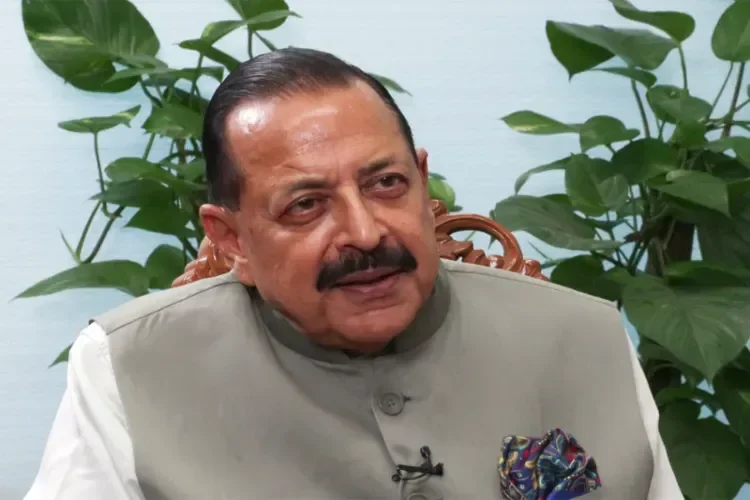
Union Minister Jitendra Singh announced that India’s space economy is projected to expand five-fold to reach approximately $45 billion within the next eight to ten years, alongside a monumental surge in the national biotechnology sector from $10 billion in 2014 to $193 billion today.
Key Highlights
- India’s space sector is forecast to grow five-fold from its current $9 billion valuation to $45 billion by 2036.
- The national biotechnology industry has experienced massive growth, escalating from $10 billion in 2014 to $193 billion in 2026.
- Prime Minister Narendra Modi disbursed Rs 2,400 crore under the PM-VBRY scheme, supporting 15 lakh new employment opportunities.
- The uncrewed Gaganyaan test flight featuring the humanoid robot Vyommitra is scheduled before the end of 2026, ahead of a manned 2027 mission.
Union Minister Jitendra Singh on Friday said India’s space economy is projected to grow five-fold to nearly USD 45 billion over the next eight to ten years, while the country’s biotechnology sector has expanded dramatically from USD 10 billion in 2014 to USD 193 billion at present.
During an interview, Singh emphasized the accelerated advancement of India’s space ecosystem, labeling it as a premier dynamic emerging industry.
He noted that the sector, formerly limited in scale, maintains a valuation of $9 billion but is positioned for substantial compounding. Current trajectories indicate the market will achieve $45 billion within the decade.
The minister credited targeted state policies and heightened private sector integration for the biotechnology industry’s rapid scaling. The market grew from $10 billion when the administration took office in 2014 to its current $193 billion valuation.
Singh stated the BioE3 framework explicitly links biotechnology with job generation, economic progress, and environmental conservation, establishing multi-sector operational pipelines.
Detailing the domestic human spaceflight roadmap, the minister confirmed the government targets a critical milestone under the Gaganyaan initiative next year.
He announced that a definitive uncrewed test using the humanoid robot Vyommitra will deploy before the conclusion of 2026. Following subsequent experimental launches, a final rehearsal will precede the inaugural crewed Indian astronaut launch in 2027.
Regarding national energy architecture, Singh affirmed that India’s pivot toward nuclear and sustainable sources reflects long-term strategic planning rather than sudden geopolitical friction in West Asia.
By 2047, the state intends to scale nuclear capacity to 100 gigawatts, supplying 10% to 11% of national electricity, while renewables will comprise 70% to 75% of the power mix.
The minister noted that alternative technologies, including marine wave energy, remain under active exploration to satisfy the national 2070 net-zero emissions mandate.
Stressing sovereign energy security, Singh declared that diminishing reliance on overseas fossil fuel imports remains an urgent macroeconomic priority, necessitating faster domestic clean tech adoption.
READ MORE:Yusuf Khan picks Mewati folk music over engineering for perpetuating legacy
These programmatic updates coincide with broader state efforts to reinforce strategic segments like space tech, biotechnology, and clean energy to secure long-term industrial modernization, innovation, and resource autonomy.
This matches domestic job initiatives, as Prime Minister Narendra Modi separately distributed Rs 2,400 crore in fiscal incentives under the Pradhan Mantri Viksit Bharat Rozgar Yojana (PM-VBRY). This injection has facilitated 15 lakh new jobs across the country.
The Prime Minister, returning from G-7 Summit engagements in France and Slovakia, remarked that the global community increasingly recognizes Indian talent. The PM-VBRY framework bridges the gap between industrial demands and corporate workforces, creating 70 lakh total jobs to date while expanding social security nets.
Furthermore, state infrastructure investments exceeding Rs 12 lakh crore and Rs 33 lakh crore in Mudra Yojana allocations continue to fuel self-employment. This economic base is mirrored in India’s technology ecosystem, where registered startups grew from 500 a decade ago to over 200,000 in 2026 across all districts.
Future Outlook
India’s long-term economic strategy relies on parallel advancements in high-technology manufacturing and sovereign resource security. By anchoring its job creation strategies to emerging technology sectors like the gig economy, drone infrastructure, and green energy, the state aims to insulate its workforce from global market shocks. The targeted expansion of the space economy to $45 billion by the mid-2030s and nuclear capacity to 100 gigawatts by 2047 are designed to establish India as a primary driver of global technological innovation.
FAQs
What is the projected value of India’s space economy?
India’s space economy is projected to grow five-fold from its current valuation of $9 billion to approximately $45 billion over the next eight to ten years.
When will the crewed Gaganyaan space mission launch?
Following an uncrewed test flight with the humanoid robot Vyommitra at the end of 2026 and subsequent rehearsal flights, India plans to launch its crewed Gaganyaan mission in 2027.
How much has India’s biotechnology sector grown since 2014?
The biotechnology sector has expanded from $10 billion in 2014 to a valuation of $193 billion in 2026, driven by the BioE3 policy.
What are India’s long-term nuclear and renewable energy targets?
India aims to achieve 100 gigawatts of nuclear capacity by 2047, providing 10% to 11% of its electricity needs, while renewable energy sources are projected to fulfill 70% to 75% of the total energy mix.