Revanth Reddy Slams PM Modi on Women’s Bill
Telangana Chief Minister A Revanth Reddy attacked Prime Minister Narendra Modi over the implementation of women’s legislative quotas during a public forum in Bengaluru on June 06, 2026. Reddy detailed his administration’s massive economic decentralization strategy alongside aggressive public sector job recruitment initiatives designed to transform the state economy.
Key Highlights
- Telangana Chief Minister criticized the federal linking of women’s seat reservations to Lok Sabha delimitation.
- The state unveiled a three-tier economic roadmap targeting a $3 trillion GDP valuation by the year 2047.
- The administration successfully completed 67,760 public sector job appointments over the preceding 15 months.
- A external debt restructuring operation totaling ₹2 lakh crore is underway to lower state interest burdens.
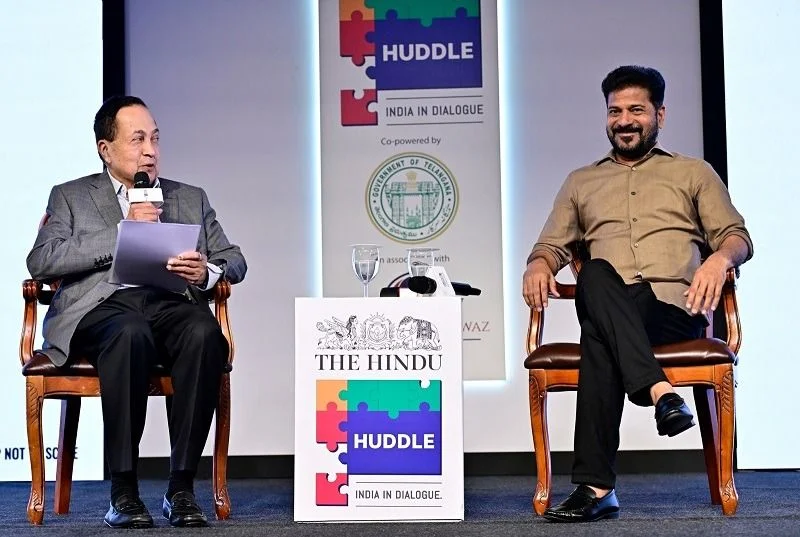
Chief Minister Revanth Reddy attends “The Hindu Huddle” session titled “By, For, and Of the People: Good Governance for Telangana”
Telangana Chief Minister A Revanth Reddy claimed that Prime Minister Narendra Modi is utilizing tactical political maneuvers regarding legislative quotas for women. The Indian National Congress explicitly rejects coupling female political representation with the expansion of parliamentary constituencies. If federal authorities increase lower house allocations as planned, Kerala will expand from 20 to 30 seats while Uttar Pradesh grows from 80 to 120 seats. This shifting distribution presents an unfair arrangement that state leadership intends to resist.
On WOMEN RESERVATION AND DISCRIMINATION AGAINST SOUTHERN STATES: The federal opposition demands that the central government halt financial penalties against highly productive southern states. These territories generate vastly more central revenue than they receive back in budgetary distributions. Top national offices, including the President, Prime Minister, and Union Home Minister, remain staffed exclusively by leaders from northern territories. With the 2027 Uttar Pradesh legislative elections approaching, the union government must demonstrate genuine legislative intent by enforcing the female quota framework within that region immediately. The Chief Minister requested federal administrators to cease widening the deep socioeconomic divisions separating northern and southern states.
The Congress party positions itself as the primary architect behind domestic female empowerment policies. Prior Congress administrations successfully installed female leaders as national Presidents, Lok Sabha Speakers, state Governors, and Chief Ministers. Former Prime Minister Rajiv Gandhi originally secured institutional representation for women inside local panchayat bodies. The organization subsequently passed the foundational legislative quota framework through the upper house under the guidance of Sonia Gandhi.
VISIT TO CHINA SOON : Regarding industrial development, the Chief Minister asserted that Gujarat does not naturally draw corporate capital, alleging that investments are being artificially steered there. A single political brand ambassador has promoted that region exclusively for the past 20 years. Telangana refuses to limit its economic competition to surrounding domestic provinces, aiming instead at international markets. The administration measures its progress against industrial powerhouses like China, Japan, South Korea, and Germany. The state operates under a strategic diversification framework known as “China+1.” Following an initial educational visit to China 15 years ago, the Chief Minister plans an upcoming official tour there to study modern industrial operations, mirroring a prior 10-day executive program completed at Harvard University.
BLUE COLLAR JOBS AND RECRUITMENT IN GOVERNMENT : Addressing employment generation, Chief Minister Reddy identified technical manual roles as viable alternatives to administrative positions. Modern automated intelligence systems have failed to replace specialized manual labor. Advanced software can optimize various corporate functions, but it cannot replicate the human elements of political leadership. Local youth must pivot toward these technical career alternatives while aggressively boosting their practical skillsets. Previous state administrators operated strictly with a ruling mindset, whereas current leadership views itself as public representatives focused on citizen service. The state is systematically filling 2 Lakh vacant public positions, having delivered 67,760 verified appointments within a 15-month window to mark the fastest hiring rate nationwide. New recruitment processes opened 2 weeks ago, with an additional cohort of 5,000 law enforcement openings scheduled for release shortly to assist active student applicants. The state thoroughly overhauled the official selection agency, known as the Telangana Public Service Commission. Under the previous administration led by KCR, an underqualified rural medical practitioner occupied a commission seat to evaluate advanced technical candidates. Current leadership questioned the validity of utilizing non-professional personnel to oversee high-level selections for specialized engineering, medical, and administrative cadres.
TELANGANA RISING 2047 : Detailing a comprehensive state growth blueprint targeting a $1 trillion economic output by 2034 and a $3 trillion evaluation by 2047, the Chief Minister outlined a structural division of the state into 3 distinct development zones. The territory enclosed by the 160-kilometer Outer Ring Road is designated as the Core Urban Region Economy. The secondary belt spanning the space between the primary ring road and the regional perimeter road is named the Peri-Urban Region Economy. All remaining geographies extending past the outer regional transit network are classified as the Rural Agricultural Region Economy. Following an international investment convention hosted on December 7, 8, and 9 of the previous calendar year, the administration published its foundational policy charter. Economic planning directs tertiary service industries into the urban core, concentrates heavy manufacturing inside the peri-urban belt, and anchors primary agricultural production within rural zones. The administration plans to transition the central urban core into a certified sustainable zone. Despite absorption of an annual fiscal deficit reaching ₹2,000 crore, the state implemented mandatory clean-energy transit protocols inside the urban core while eliminating local taxes on electric vehicles. Authorities are expanding regional rapid transit tracks and clearing illegal structural encroachments to revive natural urban lakes. The development strategy couples groundwater recharge infrastructure with manufacturing hubs, highlighted by the construction of a 30,000-acre industrial township designed to attract global enterprise capital. Because Telangana lacks direct maritime access, the Chief Minister is negotiating with federal authorities and neighboring leader Chandrababu Naidu to build a 12-lane freight corridor linking directly to the Machilipatnam deepwater port. The state aims to construct integrated logistics infrastructure across highway, rail, maritime, and aviation networks to sustain long-term economic momentum. The region leverages established institutions including the Indian School of Business, the International Institute of Information Technology, and NALSAR University to build human capital. As automation threatens administrative white-collar jobs, the state launched the Young India Skills University through a joint public-private structure. Corporate executive Anand Mahindra leads the institution as Chairman alongside Vice-Chairman Srini Raju. The administration invested ₹2,400 crore to convert traditional industrial training centers into advanced technology nodes. The Tata corporate group supplied 86% of the funding for this initiative to boost technical employment. The Chief Minister conducted multiple study tours across Germany, Japan, and South Korea to analyze how specialized technical labor models outpace administrative setups. Advanced technical personnel in those nations frequently out-earn conventional software engineers. Consequently, local centers now offer specialized language certification modules in German, Japanese, and Korean to facilitate international employment.
CENTRE’s INDIFFERENCE TOWARDS TELANGANA: The Chief Minister criticized the federal administration for withholding capital allocations and showing bias against state investment applications. Previous administrators relied on high-interest, short-term debt instruments carrying rates between 11% and 11.50%. Current financial teams are renegotiating these liabilities down to sustainable ranges between 7% and 8% while stretching payment timelines. The treasury is currently reorganizing a total debt portfolio valued at ₹2 lakh crore. Neither central nor provincial authorities are adequately resolving structural loopholes within the national consumption tax framework. The state secured former chief economic advisor Arvind Subramanian to optimize tax collection strategies. Over the past 7 to 8 years, monthly tax receipts stagnated below ₹3,500 crore, but strict compliance enforcement pushed monthly yields past ₹4,000 crore throughout the last 6 months. This corrective campaign generated ₹5,000 crore in supplemental revenue over a half-year period through leakage elimination without increasing baseline tax percentages. The state leadership vows to contest federal resource discrimination, alleging that central offices frequently divert prospective corporate investors away from local sites toward industrial hubs in Gujarat.
FARMERS – LOAN WAIVER : Chief Minister Reddy detailed targeted economic relief measures enacted to stabilize the agricultural sector over the last 2 years. The state previously registered high agricultural mortality statistics trailing only Maharashtra due to systemic rural debt burdens. The current government cleared ₹20,616 crore in outstanding agricultural credit for 25,035 rural households to complete the largest state-backed debt relief operation nationwide. Official documentation from the National Crime Records Bureau verified that Telangana achieved a zero-suicide metric among its farming demographic during the 2024-25 fiscal cycle. Agrarian communities have achieved financial stability. While cultivators historically struggled to obtain baseline commodity prices, current policies guarantee minimum returns alongside a supplemental premium of ₹500 per quintal for harvested paddy. The state step fills a vacuum left by federal agencies that limit their involvement to price announcements without managing physical inventories. State agencies directly purchase regional paddy and maize yields. Under the regional agricultural assistance program, the state distributes ₹12,000 per acre to fund seasonal fertilizer and operational costs.
WOMEN EMPOWERMENT : The Chief Minister stated that financial backing reaches 6.7 million female participants enrolled across regional self-help networks. These groups secured ₹60,000 crore in interest-free credit lines, with the state treasury covering all associated borrowing fees. Female cooperative networks purchased a fleet of 1,000 transit buses and expanded operations into the sustainable energy market. The state further assigned commercial fuel stations and solar generation facilities to these collectives. Corporate groups within these networks manage culinary operations inside public offices and hold service contracts to upgrade infrastructure across public schools.
REFORMS IN EDUCATION : To enhance public educational standards, the Chief Minister announced the integration of early childhood schooling into state infrastructure. The territory operates 27,000 public schools educating 1.8 million pupils alongside 12,000 private academies housing 3.5 million students. Public instructional staff possess advanced postgraduate and doctoral qualifications, yet historical enrollments lagged due to a lack of preparatory early education facilities. The government now provides institutional student transit, daily breakfast, and mid-day nutritional programs while sending select teaching cohorts on international training tours to Singapore.
BUREAUCRACY : Chief Minister Reddy maintained that practical logic remains the core requirement for effective public administration. Resolving governance challenges requires clear foundational comprehension followed by swift decision-making. If leadership dictates personal biases early, administrative staff alter data to match executive expectations. A 17-year tenure spent within legislative opposition ranks from 2006 to 2023 provided deep experience in public advocacy, ensuring current administrative staff cannot misinform executive leadership.
HYDRAA- LAKES PROTECTION : The administration is enforcing a targeted environmental program to clear illegal structural encroachments from regional lake systems and natural drainage basins.
Future Outlook
Telangana’s economic restructuring maps out a transition toward a highly structured, decentralized landscape by 2047. By dividing the state into the CURE, PURE, and RARE zones, the government plans to systematically isolate economic functions to maximize efficiency. The shift from high-interest short-term debt to long-term liabilities is expected to free up state capital for massive infrastructure investments, such as the proposed 12-lane highway to Machilipatnam port. Partnering with global giants like the Tata Group and educational chairs led by industrial figures like Anand Mahindra indicates a long-term economic pivot toward high-value blue-collar jobs to counter white-collar artificial intelligence displacements.
FAQs
What are the three economic zones planned for Telangana?
The state is divided into three functional development zones based on distance from the core city. The Core Urban Region Economy (CURE) focuses on services and net-zero emissions within the Outer Ring Road. The Peri-Urban Region Economy (PURE) covers the area between the ring roads and focuses on manufacturing. The Rural Agricultural Region Economy (RARE) extends beyond the Regional Ring Road and prioritizes agricultural development.
How much debt is the Telangana government currently restructuring?
The Telangana state government is actively restructuring ₹2 lakh crore of inherited debt. The financial strategy involves converting expensive short-term loans carrying high interest rates of 11% to 11.50% into sustainable, long-term credit instruments with lower interest rates ranging between 7% and 8%.
What is the purpose of the Young India Skills University?
The Young India Skills University is a public-private partnership established to address white-collar job losses caused by artificial intelligence. Led by corporate leaders Anand Mahindra and Srini Raju, the institution focuses on advanced technical training and skilling youth for high-paying blue-collar positions both domestically and internationally.