India Passport Seva 2.0 Enhances Global Mobility
External Affairs Minister S Jaishankar announced that the Passport Seva Programme Version 2.0 has advanced international mobility for India, aligning with the “Viksit Bharat” national vision. He described the passport as a critical driver for economic advancement, cross-border trade, and national pride, ensuring simpler access for all citizens.
Key Highlights
- The upgraded Passport Seva Programme Version 2.0 aims to streamline international travel and boost economic opportunities.
- Indian passports have gained greater international trust, reflecting the nation’s “Vishwa Bandhu” diplomatic approach.
- The domestic network of passport service centers expanded from 77 hubs in 2014 to 545 operational centers by 2026.
- Enhanced passport delivery systems are designed to prepare and empower a highly skilled domestic workforce for global employment.
EAM S Jaishankar stated that the Passport Seva Programme 2.0 has redefined global mobility for Viksit Bharat. He emphasized that a passport is a key tool for economic mobility and national identity, and its issuance should be a simple right.
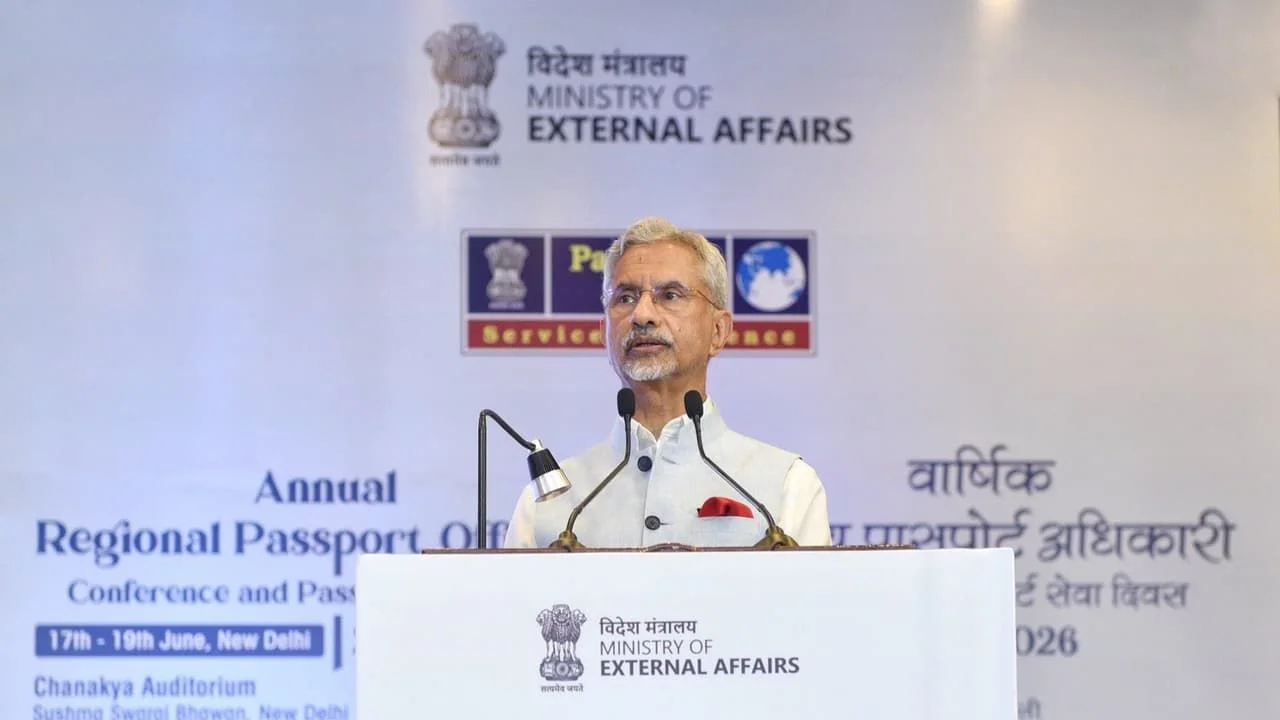
External Affairs Minister S Jaishankar confirmed on Friday that the Passport Seva Programme Version 2.0 has enhanced international mobility, supporting the broader objective of establishing a developed nation. He emphasized that these credentials represent far more than standard documentation, serving as vital mechanisms for financial advancement, global commerce, and civic identity.
Speaking at the Annual Regional Passport Officers’ Conference hosted in New Delhi, Jaishankar remarked that the upgraded initiative has fundamentally transformed cross-border movement. He noted that the booklet functions as a powerful instrument to unlock commercial expansion and secure international recognition.
Indian Passport Gaining Respect Globally
Jaishankar remarked that international markets increasingly prize Indian professional talent, pointing to positive foreign reception observed during his recent diplomatic missions to European nations, including France, Slovakia, and the G7 summit. He stated that global trust in the national travel document has risen as foreign policy positions the country as a universal ally, or “Vishwa Bandhu,” noting that securing this document must remain an uncomplicated entitlement.
The minister noted that his return from accompanying the Prime Minister across European diplomatic forums highlighted a consistent appreciation for domestic professionals. He observed that international demand for this skilled talent pool is expanding rapidly across multiple sectors.
As state diplomacy cements the nation’s international standing, the passport commands elevated authority and assurance on the world stage. Jaishankar reiterated that the department must ensure the application pipeline operates as a transparent citizen entitlement rather than an administrative obstacle.
Expansion of Passport Seva Kendras
Jaishankar detailed the widespread geographical growth of the passport infrastructure, which has optimized citizen access through an expanded network of specialized centers. The operational footprint climbed from 77 sites in 2014 to 545 active locations today, successfully penetrating isolated territories through a joint initiative between the Ministry of External Affairs and the Department of Posts.
In a digital statement published on X, the minister expressed satisfaction regarding his address at the New Delhi conference. He highlighted that expanding to 545 centers from 77 over a 12-year period demonstrates a successful collaborative model between the diplomatic ministry and postal services to reach distant communities.
Improving Service Delivery for a Global Workforce
The minister stated that discussions during the conventional assembly focused heavily on optimizing administrative efficiency by evaluating systematic citizen input. He noted that modernizing issuance frameworks serves as a fundamental catalyst for establishing a highly competitive workforce capable of operating within an integrated international market.
The organizational reviews focused entirely on upgrading citizen experiences by integrating public evaluations. The administrative objective centers on equipping a modern labor force for international markets, utilizing swift document processing as a primary economic facilitator while acknowledging outstanding regional departmental achievements.
Future Outlook
The modernization under Passport Seva Programme 2.0 signals a shift toward fully digital, secure, and biometric-backed consular services. As India positions its workforce to meet international labor shortages, future phases are expected to integrate advanced data analytics to further reduce verification times. The sustained partnership with regional postal networks will likely expand to digital post offices, ensuring that passport procurement scales efficiently alongside the country’s economic influence through 2026 and beyond.
FAQs
What is the primary goal of the Passport Seva Programme 2.0?
The initiative aims to modernize passport issuance, improve digital security, and streamline international mobility to support economic growth and help build a highly skilled workforce for the global market.
How many Passport Seva Kendras are operational in India as of 2026?
The network has expanded significantly from 77 stations in 2014 to 545 active operational centers today, successfully extending reach to remote areas across the nation.
Which government departments collaborate to run these passport centers?
The passport delivery framework operates as a highly successful cooperative partnership between the Ministry of External Affairs and the Department of Posts.