LG Manoj Sinha Addresses Interfaith Dialogue in Srinagar
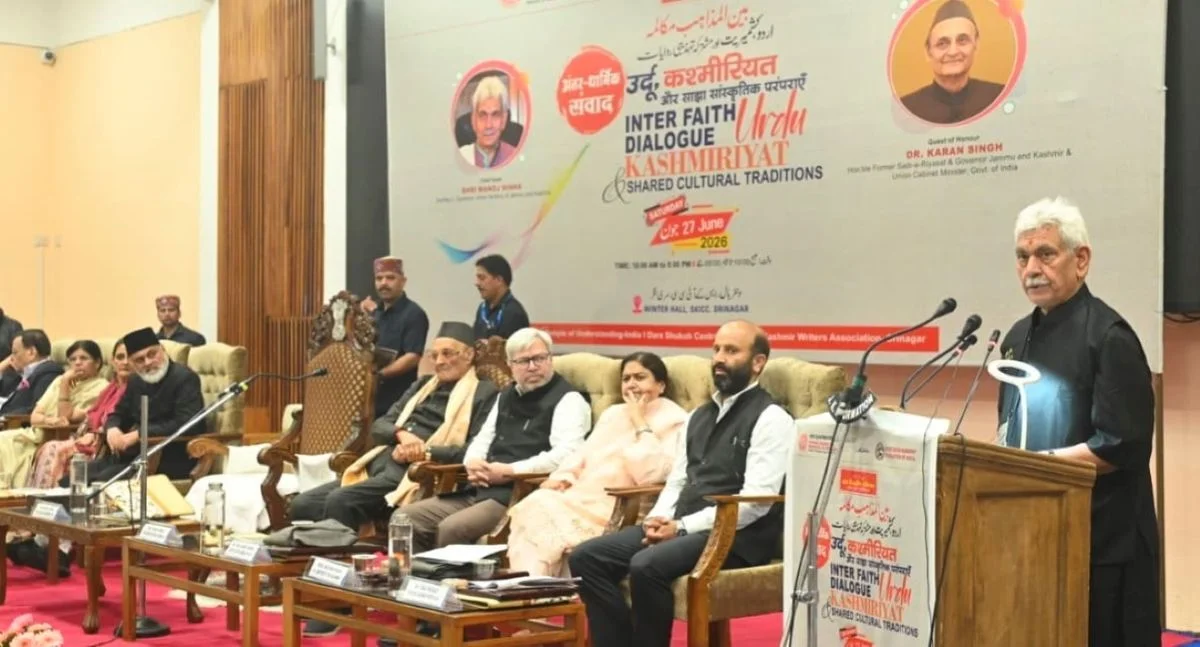
Jammu and Kashmir Lieutenant Governor Manoj Sinha stated that Hinduism embraces diversity and never enforced its beliefs on others during an interfaith conference in Srinagar on June 27, 2026. Sinha emphasized that ancient India provided multiple global religions the necessary freedom to thrive.
Key Highlights
- Lieutenant Governor Manoj Sinha addressed an interfaith forum in Srinagar focused on cultural diversity and harmony.
- He stated that Sanatana Dharma never enforced itself and allowed multiple global faiths to flourish in ancient India.
- The event was jointly organized by the National Council for Promotion of Urdu Language and the Inter-Faith Harmony Foundation of India.
- Notable dignitaries, including former Union Minister Karan Singh and academic leaders, attended the convention.
Srinagar, Jun 27: Lieutenant Governor Manoj Sinha on Saturday asserted that Hinduism welcomed pluralism and abstained from forced integration, noting that early India provided Christianity, Islam, Judaism, and Zoroastrianism the liberty to expand.
Speaking at the ‘Interfaith Dialogue’ structured by the National Council for Promotion of Urdu Language alongside the Inter-Faith Harmony Foundation of India, LG Sinha remarked, “Global citizens acknowledge that Hinduism – Sanatana Dharma, the oldest enduring faith worldwide, never dictated terms. Instead, it welcomed divergence and mutual existence. Early India established a bedrock of honor, allowing Christianity, Islam, Judaism, and Zoroastrianism the space to thrive.”
He emphasized the historical legacy of India as a historic civilization grounded in shared reverence, where distinct belief systems live together, prosper, and educate global communities on peaceful coexistence.
“In a global ecosystem confronting disputes and bigotry, the foundational essence of Sanatana Dharma and Indian philosophy offers a path forward. Current global dynamics show divisions across faith, dialect, and ancestry, yet Indian ideologies possess the distinct capability to unite these factions,” the LG stated.
He mentioned that India represents a vibrant concept asserting that human society must coexist as a unified collective.
LG Sinha expressed that the contemporary generation must advance this philosophy, demonstrating to global observers that harmony remains achievable through shared appreciation.
“Within academic, theological, and heritage terms, I identify this as ‘Indianness’- ‘Bhartiyata’, the cultural framework that presented the global landscape with equal respect for all faiths, the quest for reality, oneness amid variance, the concept of the earth as a singular household (Vasudhaiva Kutumbakam), and a collective heritage awareness. Our historic scriptures, the Vedas and Upanishads, representing an information lineage extending past 5000 years, have continuously advocated for integrated living. They instructed humankind that adherents of diverse doctrines must live together while honoring alternative systems of thought. That remains the permanent truth,” he observed. “Millennia ago, our visionaries declared that ultimate reality is not restricted to one trajectory. Reality is boundless, and multiple courses converge upon it. Consequently, India has continuously perceived variation not as a fracture but as a benefit. This perspective finds validation in the premier region of India, Jammu and Kashmir, where communal synchronization and cohabitation have formatted daily existence for generations.”
The LG stated that individuals frequently utilize the term ‘Kashmiriyat’, which fundamentally originates from the ideology of ‘Indianness’ – ‘Bhartiyata’ and represents the core tenet India has demonstrated globally since the Vedic timeline, showing equal appreciation across all theological paths, heritages, and customs.
He noted that when Islam arrived in India during the 12th and 13th centuries, bringing numerous Sufi practitioners and Islamic academics, they encountered a distinct Indian heritage centered around affection, theological depth, empathy, and egalitarian principles.
“Sufi practitioners drew inspiration from the concepts of the Vedas, Upanishads, Buddhism, and Jainism, acquiring the principles of shared existence directly from Indian texts. Additionally, multiple compilations of Sanskrit expertise underwent translation into Arabic. Our predecessors invoked, “Sarve Bhavantu Sukhinaḥ, Sarve Santu Niramayaḥ” – wishing joy and health for everyone. This invocation targets no singular faith or division but seeks the wellness of total humanity. I assert this defines the true character of India,” LG Sinha uttered.
He declared that India and its historic tenets have never instructed individuals to discard their personal doctrines.
“India has consistently advised communities to preserve their original faith, retain their custom heritages, and reside alongside us in synchronization. This highlights the unique identity of India. This marks the distinction of the Indian theological timeline,” the LG stated.
Former Union Minister Karan Singh; University of Kashmir Vice Chancellor Prof Nilofer Khan; Inter-Faith Harmony Foundation of India President Khwaja Iftikhar Ahmed; National Council for Promotion of Urdu Language Director Muhammad Shams Equbal; Dara Shikoh Centre Founder Director Jyotsna Singh; Inter Faith Harmony Foundation of India Operations Director Nasreen Shama; Kashmir Writers Association President Fida Firdous; National Coordinator Navaid ul Islam Khan; SSP Srinagar G V Sundeep Chakravarthy; Deputy Commissioner Srinagar Akshay Labroo; along with administrative personnel, notable residents, and academic figures participated in the event.
History of Indian Pluralism and Sufism
The historical framework of Indian philosophical thought dates back over 5000 years to the composition of the Vedas and Upanishads, which introduced core concepts like Vasudhaiva Kutumbakam (the world is one family). This spiritual foundation facilitated the peaceful integration of global religions arriving on the subcontinent. By the 12th and 13th centuries, the advent of Sufism created a unique synthesis, as Islamic scholars integrated local Sanskrit knowledge, Buddhist principles, and Upanishadic philosophy into their practices, reinforcing the regional culture of coexistence known in Jammu and Kashmir as Kashmiriyat.
FAQs
What event did Jammu and Kashmir LG Manoj Sinha address?
Lieutenant Governor Manoj Sinha addressed the ‘Interfaith Dialogue’ conference in Srinagar, which focused on religious harmony, diversity, and the historical foundations of Indian philosophy.
Which organizations arranged the interfaith conference in Srinagar?
The convention was jointly organized by the National Council for Promotion of Urdu Language and the Inter-Faith Harmony Foundation of India.
Who were the notable attendees at the interfaith dialogue?
The event was attended by former Union Minister Karan Singh, University of Kashmir Vice Chancellor Prof Nilofer Khan, Inter-Faith Harmony Foundation of India President Khwaja Iftikhar Ahmed, along with senior administrative and police officials from Srinagar.
How did LG Manoj Sinha describe the relationship between Kashmiriyat and Bhartiyata?
LG Manoj Sinha explained that the regional concept of ‘Kashmiriyat’ directly originates from the broader philosophy of ‘Bhartiyata’ (Indianness), symbolizing equal respect for all traditions, heritages, and cultures.