Trump-Meloni Feud Escalates Over NATO and Iran War
US President Donald Trump has escalated his rhetorical dispute with Italian Prime Minister Giorgia Meloni, targeting Italy’s military cooperation. Trump accused Rome of exploiting American protection while refusing to support Washington’s strategic operations against Iran’s nuclear program.
Key Highlights
- US President Donald Trump criticized Italy for denying military aircraft access to national runways during tensions with Iran.
- The diplomatic fallout deepened following claims by Trump that Prime Minister Giorgia Meloni pleaded for a photograph at the G7 summit.
- Italian Foreign Minister Antonio Tajani canceled an official trip to the United States and suspended a bilateral business forum.
- European allies, including Spain, expressed institutional solidarity with Italy amid deteriorating transatlantic relations.
The diplomatic conflict between US President Donald Trump and Italian Prime Minister Giorgia Meloni intensified significantly. Trump alleged that Italy reaps extensive financial benefits from Washington while actively withholding geopolitical solidarity against Tehran’s nuclear ambitions.
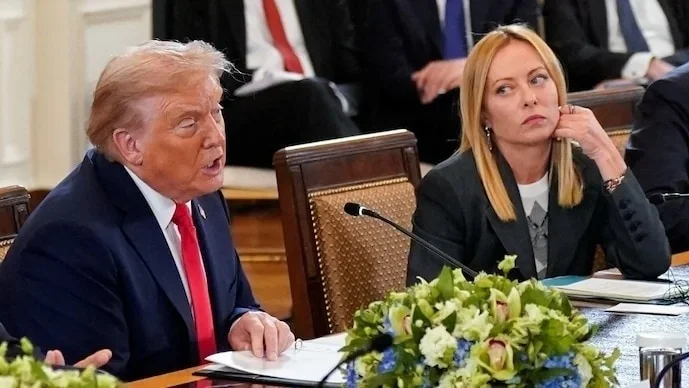
This rhetorical offensive occurred days after a sharp public dispute following the G7 Summit in France. Trump asserted that Meloni consistently sought his attention and requested images with him. Meloni dismissed the narrative, characterizing it as entirely fabricated.
In a social media statement published on Monday, Trump broadened his grievances beyond the Italian prime minister. He criticized Italy’s defense contributions to NATO, stating that American allies fail to back Washington during critical security crises.
Trump stated that after investing trillions of dollars into NATO and Italy, the European nation refused to engage against the Iranian nuclear threat. He emphasized that Washington has defended allies for decades without receiving reciprocal support when tested.
TRUMP TURNS FIRE ON NATO ALLIES
The public reprimand underscores long-standing frustrations expressed by Trump regarding NATO member states. He has frequently accused European nations of over-relying on American defense capabilities while underfunding their own military infrastructure.
During recent weeks, Trump maintained that European partners failed to back Washington’s maximum pressure campaign against Iran’s nuclear infrastructure. He condemned governments that blocked direct tactical or logistical support during the Middle Eastern military standoff.
The latest executive statements indicate that the White House now categorizes Italy among non-compliant alliance members.
Previously, Trump accused Meloni of denying American military forces operational access to domestic runways and landing strips during the confrontation with Iran.
Trump noted that Meloni restricted the usage of Italian airfield infrastructure, causing major logistical complications. He contrasted this decision with the hundreds of billions of dollars Washington spends annually to protect Italy and other alliance partners.
TRUMP AND MELONI’S G7 FALLOUT
The personal rift commenced after Trump claimed Meloni repeatedly requested photographs with him during the G7 summit in Evian-les-Bains, France.
Trump asserted that the Italian prime minister requested a picture with him multiple times during the diplomatic meetings.
He further claimed that Meloni faces diminishing domestic approval ratings due to her geopolitical divergence from the United States regarding Iran.
Trump argued that her declining popularity stems from turning down American requests to assist in preventing Iran from acquiring or engineering a nuclear weapon.
The remarks drew immediate condemnation from government officials in Rome.
MELONI HITS BACK
Meloni is astonished and defiant in the wake of the accusations, dismissing Trump’s assertions as baseless fabrications. She questioned why the US president would attack traditional allies and stated that her popularity remains an internal Italian matter.
Meloni noted that the statements are entirely manufactured, expressing astonishment at the behavior of the United States president. She observed that this does not represent the first instance of such conduct toward international partners.
Following the latest digital broadside, Meloni issued a follow-up defense, denying that her political standing is contingent on Washington’s endorsement.
Meloni described the unprovoked verbal attacks as senseless, stating that being associated with Trump has not enhanced her domestic standing.
She emphasized that her political viability rests entirely on her mandate to protect Italy’s sovereign national interests.
The public fracture coincides with sensitive diplomatic talks between Washington and Tehran in Switzerland under the Islamabad Memorandum of Understanding. Trump demands that Iran halt Hezbollah operations, reopen the Strait of Hormuz, and terminate its atomic program.
Concurrently, the White House continues to pressure Western allies to align with unilateral American security policies.
Italian officials support Meloni across the political spectrum, including Head of State Sergio Mattarella. Foreign Minister Antonio Tajani canceled his weekend visit to the United States, labeling Trump’s statements offensive and halting a Miami business forum.
Transport Minister Matteo Salvini stated that an assault on the prime minister constitutes an attack on the entire nation. Justice Minister Carlo Nordio noted that the remarks damage bilateral ties, referencing the historical sacrifices of American soldiers in World War II.
Defense Minister Guido Crosetto added that Meloni would never solicit photographs under any circumstances.
A ‘fantastic’ friendship frays between the two leaders, who previously aligned on border security and conservative values. Meloni visited Mar-a-Lago before Trump’s 2025 inauguration, where Trump praised her leadership.
However, divisions deepened over Ukraine and Trump’s prior threats to acquire Greenland by force. Spain’s Prime Minister Pedro Sánchez extended formal solidarity to Meloni during a European Council session, calling the attacks improper.
History of US-Italy Security Cooperation
The modern security alliance between the United States and Italy was established in 1949 when Rome became a founding member of NATO. Throughout the Cold War, Italy served as a critical strategic hub for American naval and air operations in the Mediterranean theater. The country hosts major US military installations, including the Naval Support Activity Naples and Sigonella Air Base.
Bilateral relations faced periodic strains during the 2003 Iraq invasion and subsequent Middle Eastern interventions due to differing public sentiment in Europe. The current dispute over Iranian airspace rights represents a significant shift, as Italy historically sought diplomatic balancing acts in the Persian Gulf to protect its energy supply lines.
FAQs
Why is Donald Trump criticizing Giorgia Meloni?
Donald Trump criticized Giorgia Meloni over Italy’s refusal to grant the US military access to Italian airfields and landing strips for operations related to the conflict with Iran. The dispute is also fueled by personal disagreements regarding interactions at the G7 summit.
What was the response from the Italian government?
Italian Prime Minister Giorgia Meloni rejected the claims as entirely fabricated. Foreign Minister Antonio Tajani canceled an official trip to the United States and suspended a major bilateral business forum in Miami to protest the statements.
Where did the initial G7 dispute take place?
The initial interactions occurred during the G7 summit held in Evian-les-Bains, France, where media outlets filmed both leaders interacting closely before Trump claimed Meloni begged for a photo opportunity.
Which other international leaders have commented on the situation?
Spanish Prime Minister Pedro Sánchez expressed solidarity with Giorgia Meloni during a European Council meeting, stating that the political and personal attacks against her were unwarranted.
What are the core US demands regarding Iran under the Islamabad Memorandum of Understanding?
The United States is demanding that Iran completely abandon its nuclear weapons ambitions, halt the regional activities of Hezbollah in Lebanon, and immediately reopen the Strait of Hormuz to international shipping.