Judge Rebukes DOJ Over Unsigned Complaint Against Ex-FBI Officials
A federal magistrate judge in Washington struck an unsigned criminal complaint filed overnight by Justice Department prosecutors on 27 October 2026, rejecting their attempt to add obstruction allegations against former FBI officials Nikki Floris and Bradley Benavides without first obtaining judicial approval.
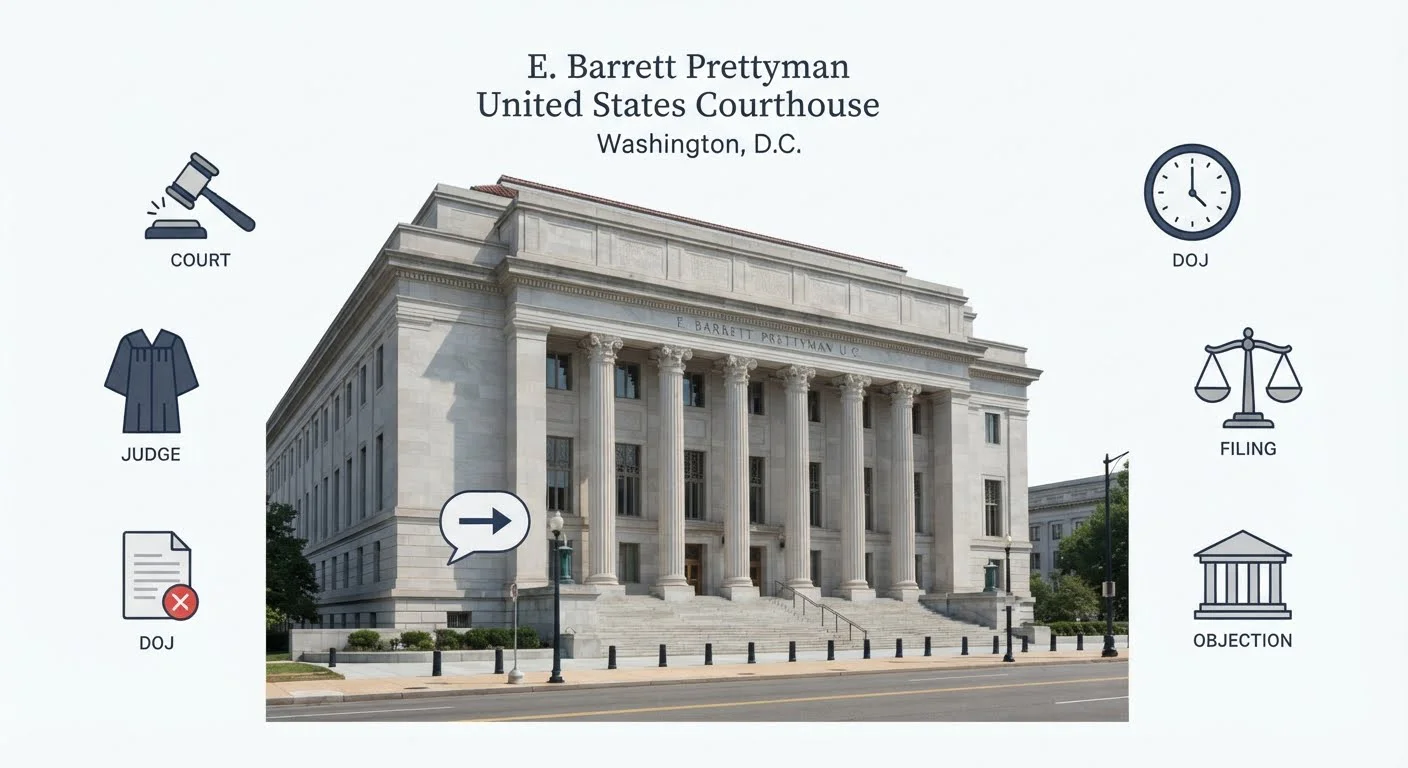
U.S. Magistrate Judge Zia M. Faruqui criticised the filing during a preliminary hearing in the U.S.
District Court for the District of Columbia. According to Fox News, the judge refused to recognise the amended complaint as a valid charging document because prosecutors had not obtained the required determination of probable cause.
Key Takeaways
- Original case remains: The court’s rejection of the amended complaint did not dismiss the existing false-statement allegations.
- Changed descriptions: Prosecutors revised language describing the defendants’ involvement in investigations concerning Hunter Biden.
- Judicial scrutiny: The preliminary hearing proceeded on the original complaint after the amended filing was struck.
- Defence challenge: Lawyers for Floris questioned the prosecution’s methods and argued that the overnight filing undermined procedural safeguards.
Judge Rejects Overnight Filing Without Approval
The Justice Department filed the amended complaint on the public docket hours before a scheduled preliminary hearing. The document lacked a judge’s signature and the required judicial determination of probable cause.
The proposed filing sought to introduce felony obstruction allegations against Floris and Benavides, who were already accused of making false statements to Congress about their involvement in FBI investigations concerning Hunter Biden, the son of former President Joe Biden.
Faruqui challenged the government’s decision to place the allegations on the public docket without securing judicial approval. “It is not our court’s practice, and I think it is appropriately not our practice, that unsigned complaints are filed on the docket,” he said, according to the Associated Press.
The judge said the government’s approach was inappropriate because it publicly introduced allegations before a magistrate had determined whether probable cause supported them.
Faruqui also questioned why prosecutors had departed from the district court’s established charging practices in this particular case. The complaint had been submitted shortly before the government was due to defend its existing allegations at a hearing where the evidentiary basis for the charges could be challenged.
According to Fox News, Faruqui told prosecutors that an amended complaint required a judicial finding of probable cause, rather than the submission of paperwork overnight with the expectation that the court would subsequently approve it.
Prosecutor Questioned Over Unusual Procedure
Assistant U.S. Attorney John Borchert, representing the prosecution, acknowledged during the hearing that he had not previously filed additional criminal charges against a defendant without first obtaining judicial review, according to Fox News.
The admission prompted further questions from Faruqui about why prosecutors had chosen a procedure that differed from the court’s usual approach.
“We are not afraid of a probable cause finding,” Borchert told the court, according to ABC News. His response followed Faruqui’s suggestion that the government’s filing created the appearance of avoiding judicial scrutiny.
The exchange focused attention on the prosecution’s charging procedure, rather than on whether the underlying allegations against the former officials could ultimately be proven.
Faruqui rejected the proposed document, leaving prosecutors unable to rely on the attempted amendment as an authorised basis for the additional charges.
The ruling addressed the manner in which the government sought to expand the prosecution. It was not a judicial determination that the defendants had committed or had not committed the offences alleged against them.
Revised Complaint Softens Earlier Allegations
The amended document also contained important changes to the language prosecutors used to describe the defendants’ alleged conduct.
According to Fox News, the revised complaint said Floris and Benavides were “involved in” the FBI Foreign Influence Task Force’s work concerning Hunter Biden. The original complaint had described them as being at the “center” of those activities.
Another revision concerned Floris’s participation in discussions about the investigations. The original complaint described her as having taken part in “scores of conversations”.
The amended document reduced that description to “conversations”, removing the suggestion of a particular volume of discussions.
Floris’s lawyers argued that the softened descriptions undermined the factual basis of the original complaint. The revisions did not establish whether either defendant had made false statements, but they gave the defence grounds to question how prosecutors had characterised the evidence.
The proposed obstruction charge introduced a separate allegation involving interference with a congressional proceeding, expanding the legal issues beyond the accuracy of the defendants’ earlier statements.
That proposed expansion mattered to the defence because prosecutors were attempting to introduce additional criminal liability while changing descriptions contained in the document underpinning the existing case.
Original False-Statement Case Remains Before Court
The underlying prosecution concerns testimony given to Congress in 2023, when lawmakers examined the FBI’s knowledge of and involvement in investigations connected to Hunter Biden.
Floris previously served as deputy assistant director of the FBI’s Counterintelligence Division. Benavides was a senior counterintelligence section chief.
Their former responsibilities were relevant to congressional questions concerning the bureau’s handling of the investigations.
The Justice Department alleges that the officials misrepresented their knowledge of, or participation in, that work when answering questions from lawmakers.
Both defendants were arrested the previous week after prosecutors brought the original false-statement allegations, according to Fox News.
The government’s claims remain unproven. The hearing concerned whether prosecutors had established sufficient grounds for the case to proceed, not a trial verdict determining criminal responsibility.
The allegations involving Hunter Biden formed the background to the disputed congressional testimony. The defendants were not charged with offences committed by Hunter Biden himself, but with allegedly providing false accounts of their own involvement in related investigative work.
Defence Lawyers Challenge Prosecution’s Conduct
Lawyers Mary Dohrmann and Margaret Donovan, representing Floris, challenged the government’s overnight filing and questioned its handling of the criminal allegations.
The defence argued that prosecutors had taken an improper shortcut by placing additional accusations on the public docket shortly before the scheduled hearing.
Floris’s lawyers accused prosecutors of trying to delay their client’s opportunity to contest the allegations. In a statement reported by CBS News, the legal team said it had never encountered such a filing during its collective years of Justice Department service.
The lawyers characterised the additional charges as an attempt to litigate the case through publicity rather than courtroom proceedings.
Dohrmann also questioned whether the government’s conduct resulted from incompetence, recklessness or cruelty, according to the courtroom reporting described in the case.
The defence’s criticism concerned both the decision to introduce new allegations and the timing of that decision, when the government was already facing judicial examination of the original complaint.
These arguments represented the lawyers’ interpretation of the prosecution’s conduct. Faruqui’s procedural ruling did not establish that prosecutors had deliberately acted for political purposes.
The defence nevertheless treated the filing as significant because the government had publicly presented a more serious accusation without obtaining the approval required for the charging document.
Why the Charging Method Matters
Faruqui also questioned why prosecutors used a criminal complaint for allegations involving congressional testimony from 2023. Such complaints are commonly associated with urgent circumstances, while prosecutors ordinarily seek grand jury indictments for non-urgent felony cases involving past conduct.
The distinction was particularly relevant because prosecutors were pursuing allegations based on events that had occurred several years earlier, rather than seeking immediate court authorisation to respond to an unfolding threat.
The judge’s questions placed the government’s procedural decisions under scrutiny independently of the substance of the charges.
In this case, the magistrate’s role included reviewing whether the evidence supported a finding of probable cause. Prosecutors’ decision to file a proposed superseding complaint directly on the public docket did not replace that requirement.
The court’s rejection also meant that the government could not use its unsigned amended complaint to expand the prosecution at that hearing.
Case Continues Under Original Allegations
Following the ruling, the preliminary hearing continued on the government’s original false-statement complaint, leaving prosecutors responsible for supporting the allegations already before the court.
The judge’s decision did not prevent the Justice Department from pursuing a properly authorised charging document or seeking an indictment through the grand jury process.
The prosecution must now support its remaining allegations through the appropriate judicial process. Under federal criminal procedure, prosecutors generally must secure an indictment within 30 days of an arrest unless an applicable exception or extension applies.
The government therefore faces separate questions about the evidentiary basis for the accusations and the procedural requirements governing any further charges.
For Floris and Benavides, the next decisive development will be whether prosecutors can advance the case through an authorised charging process while the defence continues challenging the allegations.