Medical Expenses Drive Millions Into Poverty In India
Escalating medical expenses are quietly reversing economic progress in India. High out-of-pocket healthcare costs force millions of vulnerable families into destitution, significantly expanding the national poverty gap.
Key Highlights
- Out-of-pocket health costs push 3.1 million additional Indian households into poverty.
- The national poverty rate climbs from 12.26% to 13.51% after medical expenditures.
- Poorest rural families spend 23.4% of total consumption on healthcare.
- Only 21% of Indian households possess any form of health insurance.
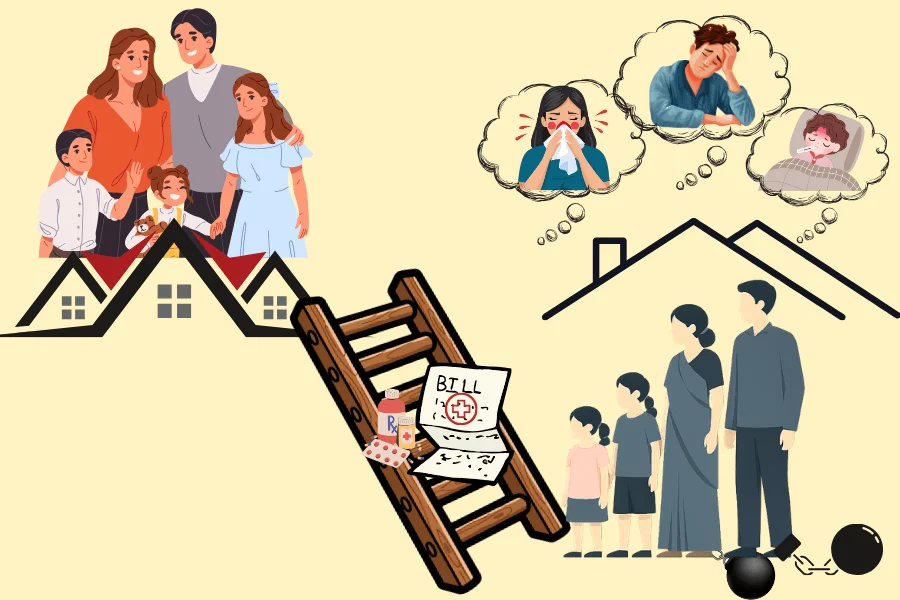
India’s poverty narrative is undergoing a quiet transformation driven by healthcare liabilities. When sickness hits a family, the economic fallout regularly outlasts the medical treatment. These heavy financial burdens fundamentally alter where a household stands on the economic ladder.
Statistical data from the National Sample Survey reveals that accounting for medical spending elevates the domestic poverty rate from 12.26% to 13.51%. This shift forces an extra 3.1 million families into systemic poverty.
This trend exposes structural vulnerabilities in India’s medical framework. In this environment, everyday citizens must fund their own treatments directly instead of relying on collective, system-level financial pools.
How Health Spending Translates into Poverty
This economic transition operates through a direct and damaging mechanism. Financial deprivation depends heavily on mandatory expenses alongside total household earnings. Medical bills differ from ordinary costs because they occur unexpectedly and cannot be postponed. When families use out-of-pocket payments for these emergencies, they lose vital resources during crises.
The financial damage alters both poverty entry rates and the depth of destitution. Factoring in medical bills causes the domestic poverty gap to widen substantially. This change inflicts deeper harm on families that already subsist below the poverty line. For numerous citizens, health emergencies do more than modify their official economic classification; they catalyze deep, long-term poverty.
Who Bears the Cost of Healthcare
The financial pressures of medical treatment remain highly unbalanced. The most severe economic strains systematically impact families that lack monetary buffers.
Lower household earnings correlate with a higher percentage of total resources dedicated to medical care. The most impoverished rural segments allocate roughly 23.4% of total consumption to healthcare, whereas the wealthiest segments spend 17.4%. For these low-income families, routine clinical demands quickly cannibalize necessary funds meant for nutrition, schooling, and shelter.
Locational factors worsen these financial risks. Rural populations face a sharp rise in poverty, which climbs from 17.71% to 19.05%. Urban regions witness an increase from 6.80% to 7.97%, demonstrating a parallel though marginally less intense pattern. This regional divergence stems from uneven access to public clinics and heavy dependence on private doctors.
In severe instances, documented medical liabilities eclipse entire household consumption metrics. This imbalance signals aggressive asset liquidations, informal borrowing, and the start of debt-driven healthcare financing. Among impoverished rural households in Bihar, healthcare costs sometimes consume 86% of total consumption, eliminating budgets for survival necessities.
How the System Amplifies Risk
The unequal distribution of medical liabilities stems from how the broader health network manages systemic risk.
A large portion of this instability originates from local pricing models and service access. Across multiple territories, inconsistent quality and limited availability of public clinics force citizens to use private alternatives by default. This dependency carries major financial liabilities, as private medical care is generally costlier and poorly monitored. Consequently, households relying on private clinicians face an increased probability of falling into poverty by over 5 percentage points.
Current financial safety nets fail to mitigate these systemic exposures effectively. Merely 21% of the population maintains any form of medical insurance coverage. Furthermore, insurance reimbursement rates stay critically low at 1.9% in rural communities and 6.85% in urban zones. While insurance coverage lowers poverty entry risks by roughly 3.78 percentage points, its systemic impact remains minor against pervasive out-of-pocket costs.
Domestic demographic structures also dictate the severity of these financial threats. Extended hospital stays, persistent chronic conditions, and elderly dependents consistently increase household financial vulnerability. While these health trends remain predictable across the broader population, risk pooling remains insufficient. Social disparities compound these dynamics, leaving vulnerable groups exposed to higher rates of medical impoverishment, with Scheduled Tribe and Scheduled Caste families showing a 7.3 and 4.2 percentage point higher likelihood of distress, respectively.
Collectively, these structural elements concentrate financial volatility directly on families rather than absorbing it through state frameworks.
From Health Costs to Economic Risk
State funding for the domestic medical sector hovers near 2% of GDP. This low expenditure level prevents the public framework from absorbing financial shocks effectively.
The resulting economic distortions quickly outgrow the medical sector. When citizens fund critical treatments by draining savings, taking high-interest loans, or selling property, the damage impacts broader macroeconomic metrics. Financial volatility increases, household consumption drops, and domestic investments toward basic education, balanced nutrition, and sustainable livelihoods collapse entirely.
At the national level, persistent exposure to unexpected health shocks undermines labor productivity and economic expansion. Workplace absences, inequitable medical access, and severe financial anxiety combine to stall and fragment domestic progress.
What looks like an isolated medical cost issue is fundamentally an unstable system of risk allocation. When structural safety nets fail, the responsibility of managing health emergencies falls on individual citizens, leaving lasting scars on poverty reduction and economic development.
Fixing this structural vulnerability requires interventions beyond expanding basic medical access. The state must lower out-of-pocket costs at clinics, improve public health infrastructure reliability, and pool predictable liabilities like aging and chronic illness before they cause financial ruin.
A clear indicator of structural progress will be a measurable reduction in the share of household income consumed by medical bills. As long as medical expenses trigger household insolvency, national poverty eradication strategies will remain incomplete.
Future Outlook
As India targets higher economic growth targets moving toward the next decade, reforming healthcare infrastructure is shifting from a social welfare issue to a macroeconomic necessity. Economists warn that failing to raise public health spending above the current 2% of GDP will lock millions of citizens into a cycle of medical debt. Over the coming years, government initiatives like Ayushman Bharat will face intense pressure to expand coverage limits and significantly reduce out-of-pocket costs for outpatient care and chronic medications, which constitute the largest share of household financial distress.
FAQs
How much do healthcare costs increase India’s national poverty rate?
Healthcare expenses cause India’s national poverty rate to rise from 12.26% to 13.51%. This statistical increase means medical costs push an estimated 3.1 million additional households into poverty.
Why are rural households more vulnerable to medical shock in India?
Rural families experience a larger poverty increase from 17.71% to 19.05% due to lower access to quality public clinics. This forces them to rely on unregulated private care, which often requires borrowing money or selling assets to fund treatments.
What percentage of Indian households have health insurance?
Only 21% of households in India report having any health insurance coverage. Additionally, actual medical reimbursement rates remain low, averaging just 1.9% in rural areas and 6.85% in urban centers.
How does health spending affect the poorest rural families in Bihar?
Among the most impoverished rural households in Bihar, medical expenditures can swallow up to 86% of total consumption. This extreme financial burden leaves families with almost no resources for food, shelter, or education.