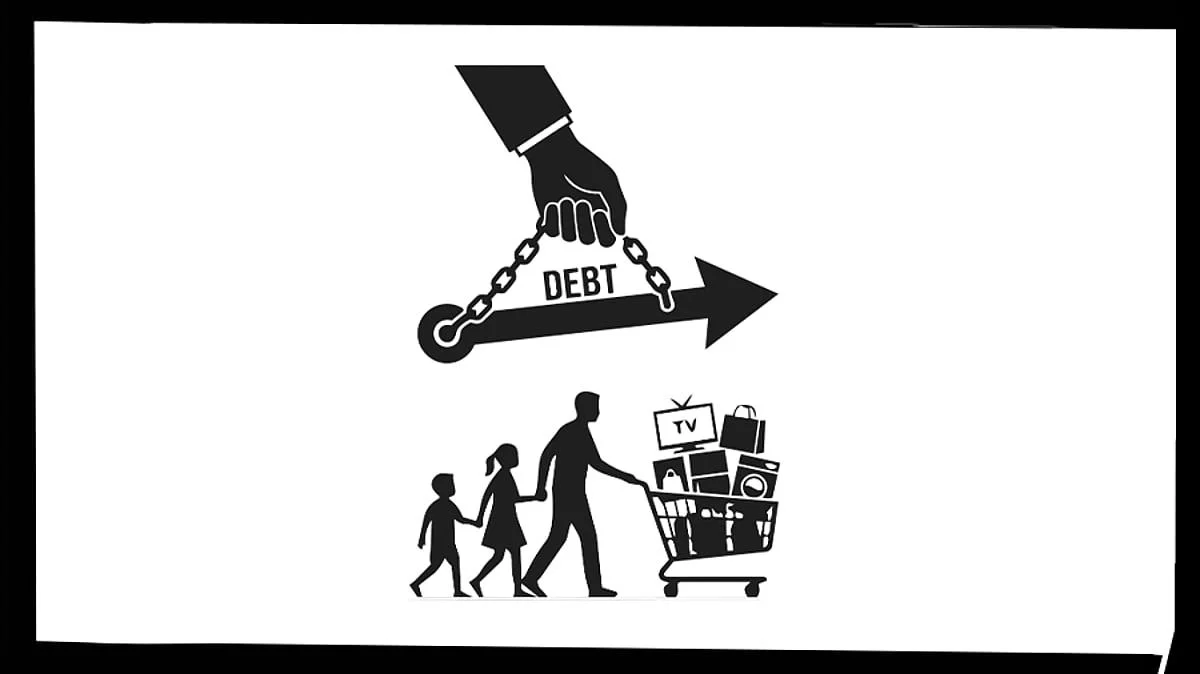
India Economic Growth vs Household Debt Crisis
A stark dichotomy has emerged between India’s stellar macroeconomic indicators and the financial reality of its citizens. While national balance sheets project robust fiscal discipline, average household budgets reveal a fragile domestic ecosystem under severe stress.
Key Highlights
- India’s net household financial savings plunged to a historic low of 5.2% of GNDI in FY2023.
- Household financial liabilities nearly doubled to 5.7% of GDP by FY2023, pushing total debt past 40% of GDP.
- Gold loans surged by 128.5% year-on-year, reaching Rs 3.38 lakh-crore as distress borrowing accelerates.
- Unsecured personal loans and retail credit registered compounding annual growth rates of 22% to 25% recently.
An examination of India’s macroeconomic metrics indicates sustained growth and strong fiscal management. Conversely, an assessment of typical family expenditures reveals a significantly more vulnerable economic situation.
ANYTIME, ANYWHERE.
Experience a more refined e-paper today
Over the past 12 years, the critical connection between aggregate national wealth accumulation and individual household purchasing power has severed.
As inflation-adjusted incomes stagnate across both rural and urban sectors, a quiet transition toward credit-dependent consumption has taken hold. Citizens are increasingly replacing deficit earnings with credit cards, personal debt, and gold-backed financing to manage escalating living expenses.
This trend highlights an intensifying wage-debt squeeze that is fracturing the internal marketplace, forcing working-class populations to navigate an unstable financial landscape.
The mounting economic pressure on Indian families since 2014 cannot be classified as a fleeting, externally driven price shock. Instead, it reflects a structural transformation in the methods through which national capital is accumulated and distributed.
While corporate equity benchmarks and gross domestic product have expanded, the domestic transmission channels have failed. Maintaining this systemic earnings deficit over a 12-year period alters fundamental macroeconomic dynamics.
This revenue shortfall directly illuminates the contraction of India’s net household financial savings to a historical nadir of 5.2% of gross national disposable income (GNDI) in FY2023, falling from a multi-decade baseline of 7% to 8%. Concurrently, family financial obligations doubled from 3% of GDP in FY2014 to 5.7% in FY2023, driving aggregate household debt beyond 40% of GDP by late 2023.
Long-term economic research verifies a clear K-shaped divergence, proving that recent economic expansions have heavily favored corporate profit margins rather than proportionate employee compensation.
Within structured enterprises, non-managerial labor remuneration as a fraction of aggregate corporate outlays has steadily diminished. Furthermore, inflation-adjusted wage progression in primary infrastructure and heavy manufacturing trailed the real rate of inflation over the past five years. The prevailing corporate infrastructure prioritizes international profitability by reducing the consumption capacity of its domestic labor force.
This financial constraint extends far beyond metropolitan areas.
Although state interventions routinely adjust minimum support prices (MSPs) to a standard of 1.5 times production costs, these interventions yield highly uneven outcomes. The financial advantages flow primarily to property-owning agriculturalists, leaving landless day laborers dependent on volatile cash compensation.
Adjusted earnings for day laborers expanded at an annualized rate below 1.5% across the 12-year baseline. This income suppression is worsened by a shortage of dependable employment paths within formal metropolitan networks.
The broader economy experienced a substantial reverse migration trend, returning millions of industrial laborers to agricultural roles starting in 2018 and 2019. This systemic labor oversupply weakened the employment market, reducing the capacity of workforce groups to secure equitable minimum compensation.
The commercialisation of survival
When an economic framework continuously substitutes income expansion with expanded credit facilities, the baseline characteristics of household liabilities change. The primary macroeconomic vulnerability for the nation is not the absolute volume of family debt, but its survival-driven architecture.
The internal composition of household credit has pivoted sharply away from wealth-building assets, such as residential property mortgages, toward immediate, unsecured debt vehicles.
Official financial stability assessments from the Reserve Bank of India (RBI) reveal that unsecured lines of credit and consumer retail credit advanced at annualized compounding rates between 22% and 25% in recent years.
Utilized balances on credit cards and financing backed by gold assets—historically viewed as emergency options—have escalated rapidly. Gold-backed credit segments alone climbed to Rs 3.38 lakh-crore, marking an absolute year-on-year surge of 128.5%. This rapid regional credit inflation is heavily concentrated within lower-income demographics experiencing the most acute earnings stagnation.
Data from TransUnion CIBIL indicates that micro-loans valued under Rs 50,000 registered the sharpest growth, propelled by digital financing platforms and micro-credit providers serving distressed applicants.
By utilizing high-cost, near-term liabilities to navigate daily living expenses, working-class households compromise future financial stability to preserve present-day consumption levels. This credit-supported demand offers a deceptive facade of market stability while undermining the long-term solvency of domestic households.
The stabilization of broader macroeconomic measurements has progressed at the direct expense of working-class family balance sheets.
Unsecured retail credit growth cannot serve as a permanent surrogate for sustained income expansion, nor can micro-credit act as a replacement for institutional social safety mechanisms.
When household financial obligations double while inflation-adjusted agricultural compensation grows below 1% annually, the broader economic model operates on borrowed time.
Shifting away from an uneven, K-shaped trajectory toward an equitable economic model requires policy frameworks to move beyond pure supply-side metrics.
While structural interventions like corporate tax relief and manufacturing production incentives have expanded industrial capability, they failed to generate a proportional earnings multiplier for the labor market. Authorities must adjust goods and services tax (GST) thresholds on non-discretionary everyday items and vital services to lower parameters.
The overarching fiscal framework must rely more heavily on progressive direct revenue collection rather than placing fiscal pressure on the working class. Revitalizing small and medium enterprises (MSMEs) can accelerate this transition, moving informal workers into structured agreements to raise the national income floor.
Finally, targeted expansions in state budgetary funding for public medical services and educational systems are essential. By shifting healthcare and education liabilities away from individual households, the state can immediately enhance disposable income for standard consumption, disrupting the ongoing cycle of distress borrowing.
Future Outlook
The trajectory of India’s domestic consumption depends entirely on rebalancing the corporate-labor share of income. If retail credit continues to expand at 22-25% while real wages stagnate, default rates among lower-income brackets are projected to rise, potentially forcing tighter credit interventions from the RBI. Over the medium term, policy interventions that prioritize direct tax rationalization and structural support for labor-intensive MSMEs will be vital to transform the current credit-fueled demand into sustainable, income-driven economic growth.
FAQs
Why is India’s household debt rising despite strong GDP growth?
The rise in household debt is driven by a structural wage-debt squeeze. While macro indicators show expansion, real wages for urban and rural workers have flatlined over the last 12 years, forcing families to use credit cards, personal loans, and gold loans to maintain their standard of living.
What is a K-shaped economic recovery?
A K-shaped recovery is an economic situation where different sectors of the economy recover at entirely different rates. In India, this divergence is visible as corporate profits and equity indices scale up significantly, while working-class wages and purchasing power continue to decline.
How low have India’s household savings fallen?
India’s net household financial savings dropped to a historic low of 5.2% of Gross National Disposable Income (GNDI) in FY2023. This is a substantial decline from the long-standing traditional national average of 7% to 8%.
What types of loans are growing the fastest in India?
Unsecured personal loans, retail credit, and small-ticket digital loans under Rs 50,000 are seeing explosive growth. Additionally, gold loans have experienced a massive 128.5% year-on-year surge, reaching Rs 3.38 lakh-crore as distress borrowing increases.