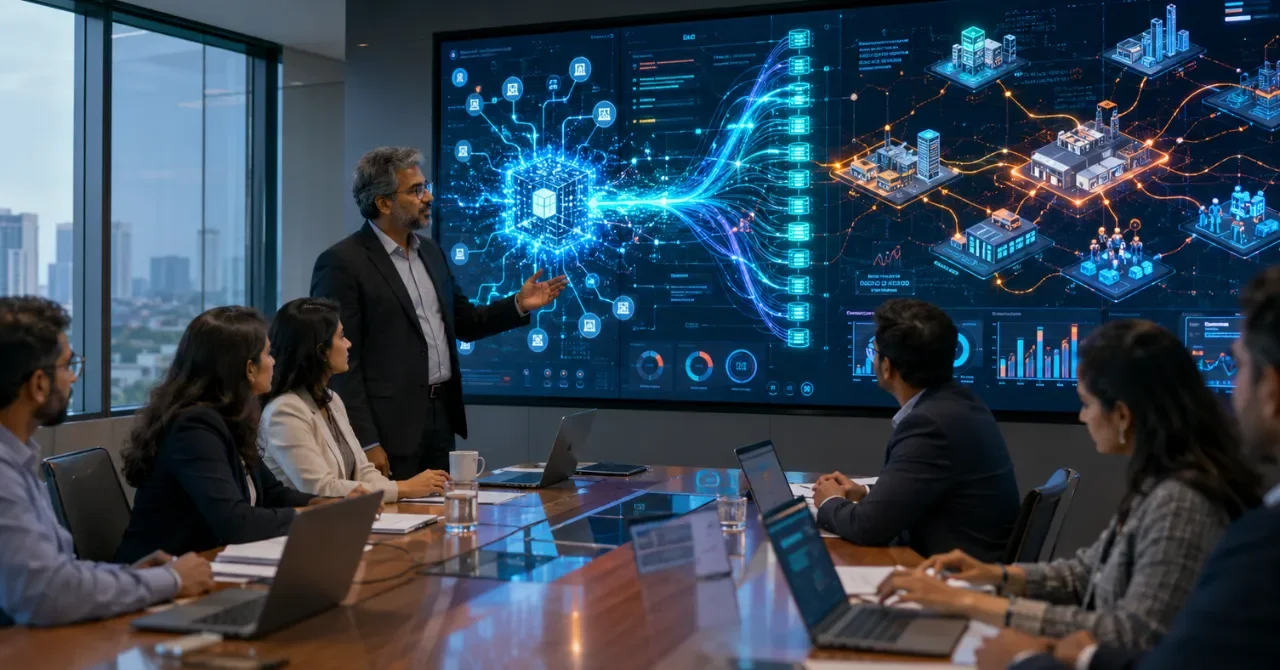
India Rallies Financial Defences Against AI Cyber Threats
Indian state authorities, financial watchdogs, and banking institutions are intensifying protections against sophisticated artificial intelligence-driven digital vulnerabilities. While a singular defensive framework does not exist yet, coordinated actions signify that the subcontinental financial sector is rapidly shifting from issuing general alerts to deploying active tactical countermeasures.
Key Highlights
- High-Level Mobilization: The Ministry of Finance convened top banking officials to address unprecedented operational hazards emerging from next-generation autonomous exploits.
- Regulator Mandates: SEBI directed market infrastructure firms to secure digital architectures, accelerate security monitoring integration, and draft long-term autonomous mitigation roadmaps.
- Operational AI Deployment: The I4C and Reserve Bank Innovation Hub integrated data pipelines with the MuleHunter.ai platform to actively purge illicit accounts.
Government departments, market overseers, and commercial lenders are executing defensive enhancements to combat a novel tier of artificial intelligence-enabled cyber hazards.
These defensive steps do not constitute a single, integrated protective structure. However, recent initiatives by the Ministry of Finance, the Securities and Exchange Board of India (SEBI), the Indian Cyber Crime Coordination Centre (I4C), and the Reserve Bank Innovation Hub (RBIH) demonstrate an active regulatory shift.
State monitors are upgrading digital boundaries, commercial entities must prepare for complex automated incursions, and intelligent systems are actively running to identify fiscal malfeasance.
The meeting that put AI risk on the financial agenda
On April 23, 2026, Finance Minister Nirmala Sitharaman directed a high-tier assembly featuring commercial banking chiefs alongside senior representatives from the Reserve Bank of India (RBI) and the Ministry of Electronics and Information Technology (MeitY) to assess algorithmic financial dangers.
This gathering occurred amid escalating anxiety regarding Anthropic’s Claude Mythos Preview, a restricted computational engine reported to possess capabilities for discovering and weaponizing software vulnerabilities at extreme velocity and scale.
The Ministry of Finance declared via X that this evolving digital hazard was unprecedented, necessitating immense vigilance, systemic readiness, and heightened synergy across commercial lenders and fiscal agencies.
Lenders received instructions to implement preemptive safeguards to insulate internal infrastructures, consumer metrics, and fiscal reserves. The convention signaled that automated cyber vulnerabilities are no longer conceptual anxieties, but immediate operational dangers requiring prompt logistical responses.
SEBI moves from warning to action
On May 5, 2026, SEBI distributed an operational directive focusing on complex algorithmic instruments engineered for software vulnerability discovery. The regulatory watchdog explicitly highlighted Claude Mythos, cautioning that these automated frameworks can pinpoint and leverage system flaws faster than traditional protocols.
SEBI stated that these dynamic capabilities directly jeopardize corporate data privacy, application functionality, and the structural reliability of core computing outputs.
The overseer additionally noted that the integrated architecture of capital markets implies that a digital compromise at a solitary firm could trigger systemic issues across stock exchanges, asset clearinghouses, brokerages, and mutual funds.
The regulatory directive obligates supervised market entities to:
Execute immediate patches on operating architectures or employ temporary virtual patching configurations if official manufacturer remedies remain unavailable.
Perform routine vulnerability testing and penetration simulation exercises leveraging both standard and specialized automated diagnostic frameworks.
Conduct comprehensive operational security reviews of external software suppliers and digital application service vendors.
Log all infrastructural modifications and perform structured operational impact evaluations prior to deployment.
Protect application programming interfaces (APIs) utilizing robust validation measures, transmission rate caps, and verified connection permissions.
Extend Security Operations Centre (SOC) observation parameters to log every network anomaly, including minor notifications that staff might typically overlook.
SEBI additionally ordered supervised organizations to expedite their integration into Market SOC, a unified, continuous protection tracking environment managed by the National Stock Exchange and BSE.
Financial corporations must also incorporate the operational capacities of advanced automated models as core threat variants within their routine risk review mechanisms.
Over a extended horizon, businesses must formulate strategies for independent mitigation frameworks capable of discovering and neutralizing threats with negligible human oversight.
A task force for shared cyber resilience
The regulatory body established a specialized working assembly designated as cyber-suraksha.ai, uniting market infrastructure entities, certified transfer agents, regulated corporations, and allied industry participants.
This cooperative group will analyze digital vulnerabilities linked to autonomous frameworks, design unified defensive strategies, distribute threat data alongside mitigation playbooks, log critical digital incursions, and verify vendor security postures.
This framework demonstrates a profound transformation in regulatory methodology. Perimeter protection at isolated enterprises is insufficient when stock exchanges, investment managers, clearinghouses, and transactional networks remain deeply linked.
However, a distinct operational bottleneck persists. Domestic institutions lacked direct functional access to Claude Mythos when the advisory entered distribution.
MediaNama disclosed that MeitY Secretary S. Krishnan stated that national authorities are negotiating accessibility protocols with American counterparts under the auspices of Anthropic’s Project Glasswing.
That specific detail remains critical. SEBI is not instructing financial players to deploy Claude Mythos for internal protection. It commands them to counter the wider categories of danger represented by autonomous systems through rigorous patch management, monitoring, and collective threat tracking.
AI is already being used against financial fraud
Regulatory strategies are matched by real-world automated fraud prevention tools actively running within the commercial banking environment.
On May 12, 2026, the Indian Cyber Crime Coordination Centre, operating under the Ministry of Home Affairs, joined the Reserve Bank Innovation Hub to sign a formal Memorandum of Understanding (MoU) maximizing the tracking of illicit mule accounts.
The operational pact permits the I4C to export fraudulent account data and telemetry from its centralized Suspect Registry directly to the RBIH.
This structured information will optimize automated threat modeling platforms, notably MuleHunter.ai, which currently serves more than 26 corporate banking institutions.
Mule profiles consist of banking registries utilized by threat networks to acquire, move, or obfuscate stolen capital. By assessing transactional velocity and shared multi-bank analytics, MuleHunter.ai identifies questionable accounts faster than legacy rule-based architectures.
Home Minister Amit Shah characterized the alliance as a advanced protective layer against digital offenses, affirming that centralized intelligence registries will empower autonomous platforms to neutralize hidden laundering channels.
In contrast to the SEBI mandate, MuleHunter.ai does not target Claude Mythos variations. The tool operates specifically to suppress tech-enabled monetary theft and the proliferation of illicit banking networks.
Concurrently, these two separate technological tracks illustrate the dual nature of the modern response: fortifying infrastructure against automated exploits while utilizing predictive algorithms to intercept financial crimes.
What this means for financial institutions
The meeting on April 23, SEBI’s mandate on May 5, and the May 12 bilateral accord mark a systematic shift from theoretical risk awareness to enforceable compliance and live defensive operations.
The broader national economy still lacks a singular, unified autonomous digital defense architecture. Nevertheless, its structural foundations are crystallizing through inter-agency data loops, mandatory infrastructural controls, shared threat reporting, centralized monitoring, and predictive fraud prevention.
The larger challenge will be execution
Updating systems, isolating APIs, logging low-priority network alerts, auditing external software partners, and transmitting intelligence across competitors demands consistent financial commitments, specialized engineers, and transparent institutional ownership.
As automated technologies rapidly transform the digital threat matrix, financial firms and regulators are deploying identical algorithmic capabilities to secure their operational parameters.
Future Outlook
As advanced autonomous systems grow more complex, Indian financial regulators aim to transition the industry from human-led responses to fully autonomous security infrastructures. The cyber-suraksha.ai initiative represents an early blueprint for automated peer-to-peer threat sharing networks. Over the coming years, compliance mandates will likely shift from periodic infrastructure auditing to continuous, real-time automated verification. The success of these initiatives depends heavily on securing official cross-border access agreements, such as Project Glasswing, to study advanced international models before they are weaponized by threat actors.
FAQs
What is Claude Mythos Preview?
Claude Mythos Preview is a highly restricted, advanced artificial intelligence model developed by Anthropic. It possesses specialized capabilities for identifying and potentially exploiting software system vulnerabilities at an unprecedented speed and scale, which has raised security concerns globally.
How does MuleHunter.ai protect bank accounts?
MuleHunter.ai is an artificial intelligence-driven fraud-risk assessment system used by more than 26 banks in India. It analyzes real-time account activity and shared intelligence across multiple institutions to detect and eliminate hidden mule accounts faster than traditional, rule-based security systems.
What are the main requirements of the SEBI May 2026 advisory?
The advisory requires regulated financial entities to immediately patch software systems, conduct regular vulnerability testing using AI tools, assess third-party vendor risks, secure APIs, monitor all low-priority alerts, and accelerate their integration into the centralized Market SOC platform.
What is the purpose of the cyber-suraksha.ai task force?
Formed by SEBI, cyber-suraksha.ai is a collaborative task force comprising market infrastructure institutions, regulated entities, and stakeholders. The group is designed to examine AI-associated cyber risks, develop unified defensive strategies, share threat intelligence, and assess third-party software provider security.