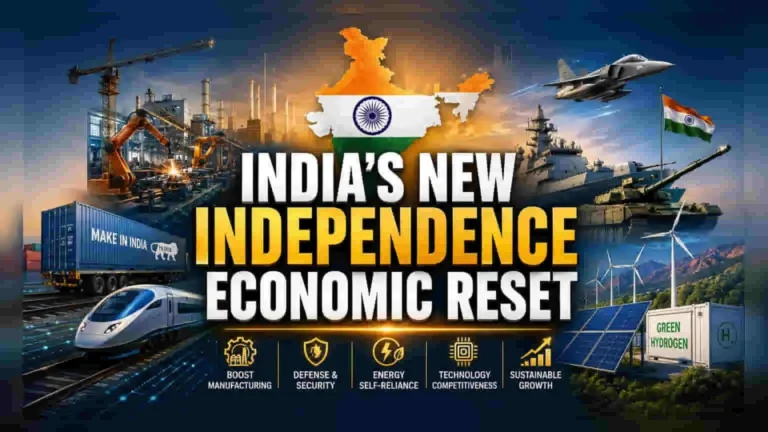
India’s Decade of Economic Evolution From Fragile to Fast Growing
India has evolved from an economically vulnerable nation into a dominant global growth driver over the past 10 years. Strategic structural initiatives, intensive infrastructure investments, and rapid technological advancements have combined to fortify the country’s fiscal resilience, boost industrial productivity, and secure its position as a fast-growing major economy.
Key Highlights
- Public capital expenditures expanded to Rs 12.22 lakh crore, representing 4.4% of the national gross domestic product.
- Public sector banking non-performing assets dropped from 11.18% to approximately 2.5% following structural intervention.
- National production initiatives elevated the country to the position of the second-largest mobile phone manufacturer globally.
- Sustainable energy infrastructure scaled up significantly, pushing total non-fossil fuel power capacity to 283.46 GW.
India’s economy has witnessed one of the most significant transformations in its modern history over the last decade. From being grouped among the world’s “Fragile Five” economies in 2014, the country has emerged as a major global growth engine powered by reforms, infrastructure investment, manufacturing expansion and technological innovation.
A major factor behind this transformation has been the government’s emphasis on public capital expenditure of Rs 12.22 lakh crore, equivalent to 4.4% of GDP. This strategic shift from consumption-led growth towards infrastructure creation has strengthened the foundation for long-term economic development.
The banking sector, once burdened by mounting bad loans, has undergone a remarkable turnaround. In 2014, public sector banks were struggling with Gross Non-Performing Assets (NPAs) of 11.18%. Through recapitalisation support of Rs 3.10 lakh crore and implementation of the Insolvency and Bankruptcy Code (IBC), the sector recovered significantly. Today, NPAs have fallen to around 2.5%, while public sector banks are generating record profits exceeding Rs 1.4 lakh crore annually.
India’s manufacturing ecosystem has also expanded rapidly under the Production Linked Incentive (PLI) Scheme, supported by an outlay of Rs 1.97 lakh crore. The initiative has transformed India into the world’s second-largest mobile phone manufacturer, with annual mobile exports crossing $28 billion.
The country’s ambitions extend beyond electronics assembly. Significant investments are being made in semiconductor manufacturing to reduce import dependence. The upcoming $11-billion semiconductor fabrication facility at Dholera, Gujarat, is expected to strengthen domestic chip production and support India’s vision of becoming a global semiconductor hub.
The telecommunications sector is also witnessing a technological breakthrough. State-run BSNL’s indigenous 5G network, developed using technology from Indian companies and institutions, marks an important milestone in achieving telecom self-reliance and reducing dependence on foreign equipment providers.
India’s push towards innovation is visible in transportation as well. The Vande Bharat Express, designed and manufactured domestically by engineers at the Integral Coach Factory in Chennai, demonstrates the country’s growing engineering capabilities while significantly reducing dependence on imported high-speed rail technology.
The space sector has opened new opportunities through private participation. Companies such as Skyroot Aerospace are helping India establish a stronger presence in the global commercial space industry, creating opportunities in satellite launches and advanced aerospace technologies.
The country’s digital economy has further driven demand for data centres, with operational capacity reaching 1.6 GW. Supporting this growth, India has expanded its renewable energy infrastructure at an unprecedented pace. Non-fossil fuel installed power capacity has reached 283.46 GW, while solar power capacity has grown to 150.26 GW, reflecting India’s commitment to sustainable development and energy security.
These developments collectively highlight how strategic reforms, technological innovation and infrastructure investments have reshaped India’s economic landscape and strengthened its position in the global economy.
India’s economic transformation over the last decade reflects a shift from vulnerability to resilience. Through banking reforms, manufacturing growth, infrastructure creation, digital innovation, renewable energy expansion and technology self-reliance, the country has built a stronger foundation for sustained growth and global leadership in the years ahead.
Future Outlook
The sustained emphasis on domestic industrialization, digital integration, and renewable power infrastructure positions the nation for enduring macro stability. Financial experts project that the ongoing expansion of production incentive programs and semiconductor fabrication ecosystems will steadily shield the domestic supply chain from external disruptions. Furthermore, state-level creative economy frameworks are anticipated to diversify employment opportunities across regional administrative zones.
FAQs
How has India’s economy changed over the last decade?
India has transformed from a Fragile Five economy into one of the world’s fastest-growing major economies through reforms, infrastructure investments and technological advancement.
What role did banking reforms play in India’s economic growth?
Banking reforms reduced gross NPAs from 11.18% to around 2.5%, improving financial stability and increasing credit availability.
How successful has the PLI Scheme been?
The PLI Scheme helped India become the world’s second-largest mobile phone manufacturer and boosted exports beyond $28 billion annually.
What is India’s semiconductor strategy?
India is investing heavily in domestic semiconductor manufacturing, including a major fabrication facility in Gujarat, to reduce import dependence.
How is renewable energy contributing to economic growth?
India’s non-fossil fuel capacity has reached 283.46 GW, supporting industrial growth, energy security and sustainability goals.