PM Modi Launches ₹18,778 Crore Projects in Surat
Prime Minister Narendra Modi inaugurated and laid foundation stones for 24 development projects worth ₹18,778 crore in Surat, Gujarat. The initiatives span crucial infrastructure, sustainable energy, and industrial sectors, advancing the national vision of a developed India by 2047.
Key Highlights
- Prime Minister Narendra Modi launched 24 central and state government development projects totaling ₹18,778 crore in South Gujarat.
- The investments allocate ₹16,968 crore toward Central Government initiatives and ₹1,810 crore for State Government infrastructure programs.
- The development model prioritizes green growth, focusing on a circular water economy, solar energy expansion, and comprehensive waste-to-wealth systems.
- Environmental milestones include targeting net-zero emissions by 2030 and planting over 16.96 crore trees across the state of Gujarat.
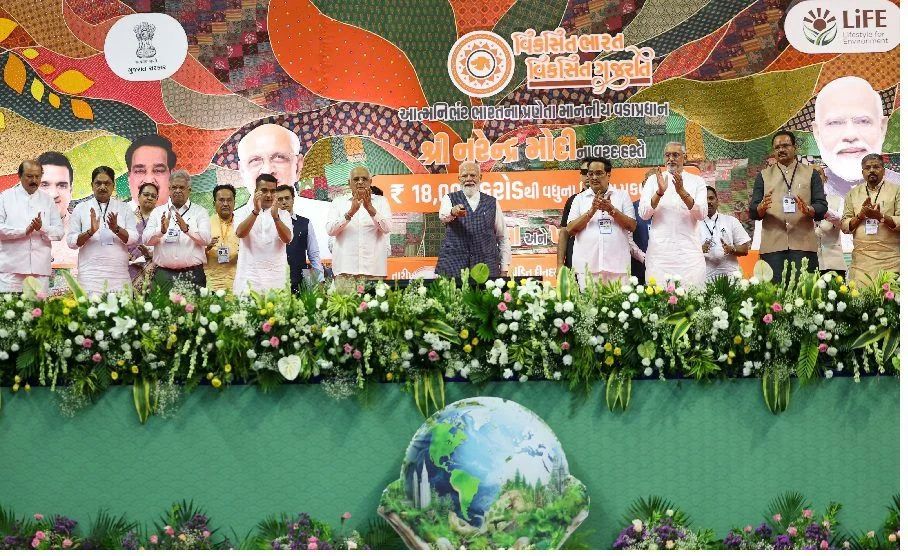
Surat (Gujarat): Prime Minister Narendra Modi commemorated World Environment Day by launching and laying foundational stones for 24 central and state government initiatives valued at ₹18,778 crore in Surat, delivering a major economic catalyst to the South Gujarat territory.
Official details from the Chief Minister’s Office confirm the financial breakdown includes central allocations worth ₹16,968 crore alongside state funding of ₹1,810 crore. These targeted public investments address key demands across the road, energy, logistics, and industrial manufacturing sectors.
The official launch took place inside the Deendayal Upadhyay Indoor Stadium in Surat. The ceremony featured Gujarat Chief Minister Bhupendra Patel, Deputy Chief Minister Harsh Sanghavi, various Union ministers, and regional administrative leaders.
PM Calls Surat a Model of Cleanliness and Sustainable Growth
During his main address, PM Modi characterized Surat as an enduring urban spirit, celebrating its historic transition from a disease-plagued locality into one of the cleanest municipal zones nationwide.
He acknowledged local residents for driving public sanitation campaigns, noting that Surat serves as an exemplary municipal standard under the nationwide Swachhata Abhiyan initiative.
The Prime Minister urged citizens to adopt environmental cleanliness as a permanent lifestyle choice to secure long-term public health outcomes across India.
Focus on Green Growth and Climate-Friendly Development
PM Modi emphasized India’s strategic transition toward green growth, asserting that industrial production and environmental conservation can expand simultaneously.
The Prime Minister drew attention to pioneering environmental policies in Gujarat, including:
- Establishing the first dedicated Climate Change Department in India
- Developing the Charanka Solar Park during its initial regional expansion
- Advancing large-scale renewable energy infrastructure projects
India currently ranks among the top five global solar power producers, with Gujarat generating approximately 20% of the total domestic renewable energy output.
Major Infrastructure Projects to Boost Connectivity and Industry
The Prime Minister stated that these newly authorized projects will expand manufacturing output while securing ecological equilibrium.
Primary infrastructure priorities involve:
- Upgrading national highways and regional roadway networks
- Funding new energy production installations
- Improving specialized industrial zone infrastructure
- Boosting transit via high-capacity expressways and rail freight networks
Enhanced transport routes will link isolated tribal communities and rural villages to mainstream commercial marketplaces, generating substantial employment.
Surat’s Circular Water Economy and Water Security Model Praised
PM Modi lauded the municipal circular water economy in Surat, where public facilities process municipal wastewater for commercial resale to industrial facilities.
He pointed to the construction of the Tapi Barrage Project as a definitive water resource asset, guaranteeing reliable drinking water supplies for the next 50 years.
Waste-to-Wealth and Sustainable Urban Development
The Prime Minister reaffirmed India’s commitment to ecological viability through modern resource management practices:
- Deploying industrialized waste-to-wealth conversion technologies
- Standardizing localized circular economic frameworks
- Accelerating grid-connected clean energy deployment
- Executing eco-friendly municipal master plans
National development frameworks prioritize synchronization with environmental preservation to safeguard long-term biodiversity.
Gujarat’s Contribution to India’s Renewable Energy Growth
Chief Minister Bhupendra Patel stated that Gujarat remains the primary driver behind the green energy transformation in India.
- The state secures a 21% share of total installations under the PM Surya Ghar Muft Bijli Yojana.
- Authorities continue scaling up commercial solar arrays and wind farms.
- Communities maintain active local engagement with the international Mission LiFE framework.
- Government agencies are working toward a finalized net-zero emissions target by 2030.
The Chief Minister confirmed the state’s policy framework directly reinforces the overarching national objective of transforming into a developed nation by 2047.
Large-Scale Water Conservation and Tree Plantation Efforts
Chief Minister Patel presented verified data detailing ongoing provincial environmental preservation metrics:
- Building 2.20 lakh rainwater collection systems under the Jal Sanrakshan Abhiyan
- Creating 2,703 Amrit Sarovar reservoirs across multiple administrative zones
- Planting 16.96 crore saplings via the upgraded Ek Ped Maa Ke Naam campaign 2.0
- Advancing biological farming techniques alongside Mission LiFE parameters
These coordinated biological interventions continue raising regional water tables while strengthening natural climate defense mechanisms.
Massive Public Participation and Green Event Practices
Deputy Chief Minister Harsh Sanghavi highlighted the specific eco-friendly protocols utilized to manage the stadium assembly:
- Substituting synthetic signage with plastic-free handmade informational displays
- Utilizing strictly recycled consumer materials for staging infrastructure
- Organizing a promotional bicycle rally drawing several thousand local participants
The administration demonstrated that massive public ceremonies can execute complex logistics without generating excessive plastic pollution.
Key Dignitaries Present
The state event drew attendance from high-ranking political representatives, including:
- Union Jal Shakti Minister CR Patil
- Regional cabinet ministers and state legislators
- Senior Indian Administrative Service officers
- Executive leaders representing the Surat Municipal Corporation
- Thousands of regional residents
This ₹18,778 crore capital allocation highlights a synchronized policy approach balancing rapid industrialization with strict carbon mitigation. By combining clean energy infrastructure, managed water networks, and smart urban design, the development matches India’s long-term sustainability goals.
Future Outlook
The massive capital deployment in Surat sets an institutional precedent for future metropolitan infrastructure planning across India. As municipal corporations face rising populations, the implementation of localized circular water economies and waste-to-wealth facilities will likely expand to other Tier-1 and Tier-2 urban centers. Over the coming decade, the completion of the Tapi Barrage Project and the integration of grid-scale solar installations will transform South Gujarat into a key testing ground for climate-resilient economic growth, serving as a core template for the broader Viksit Bharat 2047 developmental roadmap.
FAQs
What is the total financial investment for the new projects in Surat?
The combined financial investment for the newly launched development projects totals ₹18,778 crore. This includes ₹16,968 crore allocated by the Central Government and ₹1,810 crore provided by the Gujarat State Government.
What sectors are covered under these development projects?
The projects cover multiple critical economic sectors, including road and highway expansion, renewable energy production, industrial infrastructure upgrades, and advanced municipal water management systems.
How does Surat’s circular water economy model function?
Surat’s circular water economy relies on industrial-scale treatment facilities that process urban wastewater. This recycled water is then systematically distributed and sold back to industrial sectors for manufacturing purposes, reducing freshwater strain.
What is the timeline for Gujarat’s net-zero emission target?
As part of its ongoing green energy transition and sustainable development framework, the state government of Gujarat has established a target to achieve net-zero carbon emissions by the year 2030.