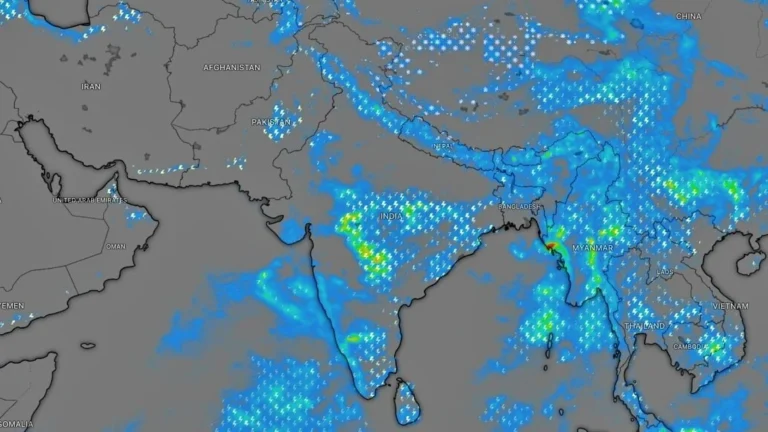
India Weather Crisis 2026: Extreme Heatwave and Monsoon Prediction Breakthrough
Climatic volatility is intensifying across India as the nation faces concurrent threats of severe heatwaves and erratic rainfall. However, meteorologists have achieved a major forecasting breakthrough. Utilizing deep ocean temperatures, researchers can now predict monsoon patterns with high precision up to 18 months in advance, transforming climate preparedness.
Key Highlights
- India faces a dual crisis of delayed monsoons and intense, highly humid heatwaves during June 2026.
- The India Meteorological Department warns of below-normal seasonal rainfall alongside severe heat stress.
- A novel “Global ENSO” forecasting model shifts the predictive focus from noisy surface data to deep ocean signals.
- Long-term shifts project a 150% rainfall surge in Northwest India, altering agricultural paradigms by 2100.
Advanced predictive modeling utilizing a novel “Global ENSO” metric has revealed that Indian monsoon systems maintain high predictability despite accelerating global warming. By evaluating deep ocean thermal metrics rather than superficial sea surface temperatures, climatologists can accurately forecast critical precipitation shifts.
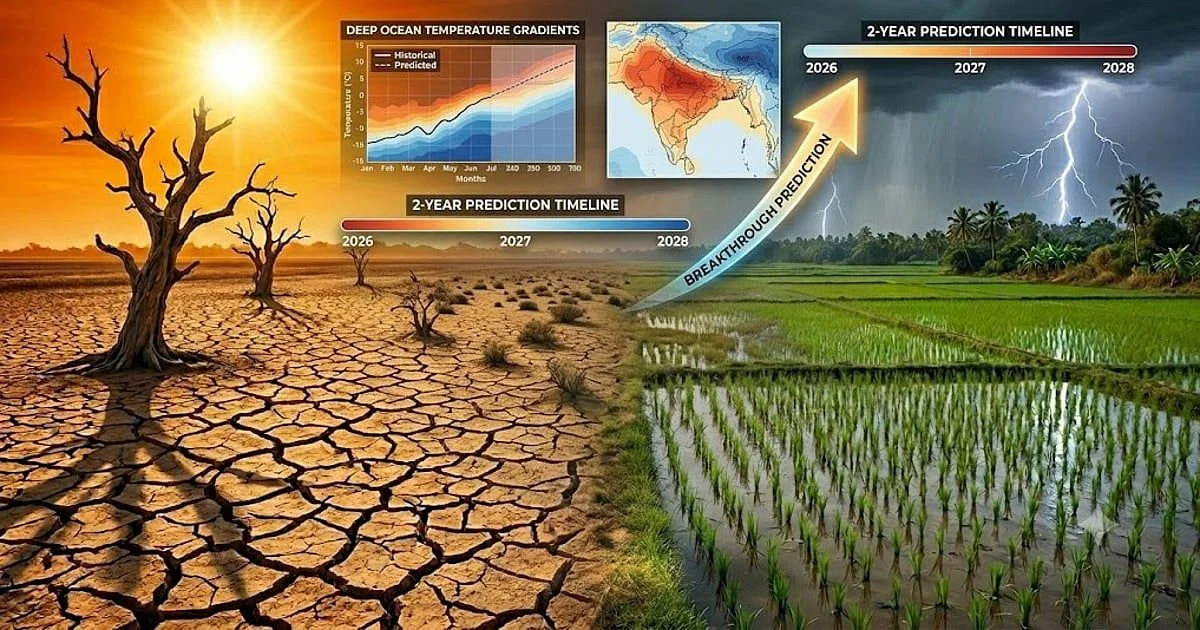
A visual juxtaposition of these extreme weather elements highlights the rising challenges of simultaneous heatwaves and torrential downpours.
Official assessments indicate that India will receive below-average precipitation between June and September 2026. The India Meteorological Department (IMD) simultaneously confirmed that intense heatwave conditions will dominate multiple regions throughout June, complicating the national environmental outlook.
This departure from historical averages raises severe concerns. Domestic climate experts warn that the nation is currently enduring unprecedented thermal extremes alongside a delayed seasonal monsoon, precipitating a dangerous combination of elevated humid heat and localized torrential downpours.
Such concurrent meteorological challenges are becoming increasingly frequent. Joint environmental research published in 2025 by ESRI India and IPE Global projected a 2.5x surge in annual heatwave days by 2030. Concurrently, the volumetric intensity of severe precipitation episodes is expected to escalate by 43%.
The official monthly outlook released by the IMD for June 2026 details widespread heatwave risks. Severe thermal anomalies are projected across Uttar Pradesh, Punjab, Bihar, Haryana, Odisha, Chhattisgarh, Gujarat, and Andhra Pradesh, with isolated risks impacting Maharashtra, Telangana, Himachal Pradesh, and Tamil Nadu.
As monsoon progression stalls, scientists warn of a volatile atmospheric collision. Merging thermal extremes and elevated humidity will generate dangerous “feels-like” environmental thresholds. These conditions severely restrict human perspiration evaporation, while secondary atmospheric fronts trigger severe thunderstorms and unpredictable regional deluges.
The dual threat explained
A comprehensive climate investigation published in the journal Advances in Atmospheric Sciences in May 2026 details these evolving patterns. Professor BN Goswami of Gauhati University emphasized that humid heat stress represents an under-recognized threat, describing it directly as a silent killer.
During active monsoon cycles, periods where the apparent temperature exceeds 45°C occur at a rate ten times more frequent than dry thermal extremes observed prior to seasonal rains.
Concurrently, extreme precipitation anomalies are growing more volatile. Vast sectors of the population now experience alternating periods of severe rainfall or intense, humid heat during dry monsoon spells.
This atmospheric instability was recently demonstrated in Thoothukudi, Tamil Nadu, where a rare tornado developed during a severe thunderstorm. Meteorologists note that while such tornadic activity remains atypical for the Indian subcontinent, traditional thunderstorm zones are historically restricted to Odisha, West Bengal, and the northern plains.
Professor Goswami, serving as the corresponding author for the May 2026 study, emphasized the urgency of the situation. He noted that the nation has reached a critical juncture where accelerating weather anomalies threaten foundational economic progress.
He stated that allocating capital toward studying the physiological impacts of extended humid heat is an absolute necessity for survival. Currently, India sustains 50% of the total global potential productivity losses tied to extreme thermal stress, which degrades labor capacity, escalates medical costs, and destroys infrastructure.
Despite the challenging near-term forecasts, the 2026 atmospheric analysis identified two encouraging long-term trends. Data indicates a definitive westward migration of core monsoon rainfall.
While Northeast India has exhibited a persistent drying trend over recent decades, this trajectory is projected to stabilize. Conversely, seasonal precipitation over traditionally arid zones within Northwest India is expected to rise dramatically, tracking an increase of up to 150% in specific areas by 2100.
This geographical realignment could fundamentally rejuvenate arid topographies, enhance aggregate domestic crop yields, and resolve systemic water deficits in territories historically defined by severe ecological scarcity.
Climatologists caution that optimizing this ecological shift will introduce secondary agricultural and logistical complications.
Elevated precipitation volumes across northwestern territories will force farming communities to transition from legacy millet cultivation toward water-intensive crops like wheat and rice. Furthermore, an escalation in severe downpours presents acute risks of accelerating topsoil erosion and flash flooding within municipalities lacking resilient drainage infrastructure.
A prediction breakthrough
For generations, atmospheric scientists expressed concern that systemic climate change would permanently destabilize the predictability of seasonal monsoons. The 2026 research actively refutes this theory.
By implementing a sophisticated “Global ENSO” tracking methodology anchored in deep ocean temperatures rather than volatile surface measurements, researchers demonstrated that monsoon consistency remains intact. Consequently, core seasonal rainfall can now be modeled with high accuracy up to 18 months prior to arrival.
Devabrat Sharma, a contributing researcher representing the Indian Institute of Technology Madras, contextualized the technological leap forward. He stated that legacy predictive models depended strictly on surface water temperatures, which introduced excessive noise and unreliability into seasonal calculations.
He clarified that deep ocean temperatures provide a substantially clearer thermodynamic signal. This enables researchers to formulate accurate outlooks spanning multiple years rather than months, fundamentally upgrading how administrative bodies prepare for severe climate anomalies.
This predictive optimization provides vital utility for long-range agricultural macro-planning, municipal water management, and multi-agency disaster mitigation. The extended forecasting window allows national policymakers to implement defensive strategies against impending droughts and floods well in advance of their onset.
Future Outlook
The integration of deep-ocean predictive modeling marks a turning point for climate adaptation across South Asia. As the dual threats of extreme humid heat and volatile rainfall intensify through 2030, the ability to map monsoon behavior 18 months out provides a critical buffer for food security and urban planning. Managing the projected 150% rainfall increase in Northwest India will require immediate, large-scale infrastructure investments to prevent catastrophic soil erosion while capitalizing on upgraded water tables.
FAQs
How does the new Global ENSO predictor improve Indian monsoon forecasting?
The new forecasting model utilizes deep ocean temperatures instead of surface water data. Deep ocean temperatures provide a significantly clearer, less noisy signal, allowing scientists to generate accurate monsoon predictions up to 18 months in advance rather than just a few months ahead.
Which Indian states are facing heatwave conditions in June 2026?
According to the India Meteorological Department, above-normal heatwave days are affecting Uttar Pradesh, Punjab, Bihar, Haryana, Odisha, Chhattisgarh, Gujarat, and Andhra Pradesh. Isolated regions of Maharashtra, Telangana, Himachal Pradesh, and Tamil Nadu are also experiencing extreme heat.
What is humid heat stress and why is it dangerous?
Humid heat stress occurs when extreme heat combines with high humidity, creating elevated “feels-like” temperatures above 45°C. It is particularly dangerous because the moisture in the air prevents human sweat from evaporating, neutralizing the body’s natural cooling mechanism and creating life-threatening health risks.
How is climate change altering long-term rainfall patterns in India?
Meteorologists are observing a distinct westward shift in monsoon activity. While drying trends in Northeast India are expected to stabilize, traditionally semi-arid regions in Northwest India are projected to experience a significant rainfall increase of up to 150% by the end of the century.