India US Trade Pact Talks Begin in New Delhi
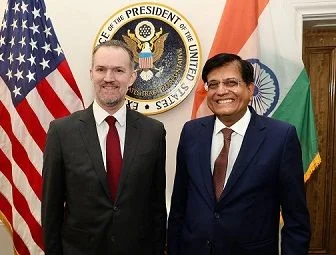
High-level bilateral trade negotiations between India and the United States resume in New Delhi this week as US Trade Representative Jamieson Greer meets Indian Commerce Minister Piyush Goyal. The two-day ministerial-level talks aim to finalize the initial framework of a comprehensive interim trade pact ahead of crucial tariff deadlines.
Key Highlights
- US Trade Representative Jamieson Greer visits New Delhi on June 23-24, 2026, for high-level ministerial trade talks.
- Negotiations center on finalizing the first phase of the bilateral trade agreement before the July 24 tariff deadline.
- India seeks a strategic tariff advantage over regional competitors, including ASEAN nations and Bangladesh.
- The talks follow recent remarks by President Donald Trump at the G7 Summit affirming proximity to a deal.
US Trade Representative Jamieson Greer and Indian Commerce and Industry Minister Piyush Goyal are scheduled to conduct two days of high-stakes discussions this week to settle the initial phase of the bilateral trade agreement. Ambassador Greer will travel to New Delhi on June 23-24, 2026, as part of a wider diplomatic tour.
“For the US trade deal talks, tomorrow my counterpart is coming to Delhi,” Goyal informed journalists during a briefing in Mumbai, signaling fresh momentum for the trade pact. The Office of the USTR confirmed that Greer will visit India before heading directly to Uzbekistan.
This critical ministerial meeting follows a round of intensive discussions led by chief negotiators from both nations, which took place earlier this month from June 2 to June 4 in the national capital. Both Washington and New Delhi have deployed senior administration officials to keep negotiations moving forward rapidly.
Commerce Secretary Rajesh Agrawal recently noted that the ministerial dialogue is anticipated to center on applying the concluding refinements to the comprehensive framework agreement. US officials confirmed that negotiators have been engaged in deep, continuous communication to iron out persistent market-access issues before the formal meetings.
On June 5, Goyal announced that India and the US are rapidly resolving all outstanding components of the interim trade pact, with both nations expected to execute the highly dynamic initial phase of the BTA by the middle of next month. This timeline aligns closely with shifting regulatory structures.
IMPORTANCE OF THE MIDDLE OF NEXT MONTH: The temporary 10% tariff implemented by Washington across all international trade partners on February 24, 2026, for a duration of 150 days, is set to expire on July 24. Consequently, standard Most Favored Nation duties will re-engage for commodities arriving at US ports.
Because this short-term import levy is applied additionally on top of standard Most Favored Nation rates, Washington must institute an updated tariff structure prior to the July 24 deadline. Importers require clear regulatory guidelines regarding upcoming duties to stabilize cross-border manufacturing pipelines.
To accomplish this, American officials are currently pursuing two distinct Section 301 statutory reviews targeting several nations, including India. This represents the sole lawful instrument available for Washington to enforce new import duties of varying scales following recent domestic judicial challenges.
SECTION 301 PROBES: During March, the Office of the US Trade Representative initiated two separate, unilateral investigations under Section 301 of the Trade Act of 1974 against multiple countries, focusing on industrial overcapacity and inadequate elimination of forced labor within global supply networks.
On June 2, the USTR introduced a draft proposal to assess 12.5% tariffs on 54 nations, including India, citing deficiencies in blocking commodities manufactured via forced labor. This framework remains a draft open for public feedback, with interested entities required to submit testimony requests by June 22, preceding formal agency hearings on July 7.
The determinations and final reporting for the second statutory investigation remain pending, adding another layer of complexity to the ongoing ministerial dialogue.
WHY THIS PROBE: On February 20, the US Supreme Court issued a definitive ruling invalidating President Donald Trump’s extensive reciprocal import levies, which had been enacted via the 1977 International Emergency Economic Powers Act. India had previously faced a 50% tariff burden under that executive action. Following the judicial block, the administration was forced to substitute the broad reciprocal measures with temporary emergency levies.
As a direct result of that legal setback, Trump instituted the stopgap 10% global import tariffs for a fixed 150-day window starting February 24.
INDIA-US BTA FRAMEWORK: On February 7, Washington and New Delhi published a bilateral joint declaration establishing the structural parameters and core guidelines for the opening phase of the interim trade agreement. This built upon initial commitments outlined by President Trump and Prime Minister Narendra Modi during their historic February 13, 2025 summit.
Within that original blueprint, Washington consented to lower import duties on Indian shipments to 18%, down from the previous 50% benchmark. The US administration removed the 25% penalty tariffs originally levied on Indian commodities due to New Delhi’s purchase of Russian crude oil, and committed to decreasing the remaining 25% portion down to 18% under the trade pact. However, the subsequent Supreme Court decision altered these specific tariff arrangements.
Given the modified regulatory and judicial environment in Washington, both administrations are actively recalibrating the core parameters of their trade framework. Ambassador Greer has previously acknowledged that India remains a protective, challenging negotiating partner, but affirmed that the existing framework allows talks to progress.
The original February joint statement includes an explicit provision stipulating that if either nation alters its agreed-upon tariff concessions, the corresponding partner retains the reciprocal right to adjust its own trade commitments.
Under this negotiated system, New Delhi proposed to phase out or significantly diminish import levies across all American industrial manufacturing exports alongside a diverse selection of agricultural commodities. This includes dried distillers’ grains, red sorghum destined for livestock feed, tree nuts, fresh and preserved fruits, soybean oil, as well as American wines and distilled spirits.
Furthermore, New Delhi indicated its long-term objective to purchase $500 billion worth of American energy commodities, commercial aviation aircraft, aerospace components, industrial precious metals, advanced technology solutions, and coking coal over the upcoming five years.
INDIA DEMANDS A COMPARATIVE ADVANTAGE ON TARIFFS: When negotiators originally finalized the structural outlines of the first phase of the bilateral trade agreement, India possessed an explicit competitive edge over its regional trade rivals. These rivals include ASEAN member states like Indonesia, Malaysia, Singapore, Thailand, the Philippines, Brunei, Vietnam, Laos, Myanmar, and Cambodia, alongside South Asian neighbors Sri Lanka, Pakistan, and Bangladesh.
Under the initial trade blueprint, the US administration had slated an 18% tariff rate specifically for Indian commodities. At that particular juncture, import duties applied to India’s regional competitors ranged between 19% and 20%. However, under the current emergency tariff regime, all global trading partners face an identical 10% supplemental levy.
Government officials emphasize that securing a distinct, formalized advantage over competing exporting countries remains an absolute priority for India within the final text of the US trade pact.
COMPARATIVE ADVANTAGE MEANS: To illustrate, if Washington applies an 18% import duty on items coming from India while assessing a 20% levy on equivalent merchandise from Vietnam, India secures a tangible commercial edge within the domestic American marketplace.
This structural tariff differential directly enhances the market competitiveness of Indian manufacturing firms relative to industrial exporters operating out of Vietnam.
Consider a practical example involving apparel production. If an Indian-made garment and a Vietnamese-made garment both carry a pre-tariff valuation of $100, the Indian item would retail at $118 in the United States after border duties, whereas the Vietnamese item would reach $120.
This reduced tariff liability renders Indian merchandise more economically appealing to corporate American procurers. Consequently, commercial retail buyers and US importers are highly likely to favor Indian supply chains, allowing Indian exporters to scale up their aggregate market share. International trade economists commonly define this relative commercial superiority as a comparative or tariff-driven market advantage.
TRADE: The United States maintained its position as India’s second-largest aggregate commercial trading partner throughout the 2025-26 fiscal period.
India’s total outbound merchandise shipments to American markets experienced a modest expansion of 0.92%, reaching a valuation of $87.3 billion during the preceding fiscal year, while inbound imports from the US surged 15.95% to hit $52.9 billion. Reflecting these shifting import-export dynamics, India’s bilateral trade surplus contracted to $34.4 billion for the 2025-26 cycle, down from the $40.89 billion surplus recorded during the 2024-25 fiscal year.
Future Outlook
The upcoming face-to-face ministerial negotiations represent a critical juncture for the economic trajectory of both nations. As Ambassador Greer continues his diplomatic tour to Uzbekistan following the New Delhi summit, trade groups expect a formalized interim agreement text to emerge before the July 24 expiration of temporary tariffs. With President Trump and Prime Minister Modi maintaining strong personal rapport following their recent G7 bilateral talks in France, where Trump explicitly noted they were “very close” to a deal, the completion of this first phase could pave the way for a deeper strategic economic alliance, resetting supply chains across the Indo-Pacific region.
FAQs
When is US Trade Representative Jamieson Greer visiting India?
US Trade Representative Jamieson Greer is visiting New Delhi on June 23-24, 2026, to engage in high-level ministerial trade talks with Commerce and Industry Minister Piyush Goyal.
Why is the July 24 deadline significant for India-US trade?
The temporary 10% global tariff imposed by the US expires on July 24, 2026. Both nations are rushing to finalize the interim trade pact before standard Most Favored Nation tariffs take effect.
What products are covered under India’s proposed tariff reductions?
India has proposed reducing or eliminating tariffs on US industrial goods and various agricultural products, including tree nuts, fresh fruits, soybean oil, dried distillers’ grains, and spirits.
What volume of US goods does India intend to purchase?
India intends to import $500 billion worth of American energy products, aircraft components, tech solutions, precious metals, and coking coal over the next five years.