India EU Free Trade Agreement Set for December Signing as Trade Talks Intensify
India and the European Union are finalized to execute their landmark free trade pact by December 2026. This comprehensive economic agreement will open extensive market access and eliminate major tariffs, driving bilateral commerce to unprecedented heights across multiple industrial sectors.
Key Highlights
- India and the 27-nation European Union intend to execute their free trade pact by December 2026.
- The historic accord will grant tariff-free access to approximately 93% of Indian export shipments.
- Indian textile, leather, gems, and jewelry sectors anticipate substantial economic growth from the tariff removals.
- Implementation of the bilateral trade agreement is projected to occur by February-March 2027.
On January 27 this year, India and the EU announced the conclusion of negotiations for the ‘mother of all deals’.
The bilateral free trade pact between India and the 27-nation European bloc will be signed by December 2026. Union Commerce and Industry Minister Piyush Goyal confirmed implementation is expected between February and March 2027.
Addressing financial professionals in Mumbai on June 21, 2026, Goyal stated that near-zero duties will unlock the continental marketplace. The upcoming deal ensures substantial commercial expansion, manufacturing breakthroughs, and enhanced export avenues for domestic enterprises.
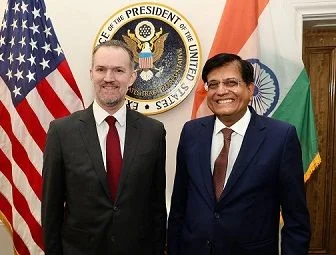
Furthermore, United States Trade Representative Jamieson Greer will arrive in India this week for high-level bilateral discussions. These consecutive diplomatic deliberations emphasize the expanding integration of New Delhi into contemporary global supply chains.
Goyal emphasized that international partners are intensely focused on India’s economic trajectory. The nation continues to cement its position as an attractive destination for global trade and strategic commercial partnerships.
Approximately 93% of Indian outbound shipments will receive duty-free entry into European markets under the comprehensive framework. Simultaneously, tariffs on continental luxury automobiles and European wines will drop, lowering prices for Indian consumers.
Consequently, the domestic apparel sector will secure access to the $263.5 billion European textile market, where current Indian exports sit at $7.7 billion. Tariffs on textiles will plunge from 12% to 0%, lifting labor-intensive small businesses.
Similarly, leather and footwear tariffs will drop from 17% to 0%, helping firms secure orders in the $100 billion European import arena. This structural shift will generate formal employment opportunities and elevate manufacturing standards.
Additionally, precious gems and jewelry tariffs will decrease from 4% to 0%. This reduction reinforces India’s specialized design exports, enhances brand collaborations, and lowers landing costs for plain and studded gold items.
Collectively, India and the European continent command 25% of global gross domestic product. Their joint economic footprint represents one-third, or $11 trillion, of the world’s total $33 trillion international trade volume.
Goyal later informed journalists that Canada wishes to finalize its proposed trade treaty with India within 2026. Canadian Prime Minister Justin Trudeau communicated this objective during the recent G7 Summit hosted in France.
Bilateral negotiators previously completed their second official round of discussions for the Comprehensive Economic Partnership Agreement this past May 2026. Both nations remain committed to advancing their mutual economic frameworks.
The industrial accident occurred on Sunday at the factory in the Kannigaipair-Manjangaranai area near Periyapalayam
Odisha Labour Minister Ganesh Ram Singkhuntia announced ongoing efforts to repatriate the remains of five female workers. The individuals perished during a hazardous ammonia gas leak at a Tamil Nadu seafood export facility.
The industrial accident impacted 74 factory workers, leaving 67 individuals hospitalized for medical observation. Emergency medical teams continue providing specialized treatment to the affected industrial staff in regional medical facilities.
Medical registries confirmed two initial fatalities by 8 pm on Sunday, while three more victims succumbed overnight. Authorities have initiated thorough institutional probes into the structural failure at the export factory.
Odisha Labour Commissioner Indramani Tripathy confirmed that field deployment units verified the tragic deaths of the five women. The state administration is accelerating administrative clearances to assist the grieving migrant families.
Expressing deep condolences, Odisha Chief Minister Mohan Charan Majhi sanctioned an ex-gratia compensation of Rs 4 lakh. The financial relief from the relief fund will aid the next of kin.
The Odisha administration maintains continuous operational contact with Tamil Nadu authorities to oversee medical care. Comprehensive inter-state institutional mechanisms are active to guarantee optimal assistance for the surviving factory workers.
Odisha Chief Secretary Anu Garg conducted urgent high-level telephonic consultations with her counterpart in Tamil Nadu on Sunday. The emergency dialogue focused on streamlining relief operations and ensuring rigorous corporate accountability.
A specialized delegation of Odisha state administrative officials arrived in Tamil Nadu to manage operational logistics. The team is supervising post-mortem evaluations and coordinating with regional law enforcement units.
State official M M Paik will remain stationed in Chennai to manage statutory clearances and post-mortem certifications. Additional administrative personnel are tracking the evolving situation directly within the Tiruvallur administrative zone.
Meanwhile, two administrative officers proceeded directly to Tiruvallur to expedite local inquiries. They are auditing site safety protocols alongside regional infrastructure inspectors.
An initial victim’s body was transferred to Chennai on Sunday evening for specialized forensic examination. The remaining deceased individuals are held at the Tiruvallur district medical facility pending legal protocols.
Medical professionals indicated that several hospitalized industrial workers remain in highly critical condition. Intensive care units are monitoring the victims closely as specialized treatment protocols continue.
Bhubaneswar authorities arrested the nephew of Odisha Transport Minister Bibhuti Bhushan Jena regarding a college student’s death. Law enforcement officials booked the suspect under statutory provisions governing the abetment of suicide.
Investigators identified the detained individual as 24-year-old Biswajit Jena, who was romantically linked to the deceased student. The victim was discovered inside her engineering college residential quarters on Saturday.
Berhampur Superintendent of Police Saravana Vivek confirmed the registration of a formal criminal case at Golanthara. The legal action followed an official statement submitted by the deceased student’s uncle.
Senior police personnel, forensic investigators, and an executive magistrate inspected the scene of the tragedy. Records show the accused was enrolled in the identical computer applications academic program.
Superintendent Vivek stated that definitive clarity regarding the demise depends entirely on the upcoming post-mortem analysis. Comprehensive legal processes will proceed strictly in accordance with statutory criminal frameworks.
The state transport minister and his immediate family members have declined to comment on the matter. No public statements regarding the ongoing criminal investigation have been issued by the family.
Future Outlook
The impending finalization of the India-EU free trade agreement by December 2026 signals a major transformation in global trade architecture. By lowering trade barriers for key sectors like textiles, leather, and jewelry, the agreement will accelerate manufacturing volumes and create thousands of formalized jobs within India. Economists project that the implementation in early 2027 will reconfigure supply chains, offering European buyers a reliable alternative while helping India expand its share in a multi-billion-dollar market.
FAQs
When will the India-EU Free Trade Agreement be signed?
The free trade agreement between India and the European Union is scheduled to be officially signed by December 2026, with implementation slated for February-March 2027.
Which Indian export sectors will benefit the most from the EU FTA?
The primary beneficiary sectors include textiles, leather goods, gems, and jewelry, all of which will see existing European import tariffs drop to 0%.
What percentage of Indian goods will get duty-free access to the EU?
Under the finalized terms of the trade agreement, approximately 93% of Indian export shipments will enjoy complete duty-free access to the 27-nation European Union market.