Akasa Air Eyes IPO by 2030 as Finances Improve
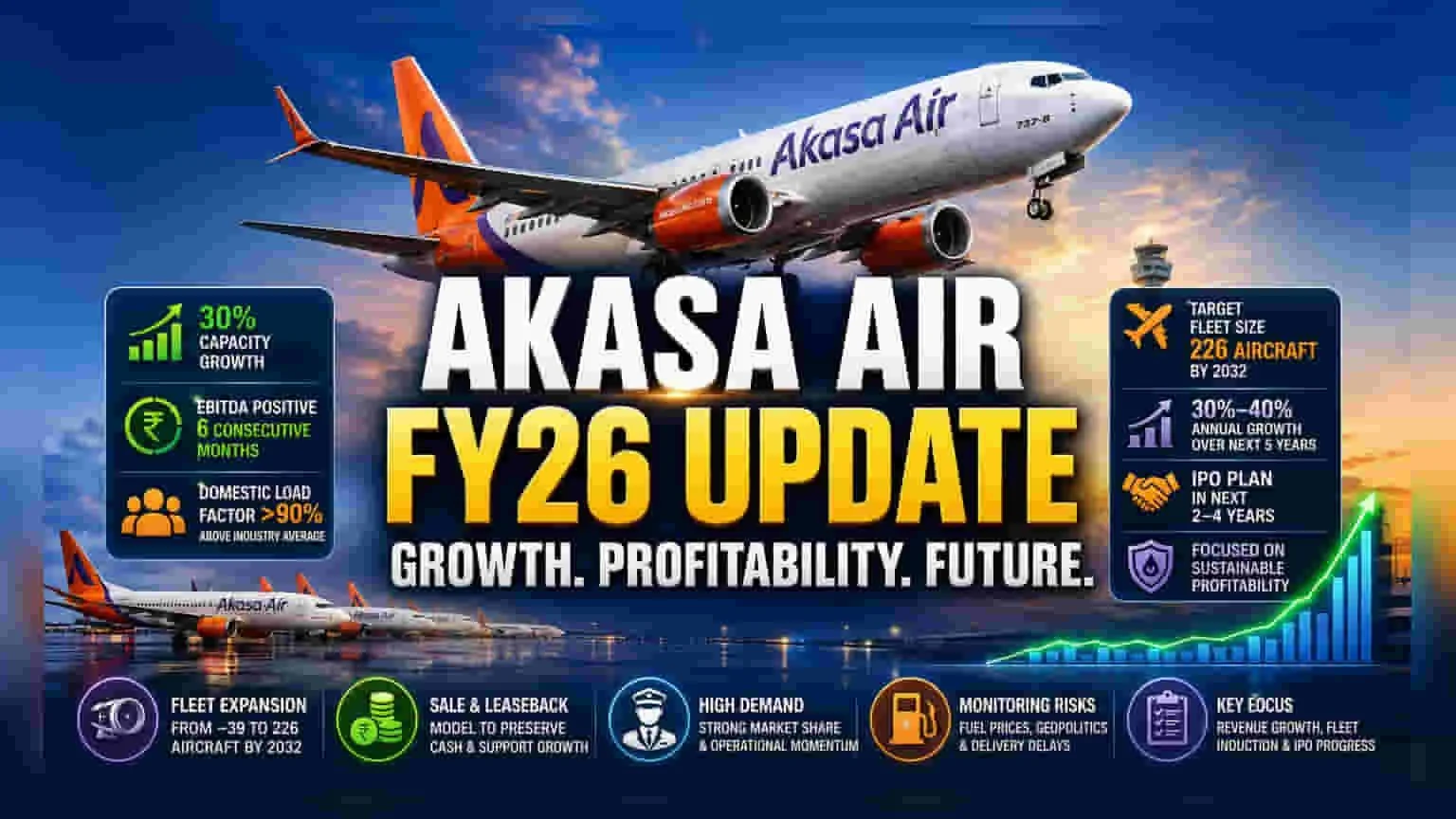
Akasa Air enhanced its financial trajectory during the fiscal year concluding March 2026, capturing six months of core operational profitability despite executing an aggressive capacity rollout. The carrier intends to scale its fleet to 226 jets by 2032 and launch an initial public offering within four years.
Key Highlights
- The low-cost carrier secured positive EBITDA for six consecutive months between September 2025 and March 2026.
- Total operational capacity expanded by 30% year-over-year, while domestic load factors surpassed 90%.
- The airline intends to grow its fleet from 39 to 226 aircraft by 2032 via an annual growth rate of 30% to 40%.
- Preparations are underway for an initial public offering (IPO) targeted within the next two to four years.
Akasa Air, entering the ranks of India’s fresher aviation players, concluded its fiscal year on March 31, 2026, with an improved operating sheet. The enterprise successfully trimmed its operational deficits while simultaneously boosting its overall capacity by 30%.
A primary milestone for the carrier was securing EBITDA positivity—the standard metric for core operational earnings before interest, tax, depreciation, and amortization—for six back-to-back months spanning September 2025 to March 2026.
Though operational parameters moved upward, executive leadership indicated that the final net loss for FY26 might outpace the INR 1,983 crore recorded in FY25. This divergence stems predominantly from non-cash foreign exchange revaluations, which represent notional accounting shifts rather than daily operational cash performance.
Fleet Expansion and Growth Strategy
The aviation firm has mapped out an aggressive scaling pipeline to expand its operational fleet to 226 aircraft by 2032. This target represents a substantial escalation from its active baseline of approximately 39 airplanes.
To achieve this blueprint, Akasa Air is targeting a compounded yearly growth velocity of 30% to 40% over the upcoming five years.
To navigate the steep capital outlays required for aircraft procurement, the enterprise has leaned heavily on a sale-and-leaseback model. This financial mechanism permits the airline to liquidate newly acquired aircraft and instantly lease them back, thereby protecting its cash reserves.
As the organizational footprint broadens, corporate treasury is investigating alternative financing arrangements to sustain this highly capital-intensive corporate expansion.
Impact on the Aviation Sector
For market participants tracking the broader Indian aviation landscape, the aggressive scaling of Akasa Air marks a notable shift. The airline documented domestic passenger load factors climbing past 90%, a metric pacing significantly above the broader sector mean.
This demand velocity indicates that the newcomer is efficiently capturing market share from incumbents.
As Akasa Air advances toward an initial public offering within the next two to four years, its market presence will likely bottleneck available airport slots, spark talent bidding wars for skilled pilots, and alter passenger distribution. This shifting dynamic places heightened operational pressure on listed market peers like IndiGo and SpiceJet to defend their operational cost structures and consumer service benchmarks.
Risks and Industry Challenges
Accelerated corporate scaling in the airline business brings structural vulnerabilities. Parallel to its industry peers, Akasa Air remains exposed to volatile macro headwinds, including stubbornly high aviation turbine fuel (ATF) pricing structures.
The corporate office is additionally tracking escalating geopolitical frictions in West Asia, which maintain the potential to disrupt global fuel supplies and aerospace supply chains.
Management clarified that its international flight corridors originating from Mumbai and Bengaluru bypass sensitive geographical airspaces entirely. Even so, regional geopolitical instability remains a permanent monitoring priority for the board. Furthermore, potential delivery delays from global aircraft manufacturing plants could stall the carrier’s deployment timelines and inflate fixed unit costs.
What Investors Should Track Next
Wall Street and local bourses must now scrutinize Akasa Air’s systemic transition toward baseline net profitability, given that positive EBITDA represents merely an initial operational step.
Primary indicators to monitor include the official progress toward the proposed public listing, the real-world pace of aircraft delivery against internal targets, and the defensive counter-strategies deployed by listed legacy carriers.
The longevity of unit revenue expansion, which achieved a 10% upward bump over the prior year, remains a pivotal metric to confirm the carrier’s long-term commercial viability.
Future Outlook
The Indian aviation corridor is positioned for intense consolidation and capacity battles heading toward 2030. With Akasa Air targeting a multi-fold fleet surge to 226 aircraft, the market will face a test of structural demand elasticity. If the carrier successfully translates its high load factors into consistent net profits while navigating volatile jet fuel matrices, its upcoming IPO could redefine valuation multiples for low-cost carriers across South Asia.
FAQs
What were Akasa Air’s financial results for the fiscal year ending March 2026?
Akasa Air narrowed its operational losses and achieved positive EBITDA for six consecutive months between September 2025 and March 2026. However, its total net loss for FY26 may exceed the INR 1,983 crore reported in FY25 due to non-cash foreign exchange accounting revaluations.
How large does Akasa Air expect its aircraft fleet to be by 2032?
The airline plans to scale its fleet to 226 aircraft by 2032, expanding from its current operational base of approximately 39 airplanes through an annual growth rate of 30% to 40% over the next five years.
When does Akasa Air plan to launch its initial public offering (IPO)?
Akasa Air is structuring its corporate timeline to launch an initial public offering within the next two to four years, aiming to list on public stock exchanges by approximately 2028 to 2030.
What financing model is Akasa Air utilizing to fund its aircraft acquisitions?
The airline primarily utilizes a sale-and-leaseback model to acquire planes and immediately lease them back, which helps preserve operational liquidity. Management is also exploring alternative capital structures to fund its future expansion.