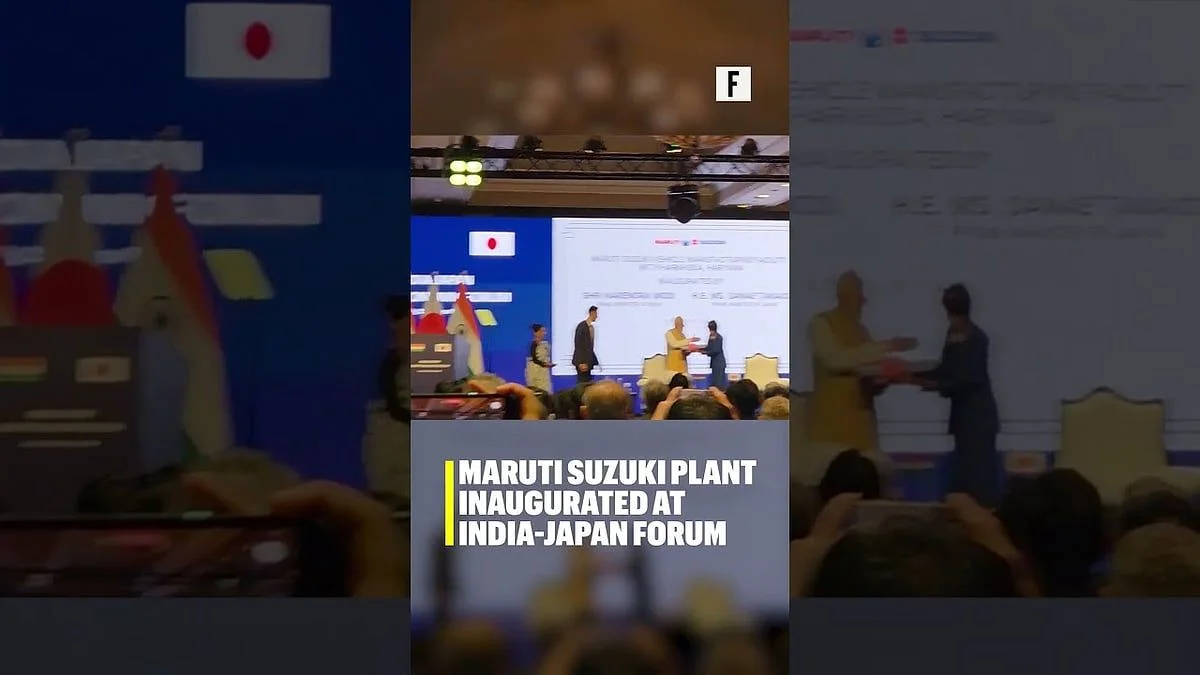
PM Modi and Japan PM Inaugurate Rs 35,000 Crore Maruti Suzuki Plant
Prime Minister Narendra Modi and Japanese Prime Minister Sanae Takaichi jointly inaugurated Maruti Suzuki’s new Rs 35,000 crore manufacturing facility at Kharkhoda, Haryana, via video conferencing. The mega facility marks a significant expansion in India’s automotive sector, boosting domestic production, employment, and sustainable industrial practices under the bilateral economic partnership.
Key Highlights
- Prime Ministers of India and Japan virtually inaugurated the Rs 35,000 crore Maruti Suzuki facility at IMT Kharkhoda.
- The 800-acre facility is projected to scale its annual production capacity to 10 lakh vehicles at full operations.
- The automotive project is expected to generate more than 21,000 direct jobs through the plant and its integrated supplier park.
- Operating on 100 per cent renewable energy, the facility incorporates Industry 5.0 systems, AI collaborative robots, and green logistics.
The virtual inauguration of the automobile production site was finalized by Prime Minister Narendra Modi and Japanese Prime Minister Sanae Takaichi during the India-Japan Joint Economic Forum. The high-profile event underscored the deepening economic ties between the two nations across critical sectors.
Suzuki Motor Corporation Representative Director and President Toshihiro Suzuki expressed immense privilege during the event. He highlighted that the advanced car manufacturing facility will transition from an initial 500,000-unit capacity to a final 1,000,000-unit output, making it a premier automotive plant globally.
Speaking at the New Delhi forum, Toshihiro Suzuki emphasized that the facility validates the Make in India campaign. He credited the supportive regulatory landscape created by Prime Minister Modi for accelerating corporate investments, employment generation, export growth, and technical integration toward national development targets.
The automotive facility launch served as a cornerstone of the broader bilateral economic forum. Delegates from both nations utilized the summit to reinforce strategic manufacturing partnerships while expanding alliances in semiconductors, artificial intelligence, digital technology, clean energy networks, and modern mobility.
The launch took place during the 16th India-Japan Annual Summit. The diplomatic event coincided with Prime Minister Takaichi’s debut official state visit to India, scheduled from July 1 to July 3, 2026.
Occupying an 800-acre land parcel, the industrial complex incorporates a dedicated supplier ecosystem. The manufacturing site is designed to yield an ultimate annual production capacity of 10 lakh vehicles, while creating over 21,000 direct employment opportunities for the regional workforce.
The Kharkhoda hub represents the fourth major automotive production site for Maruti Suzuki within the Indian market. Company executives have designed this specialized production layout to serve as one of the corporation’s most technologically advanced manufacturing ecosystems.
The total fiscal deployment for the industrial project is valued at Rs 35,000 crore. This capital allocation covers both primary factory setups and ancillary jobs generated by the integrated supplier park operating inside the automotive complex.
Corporate leadership stated that the project serves as a crucial benchmark toward achieving a broader corporate objective of 40 lakh annual units in total manufacturing capacity. The facility directly advances the national manufacturing strategy of “Make in India, Make for the World.”
The industrial design prioritizes smart manufacturing and environmental conservation. The site leverages Industry 5.0 operational methodologies under the “Suzuki Smart Factory” blueprint and derives its entire electricity supply from 100 per cent renewable energy sources.
Environmental features at the site include a Zero Liquid Discharge setup alongside 100 per cent water recycling infrastructure. Factory operations will utilize AI-driven collaborative robots (cobots), an automated biogas plant slated for a FY2026-27 launch, a 70 MW solar grid, and internal rail infrastructure for sustainable logistics.
The Kharkhoda establishment extends the automaker’s domestic footprint alongside established sites in Gurugram, Manesar, and Gujarat. The initial foundation stone was set virtually by Prime Minister Modi in August 2022, leading to commercial manufacturing commencement on February 25, 2025.
Future Outlook
The Kharkhoda manufacturing complex positions Maruti Suzuki to scale its total Indian manufacturing output to 40 lakh units annually. As India and Japan deepen technological integration, the plant’s Industry 5.0 standard serves as a blueprint for future automotive investments. The planned commissioning of an on-site biogas plant during FY2026-27 and the scaling of the internal 70 MW solar plant will further cement the facility as a benchmark for green, automated industrial manufacturing in South Asia.
FAQs
Where is the new Maruti Suzuki plant located?
The new Maruti Suzuki vehicle manufacturing facility is located at IMT Kharkhoda in the state of Haryana, India, spanning across an 800-acre industrial site.
What is the total investment and employment potential of the Kharkhoda plant?
The project represents a total investment of Rs 35,000 crore and is projected to generate more than 21,000 direct jobs, including employment created through its integrated supplier park.
What are the key green features of the Kharkhoda manufacturing facility?
The plant operates on 100 per cent renewable electricity, features a 70 MW solar power plant, includes a Zero Liquid Discharge water recycling system, utilizes an in-plant railway siding for green logistics, and plans to commission a biogas plant during FY2026-27.