BMW India Deploys Two-Pronged Mini Strategy to Overtake Mercedes
German premium car manufacturer BMW is preparing a long-term commercial offensive in India to secure the top position in the luxury segment. The automaker is deploying a decisive two-pronged market approach after spending several years ranking behind its primary global competitor in the domestic marketplace.
Key Highlights
- BMW launched the locally assembled Mini Countryman C SUV for ₹47 lakh to target younger urban buyers.
- The automaker aims to double MINI’s dealer network to 21 outlets and expand into Tier-II and Tier-III cities.
- BMW leads India’s luxury EV segment, with the iX1 accounting for over 85% of its electric vehicle sales.
- Group CEO Hardeep Singh Brar urged the government to issue clear timelines regarding higher E30 ethanol fuel blends.
The industrial strategy shifts substantial capital and corporate focus toward the MINI brand, a British automotive label acquired by the German parent firm more than 30 years ago. This coordinated expansion intends to unseat Mercedes-Benz as the largest premium vehicle manufacturer across the fast-growing South Asian economic subcontinent.
On June 16, 2026, the conglomerate introduced the Mini Countryman C sport utility vehicle at a competitive retail price of ₹47 lakh. The vehicle represents the inaugural locally manufactured SUV within the brand’s premium portfolio, aiming to capture shifting consumer preferences.
Group executive leadership emphasizes that the British label holds deep aspirational value for contemporary, upwardly mobile urban buyers nationwide. Hardeep Singh Brar, president and chief executive officer of BMW Group India, confirmed this strategic positioning during the official vehicle presentation on June 17, 2026.
The aggressive pricing model places the five-seater premium utility vehicle in direct competition with established mass-market alternatives like the Toyota Fortuner and Skoda Kodiaq. This commercial overlap underpins a broader framework where the British badge undergoes rapid network distribution enhancement to augment standard group operations.
Combined operations target annual distribution exceeding 20,000 vehicles, representing an expansion of over 11% against current volumes of approximately 18,000 units. Florian Kuentner, vice president for the brand across China, Asia-Pacific, Eastern Europe, Middle East, and Africa, reported 42% year-to-date regional volume expansion.
The manufacturing group is introducing two entirely redesigned platforms this year, marking the most expansive product lineup in domestic corporate history. Corporate strategy focuses on delivering multiple drivetrain options while utilizing the expanded dimensions of the new SUV to attract traditional family buyers.
Large-scale investments in battery-electric propulsion during 2025 allowed the organization to significantly narrow the volume deficit with its chief premium rival. The launch of the long-wheelbase iX1 electric utility vehicle at ₹50 lakh fundamentally altered corporate sales dynamics across major metropolitan distribution nodes.
This specific battery-electric platform now commands over 85% of total zero-emission passenger car deliveries for the German manufacturing group locally. The corporation retains the status of top luxury electric vehicle manufacturer in the country, maintaining annual zero-emission deliveries of nearly 3,800 units.
Historically, consumers recognized the British brand primarily for compact, specialized hatchbacks utilized as auxiliary vehicles within affluent multi-car garages. The updated SUV strategy re-engineers this consumer perception by scaling domestic factory assembly lines and widening retail footprints to capture younger demographic cohorts.
Customer groups and distribution partners explicitly requested larger vehicular footprints, prompting the current manufacturing transition toward higher-volume platforms. Executive leadership intends to double total nationwide delivery volumes while expanding the dedicated retail footprint to 21 distinctive operational dealerships.
The expanded distribution network will leverage existing corporate service infrastructure while establishing new dedicated physical points of sale across emerging urban economies. New facilities are scheduled to open in regional centers including Jaipur, Lucknow, Ranchi, Guwahati, Vijayawada, and Jodhpur to capture decentralized wealth.
The premium brand registered 730 deliveries last year, comprising a minor share of the primary German badge’s total volume of 18,001 units. Total corporate deliveries rose nearly 15% over the twelve-month period, whereas the primary competitor encountered a 3% contraction in overall transactional volume.
Despite the divergence in growth trajectories, the leading premium manufacturer continues to outpace the group by roughly 1,000 finished units annually. Doubling total volume for the smaller British brand serves as a core mechanism to bridge this specific competitive volume gap.
Although the domestic arena is not yet the fastest-expanding regional market for the brand within Asia, localization efforts remain highly promising. Executive leadership projects that localized production of the larger utility model provides an immediate opportunity to secure leadership in growth velocity.
Local factory optimization reduces base production outlays while preserving dynamic handling characteristics described by engineering teams as kart-like performance capabilities. Financial divisions support these product rollouts through structured residual asset protection programs ensuring significant future trade-in values for retail consumers.
The financial packages guarantee up to 59% residual asset valuation after a four-year ownership cycle and 66% after a three-year period. These guaranteed buyback mechanisms form an essential element of modern asset acquisition strategies within the high-end domestic automotive marketplace.
Market analysis by research firm Mordor Intelligence values the domestic luxury automotive sector at $1.5 billion, projecting expansion to $1.92 billion by 2031. Accelerating household capital accumulation acts as the primary systemic catalyst driving demand for ultra-premium consumer goods across major metros.
The Mercedes-Benz Hurun India Wealth Report 2025 indicates the domestic market contains approximately 870,000 millionaire households possessing an individual net worth near ₹8.7 crore. This demographic metric represents nearly twice the volume of affluent households recorded by wealth researchers in 2021.
High-end models represent a mere fraction of overall industry volume, accounting for 50,000 units out of 4.5 million total passenger vehicles. Group leadership states that sustainable corporate expansion requires a highly robust entry-level foundation to capture consumer upgrades over extended product life cycles.
This corporate philosophy stands in contrast to rival manufacturing strategies that prioritize top-tier premium vehicle portfolios over entry-level luxury assets. The multi-brand offensive forces a structural reassessment of traditional product segmentation and market share preservation across the premium automotive sector.
Concurrently, the transition toward alternative energy architectures introduces operational considerations, particularly regarding the state-backed ethanol-blended fuel program. Geopolitical fluctuations affecting Middle Eastern energy corridors emphasize the broader national imperative to achieve energy autonomy through alternative fuel portfolios.
National regulatory agencies have implemented E20 petrol standards to successfully mitigate overall crude import expenditures and improve external trade balances. However, administrative planning bodies are investigating higher concentrations including E22, E25, E27, and E30 blends to further strengthen energy independence.
Engineering compatibility across the active national passenger vehicle fleet remains a technical concern for manufacturing firms and regulatory agencies alike. The majority of operating road assets were engineered for lower ethanol mixtures, posing long-term durability risks to critical mechanical components.
Chief Executive Hardeep Singh Brar confirmed that converting existing engine architectures to handle E30 mixtures presents complex engineering challenges. Thorough scientific evaluation of fuel distribution lines, engine blocks, and ancillary components is required before enacting higher mandatory blend thresholds.
The domestic fleet includes millions of registered vehicles exceeding ten years in age that lack engineering compliance for baseline E20 fuels. Mandatory manufacturing regulations for E20 compatibility took effect in April 2023, leaving a large legacy fleet exposed to prospective fuel changes.
High-end consumers have already communicated initial technical concerns regarding fuel compatibility to corporate field offices, prompting calls for structural protections. Premium brands emphasize that regulatory predictability and multi-fuel distribution options at retail pumps are essential to preserve consumer market confidence.
Future Outlook
The domestic premium automotive market is positioned for significant realignments as manufacturers calibrate product portfolios for emerging wealth centers outside tier-one urban regions. The emphasis on localized vehicle manufacturing, robust entry-level luxury pricing models, and specialized sport utility architectures highlights a structural shift toward broader customer acquisition.
Simultaneously, long-term premium sector performance remains tied to regulatory adaptability as manufacturers transition toward higher localized alternative fuel standards and electric powertrains. Managing infrastructure updates alongside fuel composition variations will govern brand equity and volume expansion objectives heading into the next decade.
FAQs
What is the price and manufacturing status of the new Mini Countryman C?
The Mini Countryman C is priced at ₹47 lakh and stands as the first locally assembled sport utility vehicle in the brand’s domestic product lineup.
How large is the projected growth of the premium vehicle market in India?
The premium automotive market is currently valued at $1.5 billion and is expected to expand to $1.92 billion by 2031, supported by a rising population of wealthy households.
Can older luxury vehicles operate safely on E30 ethanol-blended fuel?
Existing engines and legacy fuel systems are generally optimized for E20 or lower blends, and upgrading them to handle E30 presents complex technical challenges that require rigorous manufacturing and engineering validation.
Similar Posts
India EV Charging Infrastructure Growth and Challenges
India’s electric vehicle revolution accelerates, driving massive demand for public charging networks, highway corridors, and smart grid solutions.
India EV Transition Faces Critical Trust and Financing Challenges
Indian fleet operators manipulate low-speed electric vehicle regulations while VinFast secures a major financial backing with Tata Capital.
Kia To Launch Multiple Hybrid SUVs And MPVs In India
Kia plans to expand its Indian portfolio with new hybrid vehicles, including the Seltos and Sorento, to counter rivals like Mahindra.
Aprilia SR Tribute Edition Scooters Launched in India
Aprilia India introduces the military-inspired SR 175 and SR 125 Tribute Edition scooters with distinct camouflage livery.
Indian Two-Wheeler Industry Growth to Moderate in FY27
ICRA forecasts Indian two-wheeler volume growth to ease to 3-5% in FY27 due to an elevated base effect and El Niño risks.
JSW Group Transforms MG Motor India Automotive Strategy
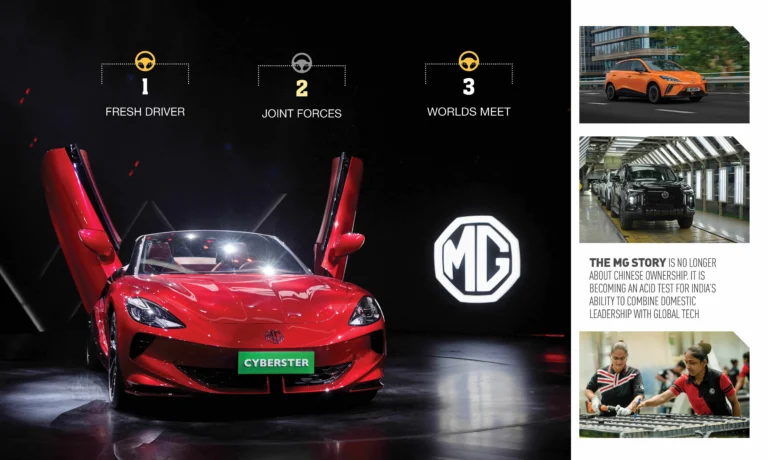
JSW Group takes control of MG Motor India, shifting the brand from Chinese ownership concerns toward an Indian-led, technologically advanced future.