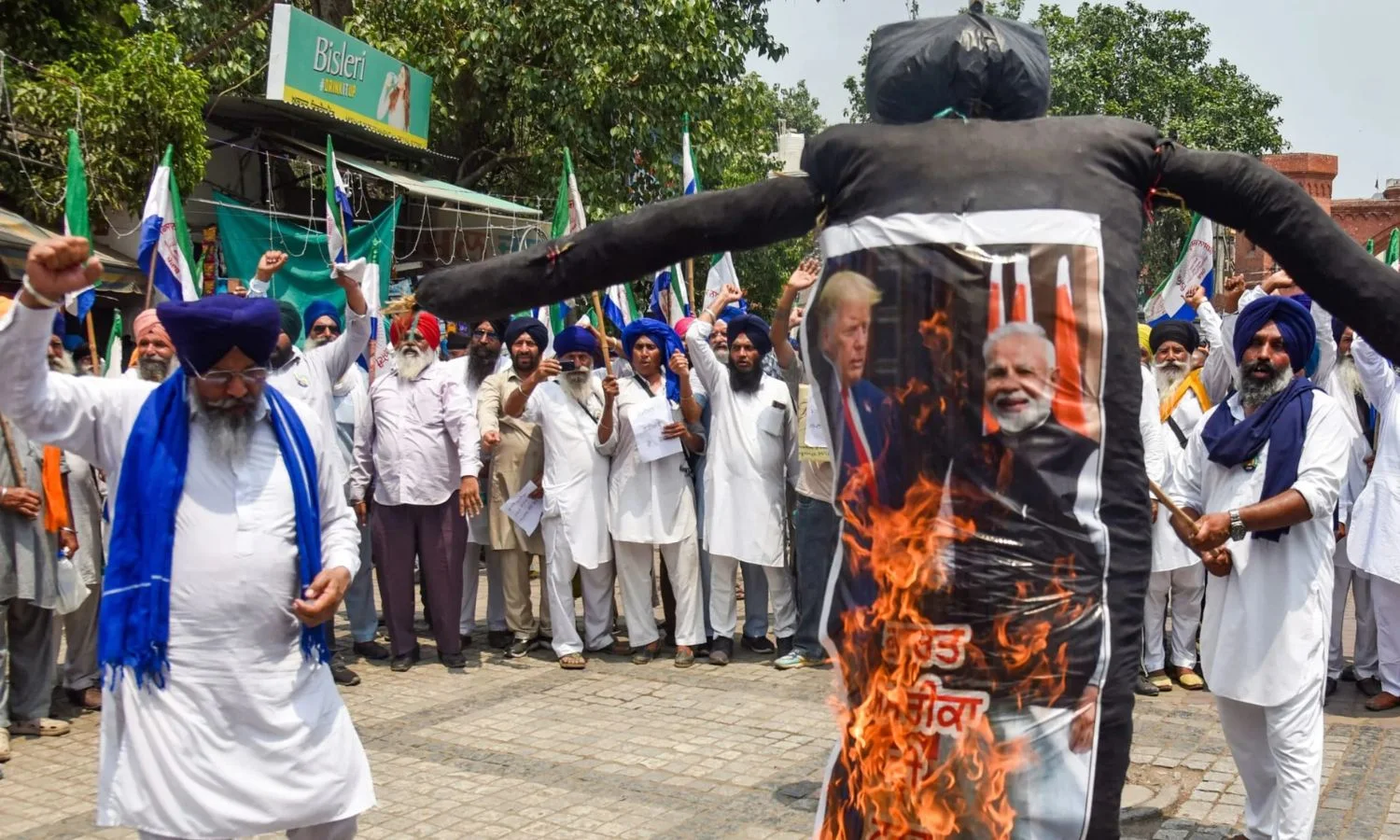
Punjab Farmers Protest Proposed India US Trade Agreement Over Market Threats
Agricultural demonstrators organized under the Kisan Mazdoor Morcha staged widespread protests across Punjab on Wednesday to oppose a proposed trade pact between India and the United States, claiming the agreement jeopardizes local agrarian livelihoods, laborers, small-scale merchants, and employment opportunities for the youth.
Key Highlights
- Protests spanned 28 locations across 21 districts in Punjab, driven by the Kisan Mazdoor Morcha coalition.
- Demonstrators burned effigies of Prime Minister Narendra Modi and US President Donald Trump during the rallies.
- Activists argue the deal exposes smallholder Indian farmers to asymmetric competition from heavily subsidized American agricultural imports.
- The union demands a legal guarantee for Minimum Support Price and the withdrawal of upcoming electricity and seed legislation.
Agitating cultivators expressed their dissent by burning effigies of Prime Minister Narendra Modi and US President Donald Trump. The coordinated demonstrations, orchestrated by the Kisan Mazdoor Morcha, materialized at approximately 28 distinct sites spanning 21 districts throughout the state of Punjab.
Protesters shouted adversarial slogans directed at the union government while demanding the immediate cessation of the contemplated bilateral commerce pact. In the Hoshiarpur district, local administrative head Paramjit Singh Bhulla directed the demonstration.
Union representatives asserted that the international accord would grant foreign commodities unfettered access to the domestic agrarian marketplace. They emphasized that this influx would severely disadvantage smallholder and marginal cultivators.
The leadership argued that state commercial strategies systematically favor transnational corporations and global mercantile interests, disregarding the economic survival of domestic farmers and the vital dairy sector.
Activists pointed out that American agricultural producers benefit from substantial Washington subsidies and manage massive operations, creating an uneven playing field for Indian counterparts who largely manage fractional plots.
Organizers warned that the trade deal could spark a massive influx of foreign grains, pulses, fruits, vegetables, and miscellaneous foodstuffs, destabilizing local crop pricing and the broader rural financial framework.
Speakers accused central authorities of replicating the unilateral strategy utilized during the formulation of the previous three controversial farm laws, noting that agricultural syndicates and essential stakeholders were entirely excluded from preliminary policy deliberations.
Beyond blocking the transcontinental trade pact, the gathered crowds demanded the immediate repeal of the Electricity Amendment Bill 2025 and the Seed Bill 2025, while simultaneously rejecting the deployment of automated smart electricity meters.
Kisan Mazdoor Morcha officials maintained that the economic ramifications extend far beyond the agrarian community, threatening the financial stability of laborers, independent shopkeepers, salaried employees, and civilian consumers. They urged public solidarity against these corporate-friendly measures.
Bhartiya Kisan Union (Doaba) chief Manjit Singh Rai referenced a recent brief from Union Agriculture Minister Shivraj Singh Chouhan regarding monsoonal forecasts, which highlighted potential rainfall deficits in specific regions, to underscore the necessity for heightened state preparedness.
Rai reiterated the long-standing demand of agricultural unions for a statutory framework guaranteeing a Minimum Support Price for all cultivated varieties. He pressed administrators to incentivize water-conscious crop rotations and optimize existing canal network distribution.
The union chief concluded that codifying crop price assurances and modernizing irrigation delivery systems would secure rural livelihoods while safeguarding national food reserves and depleting subterranean water tables.
Rai additionally advocated for the establishment of decentralized, district-level administrative units tasked with resolving localized farming grievances and managing volatile climate developments.
Future Outlook
The escalating friction between agricultural unions and the central government signals a challenging path forward for international trade negotiations. As the administration balances global diplomatic ties with domestic stability, grassroots resistance in agrarian hubs like Punjab will likely force stricter scrutiny of import terms. Future policy shifts will depend on whether the government initiates formal dialogues with union leaders regarding statutory price protections and resource management before finalizing cross-border economic treaties.
FAQs
Why are Punjab farmers protesting against the India-US trade agreement?
Farmers believe the proposed deal will open the domestic market to heavily subsidized American agricultural products. They argue that local smallholders cannot compete with large-scale US operations, which could drastically lower crop prices and damage the Indian rural economy.
What are the main demands of the Kisan Mazdoor Morcha?
The organization demands the total cancellation of the proposed India-US trade pact, a legally binding guarantee for the Minimum Support Price on all crops, and the immediate withdrawal of both the Electricity Amendment Bill 2025 and the Seed Bill 2025.
How widespread were the demonstrations in Punjab?
The protests occurred across 28 separate locations covering 21 districts within the state, indicating a highly coordinated mobilization by the agricultural unions.
Why are farmers opposing the Seed Bill 2025 and smart meters?
Cultivators fear that new legislative bills will increase production costs, compromise seed sovereignty by favoring multinational corporations, and lead to inflated power tariffs through privatized smart metering systems.