Indigenous Youth Empowered Through Mountain Stone Equine Program
An innovative equine program founded by Indigenous riders is transforming youth development and preserving cultural traditions through intensive horsemanship and rodeo training.
Key Highlights
- Mountain Stone Equine connects Indigenous youth with horsemanship, rodeo skills, and the rapid sport of Indian relay.
- The program addresses community trauma and mental wellness by offering consistent, culturally relevant equine training.
- Only 10% of Indigenous youth typically access traditional equestrian sports, powwows, or cultural arts.
- Founders face significant funding hurdles, operating as volunteers while seeking official charity status in 2026.
Community restoration and personal empowerment drive the Crawler family to reintegrate equestrian traditions into local Indigenous populations.
Lita Crawler, an Îyârhe Nakoda cowgirl, grew up mastering calf roping and barrel racing alongside her siblings.
The family maintained deep ties to the rodeo circuit, practicing their skills across regional arenas.
Crawler spent her youth traveling to venues at the Tsuut’ina or Kainai Nation due to a lack of accessible equine facilities in Mînî Thnî.
Her sister, Gracie Crawler-Jackson, noted that traveling over 1 hour to ride was mandatory because local infrastructure was unavailable.
Crawler-Jackson observed that while modern equine programs exist, they lack consistency and rarely collaborate directly with the youth to address their actual desires.
The persistent deficit in local sports opportunities motivated the sisters to establish a platform for youth eager to learn riding.
The initiative became deeply personal after Crawler lost two close friends to substance abuse, highlighting the systemic vulnerabilities facing local peers.
Supported by their mother, the sisters utilized their deep knowledge of horses to initiate systemic community change.
Crawler-Jackson emphasized that roughly 90% of Indigenous youth lack access to equestrian sports, traditional regalia, beading, or competitive Indian relay racing.
She stated that individuals possessing the privilege to participate in these traditions bear a distinct responsibility to extend that access to others.
To empower youth through equine-assisted learning, the sisters launched Mountain Stone Equine with the support of their parents, Troy and Amanda Crawler.
Operating as the program coordinator, Crawler-Jackson highlighted that the organization is uniquely built on the lived experiences of reservation youth.
While numerous equine programs exist across Canada, this initiative focuses specifically on teaching discipline, athleticism, and competitive rodeo skills.
Based at Star 6 Ranch, the curriculum emphasizes fundamental horsemanship before advancing students into high-speed Indian relay techniques.
Crawler noted that the program focuses heavily on individual personal development, fostering leadership, communication, and self-confidence.
Crawler-Jackson explained that rodeo requires extreme mental fortitude, as competitors must manage rapid shifts between victory and sudden errors.
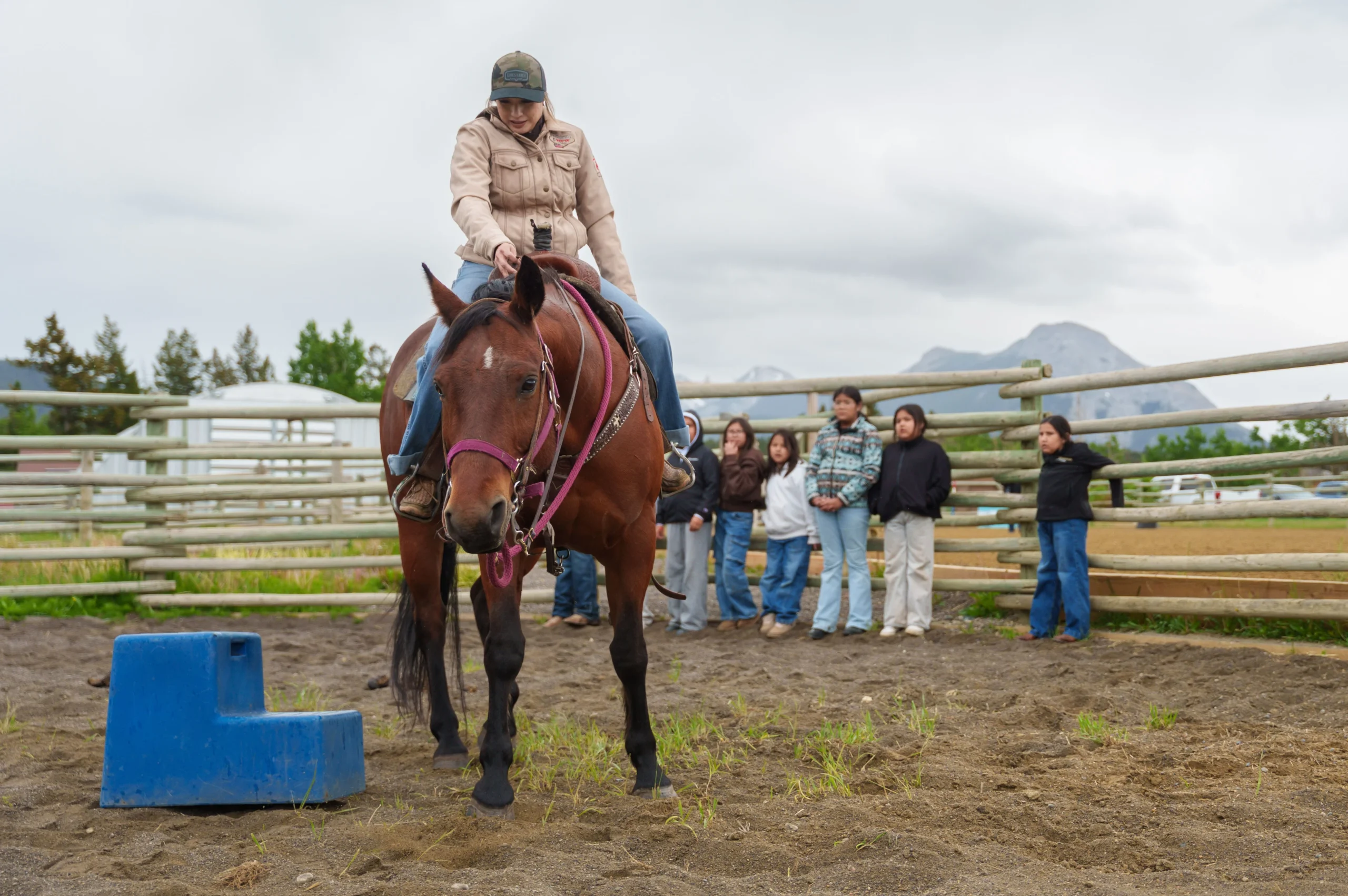
The organization runs an after-school program every Wednesday night, where Crawler personally instructs youth in saddling and riding.
The Chiniki First Nation rider remarked that timid participants consistently discover confidence through direct interaction with the horses.
Crawler-Jackson recalled a training session with high school students from the Piikani Nation that demonstrated significant emotional breakthrough.
School chaperones noted that previously isolated students began smiling and communicating freely, marking a major success for the program.
New exposure to the sport inspires many young participants to pursue future careers in professional rodeo circuits.
Crawler-Jackson emphasized that grassroots leadership outside of formal chief and council roles can generate substantial community progress.
The founders consciously designed the space to welcome youth from all Nations, breaking down historical patterns of tribal exclusivity.
Crawler committed fully to the sport after experiencing her first Indian relay competitive event in 2018.
She quickly advanced from her initial race with a Mînî Thnî team to competing in elite barrel racing events across North America.
Crawler recalled her surprise and excitement upon discovering the inclusion of the Lady Warrior event on an early promotional poster.
Her current participation is driven by a desire to inspire young girls who express an eagerness to learn advanced riding skills.
As she grows older, Crawler views her role as a responsibility to sustain the Lady Warrior tradition for future generations.
Despite the broad commercial growth of Indian relay, local youth participation within the Stoney Nakoda First Nation has declined over time.
Crawler-Jackson observed that the community previously produced numerous world champions, a trend that has slowed among younger generations.
While relay racing previously served as a central feature of Banff Indian Days, very few families currently pass down these traditions.
Elder Henry Holloway, a former jockey who competed in Banff, expressed a strong desire to see his people return to those historic tracks.
Crawler-Jackson shared that elders believe horses possess a foundational healing power intended to restore the community.
Funding hurdles
Operating since 2024, Mountain Stone Equine faces early-stage operational challenges to maintain free programming for youth.
The founders currently sustain the entire operation on a completely voluntary basis.
While the Star 6 Ranch Foundation provides critical facility access, acquiring horses and continuous resources remains difficult.
Crawler-Jackson noted that Indigenous business owners face heightened barriers, particularly when navigating bureaucratic grant approval processes.
Securing necessary corporate or government funding frequently requires timely authorizations from band leadership, which can cause administrative delays.
The sisters are actively pursuing official charity status to secure consistent weekly and monthly programming.
Crawler emphasized that reliable funding is the primary requirement to satisfy the high demand from youth wanting to return.
Future Outlook
Mountain Stone Equine aims to establish its own dedicated riding facility to escape current operational limitations. By obtaining official Canadian charity status, the organization plans to secure long-term corporate sponsorships and federal grants. This financial stability will fund a permanent, indigenous-led Indian relay team and expand weekly after-school programs to reach multiple First Nations communities across the region.
FAQs
What is Mountain Stone Equine?
Mountain Stone Equine is an Indigenous-led organization founded in 2024 that provides youth with free equine-assisted learning, competitive rodeo training, and Indian relay instruction.
Where does the equine program take place?
The program operates out of the Star 6 Ranch facility located in Exshaw, offering structured horsemanship courses every Wednesday night.
What funding challenges does the organization face?
The initiative runs entirely on volunteer labor and faces difficulties securing horses and resources due to complex grant structures and administrative hurdles.
Who can participate in the programs?
The program is explicitly designed to be inclusive, welcoming Indigenous youth from all Nations rather than restricting access to a single community.