Pashupati Seal Debate Sparks Indian Identity Clash
A fierce academic battle over the 4,300-year-old Pashupati Seal has erupted, highlighting the persistent difficulties in defining the civilizational identity of India through ancient archaeological discoveries.
Key Highlights
- An online dispute over an ancient artifact has reignited major debates concerning the continuity of Indian civilization.
- Scholars are heavily divided on whether the artifact represents a Proto-Shiva figure or an imported Eurasian deity.
- The clash exposes deep systemic rifts between indigenous historical perspectives and Western academic institutions.
The core issue raised by the Pashupati Seal debate is the ongoing challenge of defining India’s civilizational identity through the interpretation of ancient artifacts.
“The most effective way to destroy people is to deny and obliterate their own understanding of their history.” – George Orwell
Reconstructing historical narratives demands constant navigation between objective reality and the inevitable subjectivity involved in choosing, analyzing, and presenting historical data. Instead of offering neutral commentary, historians frequently select and interpret fragmented, non-objective evidence. This systemic complexity reveals that constructing history is far from a purely detached or scientific endeavor. It remains highly contested, open to constant modification, and heavily impacted by contemporary political and cultural friction.
The current public dispute over the true meaning of the “Pashupati” Seal from the Indus Valley Civilization, which scholars now frequently term the Sindhu-Saraswati Civilization, demonstrates this reality. Rutgers University Professor Audrey Truschke’s challenge to the orthodox reading of the artifact highlights the intense difficulty of establishing absolute historical truths. This academic collision emphasizes how historical analysis simultaneously molds and reflects contemporary cultural frameworks.
PASHUPAT SEAL AND MINISTRY OF CULTURE POST
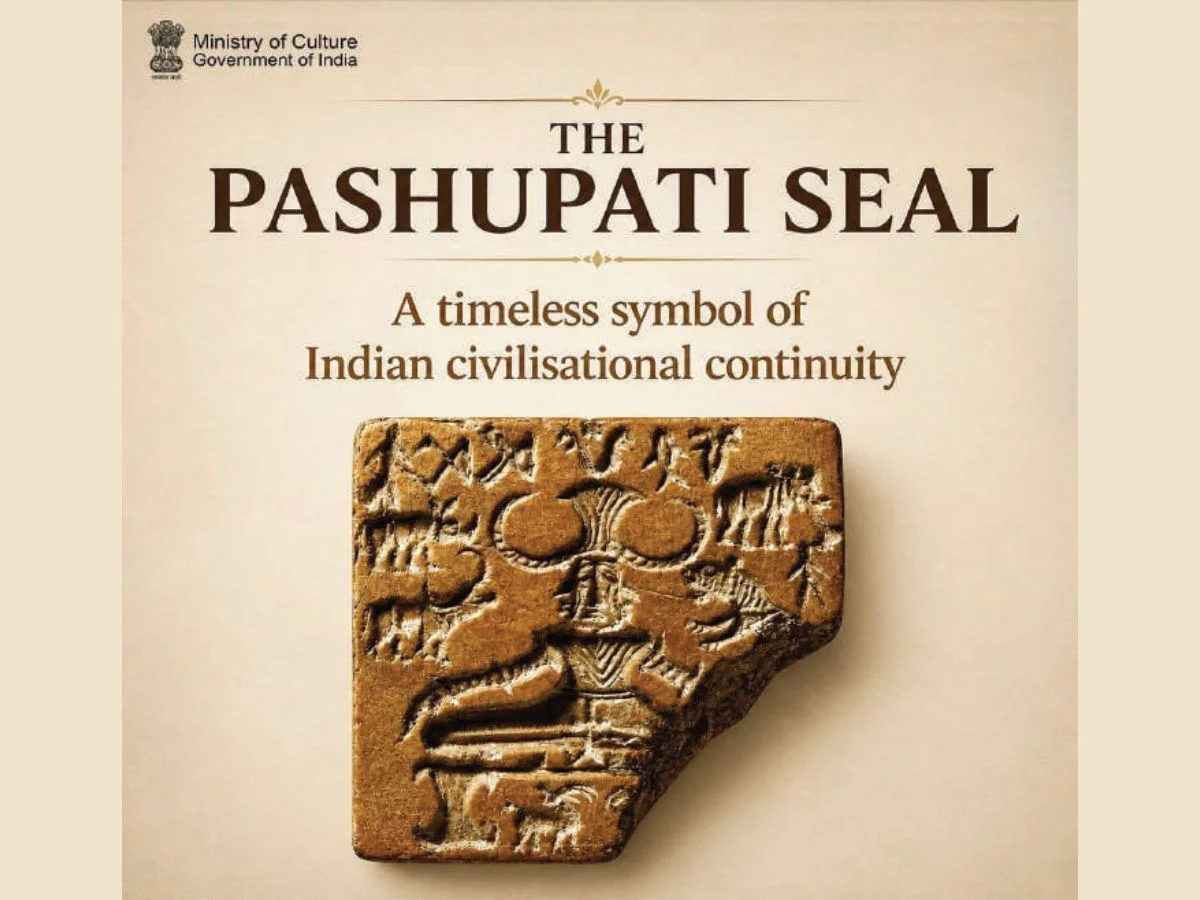
A social media post on X by Rutgers University South Asian History Professor Audrey Truschke ignited intense global debate regarding a famous artifact. Truschke responded directly to a photograph of the seal published by the Ministry of Culture of India on May 27-28, 2026. Discovered at Mohenjo-daro during excavations in 1928-29, the steatite object dates back roughly 4,300 years. It portrays a seated, potentially three-faced individual sporting a prominent horned headdress in a cross-legged position. Observers frequently compare this specific meditative stance to the traditional yogic posture known as Mulabandhasana. Diverse fauna, including a rhinoceros, an elephant, a buffalo, and a tiger, border the central figure. Renowned British archaeologist John Marshall famously designated the depiction as “Proto-Shiva” or an early variation of Pashupati, linking it directly to later Hindu deities.
The Ministry of Culture initiated the discourse by framing the artifact as a crucial emblem representing the uninterrupted continuity of Indian civilization. The government agency focused specifically on the evident yogic stance, the clear Shaivite attributes, and the religious links to contemporary Hinduism.
Truschke aggressively countered the official state narrative in a direct reply on the social media platform. She asserted that the figure is not Shiva and likely derives from proto-Elamite art representing a Eurasian master of animals. The historian warned researchers against projecting modern religious frameworks onto un-deciphered ancient Indian relics.
Her public assertions triggered immediate pushback from various analysts who accused her of cherry-picking evidence to obscure indigenous history. Critics argued her position mirrors an outdated colonialist-Marxist viewpoint designed to systematically deny ancient Hindu foundations.
Shawnee State University Professor of History and Religious Studies Lavanya Vemsani entered the digital fray to defend the traditional historical consensus. Vemsani claimed that undeniable evidence proves the artifact explicitly represents Pashupati-Shiva, completely rejecting the alternative Eurasian hypothesis. She stated via email that colonialist scholars routinely weaponize trivial aesthetic features to force sweeping conclusions while ignoring obvious cultural realities.
Oklahoma State University Regents Professor Subhash Kak similarly validated the classical interpretation connecting the ancient image to Shiva. Kak noted via email that the distinct yogic seating configuration and accompanying beasts clearly present Shiva as the lord of animals. He emphasized that the imagery cannot be Elamite because the rhinoceros and elephant are entirely native to the Indian subcontinent. Furthermore, Kak pointed to international archeological findings, such as Denmark’s Gundestrup Cauldron. He referenced research by Thomas E. Petray Jr. indicating that the interior artwork on the European cauldron displays undeniable parallels to Indic traditions.
Prominent author Amish Tripathi bolstered this perspective by highlighting the specific geography of the depicted animals, noting that elephants and rhinos belong to South Asia rather than Elam. Tripathi questioned whether critics would now absurdly claim that yoga originated in ancient Elam. To validate his stance, he referenced detailed consultations with Dr. Bharath Rao, a specialized cryptographer investigating the un-deciphered Indus script.
JOHN MARSHALL’S INFLUENTIAL INTERPRETATION
Sir John Marshall, the British Director-General who managed the ancient excavations, originally formulated the primary interpretation during the early 1930s. Marshall deduced that the carved figure was an early iteration of Pashupati, a prominent epithet tied directly to Rudra and Shiva. The archaeologist anchored his theory on specific visual traits: the apparent tricephalic nature of the head, the distinct horns, and the meditative position. He argued these features aligned perfectly with Shiva’s role as a master yogi controlling wild beasts.
Marshall’s analytical framework secured widespread academic consensus, anchoring public perceptions of the ancient civilization as a foundational cornerstone of Hinduism. The ancient artifact remains preserved inside the National Museum in New Delhi.
COLONIAL AND MARXIST HISTORIOGRAPHY
Subjugated populations frequently develop a deep-seated skepticism toward their own cultural heritage over generations. Imperial rule systematically distorts a society’s collective memory and historical self-awareness. Traditional Indian academic structures heavily influenced by colonial and Marxist paradigms often minimize indigenous historical roots. These academic factions frequently dismiss dissenting research as unscientific. Historical Western Indologists long argued that native Indians lacked the critical capacity to interpret their own sacred texts. They claimed domestic scholars lacked scientific objectivity, meaning external Western analysis was required. Marxist intellectuals largely reinforced these dismissive Eurocentric perspectives. Conversely, philosopher S.N. Balagangadhara argues that contemporary historical methodologies and modern social sciences function essentially as secularized adaptations of post-Enlightenment Protestant theology.
The current ideological conflict proves that this ancient relic still drives intense debates over cultural identity and historical inheritance. Indian academics who challenge dominant Eurocentric models are frequently marginalized with political labels like “Hindutva” or “Hindu Right.” Vemsani stated that leftist historians simply inherited colonial frameworks, treating them as absolute truths while resisting fresh historical inquiries. She noted that these factions routinely label independent researchers to undermine alternative historical insights.
Philosophers Vishwa Adluri and Joydeep Bagchee analyzed this dynamic in their scholarly publication exposing rhetorical tactics in South Asian studies. They argued that weaponizing political labels in academic settings serves as a deliberate strategy to police non-conforming Indian scholars. The authors concluded that using political smear tactics merely exploits genuine human suffering as an intellectual shield.
TRUSCHKE’S SCHOLARSHIP QUESTIONED
Critics frequently target Truschke’s professional conduct, alleging she uses her academic credentials and peer-reviewed portfolio to assert intellectual superiority. Kak dismissed this institutional defense as entirely irrelevant to the actual historical facts of the case. He stated that the professor lacks a deep grasp of the relevant literature, adding that art history requires flexible, plausible judgments rather than rigid pronouncements.
Multiple researchers have pinpointed significant analytical errors throughout Truschke’s historical commentary on ancient India. A few years ago, the professor asserted on social media that during the Agnipariksha trial in the Ramayana, Mata Sita insulted Bhagwan Ram using vulgar, misogynistic language. She also claimed that during another scriptural event, Sita accused Bhagwan Lakshman of harboring inappropriate desires for her.
When researchers demanded original Sanskrit citations to back these radical claims, Truschke provided erroneous verse references. She subsequently deflected accountability by attributing the crude phrasing to Professor Robert Goldberg from the University of California, Berkeley.
Professor Goldberg issued a prompt, definitive email rejection to distance himself from her controversial statements. The Sanskrit scholar expressed deep concern over Truschke using vulgar language and falsely attributing it to the classical poet Valmiki. Goldberg clarified that neither he nor his co-translator ever utilized such coarse terminology, emphasizing that Sita would never speak in that manner. He confirmed that their published translations contain absolutely no trace of the vulgar words popularized by Truschke.
NEED FOR A NON-DOGMATIC HISTORY
Vibrant debate within historiography remains essential to shatter dogmatic biases and nurture independent critical analysis. However, these academic revisions inevitably generate societal friction. When communities treat historical narratives as immutable dogma, any new interpretation is perceived as a direct existential assault. This dynamic triggers intense cultural battles across school boards, museum exhibits, and public spaces globally. Ultimately, historical analysis remains an active battleground because the past functions as a vital anchor for current identities and future possibilities. Divergent societal goals naturally produce conflicting histories. Exemplary historians openly acknowledge these debates, layout factual evidence transparently, and genuinely confront opposing arguments rather than claiming absolute narrative finality.
Constructing history extends far beyond institutional academia. Every individual carries distinct inherited narratives, effectively making all citizens historians of their own heritage.
Contemporary historical research faces persistent critiques regarding how specialists select, isolate, and distribute historical knowledge. These ongoing disputes fundamentally stem from the structural friction between maintaining objective, evidence-driven research and the inescapable human biases of the researchers.
Historical Context of the Indus Script Dispute
The ongoing controversy surrounding the Pashupati Seal is inextricably linked to the broader, unresolved challenge of deciphering the Indus Valley Script. Discovered during the initial 1920s excavations, this logosellabic writing system consists of an estimated 400 to 600 distinct symbols found on thousands of small steatite seals, amulets, and ceramic fragments.
Because the average inscription length is just five characters long, cryptographers, linguists, and historians have struggled to establish a universally accepted translation. This linguistic vacuum has turned ancient artifacts like the Pashupati Seal into ideological battlegrounds, where external frameworks are easily applied in the absence of definitive written records.
| CHRONOLOGY OF INDUS VALLEY DISCOVERIES |
| YEAR | ARCHAEOLOGICAL EVENT / MILESTONE |
| 1921 | Discovery of Harappa by D.R. Sahni |
| 1922 | Excavation of Mohenjo-daro by R.D. Banerji |
| 1928 – 1929 | Discovery of the Pashupati Seal |
| 1931 | John Marshall proposes “Proto-Shiva” theory |
| 2026 | Social media debate sparks identity crisis |
FAQs
What is the Pashupati Seal?
The Pashupati Seal is a 4,300-year-old steatite artifact discovered at the Mohenjo-daro archaeological site of the Indus Valley Civilization. It features a carved figure wearing a horned headpiece, seated in a meditative posture, and surrounded by wild animals native to South Asia.
Why is Audrey Truschke challenging the traditional interpretation?
Audrey Truschke claims that the central figure does not represent an early form of the Hindu deity Shiva. Instead, she argues that the iconography is adapted from proto-Elamite traditions representing a generic Eurasian master of animals, cautioning against projecting modern religious identities onto un-deciphered ancient relics.
Who originally identified the figure as Proto-Shiva?
Sir John Marshall, the British archaeologist who oversaw the excavations of the Indus Valley Civilization, originally proposed the “Proto-Shiva” designation in the early 1930s. He based this on the figure’s yogic stance, three potential faces, and dominion over surrounding wildlife.
Where is the original Pashupati Seal located?
The authentic ancient artifact is permanently preserved and displayed at the National Museum in New Delhi, India.