Yogi Adityanath’s Nine Years in Uttar Pradesh Marked by Growth and Security
Chief Minister Yogi Adityanath has completed more than nine years leading Uttar Pradesh, cementing a governance model focused on strict law enforcement, economic modernization, and cultural pride. This administration has fundamentally reshaped public perception and structural safety across the state since taking office in 2017.
Key Highlights
- The administration dismantled organized crime networks through an absolute zero-tolerance policy against state mafias and illegal operations.
- Infrastructure projects like the Ganga and Purvanchal Expressways have transitioned the region toward becoming the second-largest domestic economy.
- Significant cultural milestones include the 2021 Kashi Vishwanath Corridor and the historic Ayodhya Pran Pratishtha on January 22, 2024.
- On International Yoga Day 2026, the Chief Minister inaugurated 88 developmental projects worth over Rs 697 crore in Mahoba.
Approaching nearly a decade in power, the impact of the Yogi Adityanath administration on Uttar Pradesh undergoes deep public assessment. Advocates link this extensive tenure to enhanced public safety, accelerated infrastructure growth, and a definitive assertion of cultural identity.
Citizens now evaluate what the Chief Minister represents after years of systemic changes. Observers analyze the specific elements separating his leadership from prior regimes and how he managed to secure such a durable foundation of institutional trust.
Previously, the populace endured regular communal friction, systemic marginalization of weaker sections, neglect of indigenous traditions, and political appeasement. Today, the evolving international status of the territory has restored regional confidence and dignity.
This governance structure successfully combined citizen security, administrative transparency, cultural renewal, and commercial investment into a unified operational model in 2017. This integrated strategy now serves as the defining trademark of modern Uttar Pradesh.
Prior to 2017, hyper-polarized electoral strategies and institutionalized favoritism compromised administrative integrity. The state suffered from severe economic stagnation while criminal syndicates operated with relative impunity, eroding the public’s collective will to resist.
National Crime Records Bureau statistics confirmed that Uttar Pradesh led the country in offenses against Scheduled Castes between 2014 and 2016. Existing legal protections for marginalized communities had grown completely ineffective, failing to provide basic security.
The Muzaffarnagar disturbances remains an enduring historical scar, forcing widespread civilian displacement and illegal land seizures by criminal actors. Throughout these crises, the sitting provincial government remained entirely passive.
Widespread public dissatisfaction culminated in the 2017 assembly elections, where voters delivered a historic mandate. The Bharatiya Janata Party secured 312 out of 403 legislative seats, marking a major political shift.
Such an overwhelming democratic mandate naturally generated immense public expectations. Chief Minister Adityanath internalised these challenges by aligning administrative actions with deep philosophical principles of grassroots public welfare and societal outreach.
Drawing strategic inspiration from political thinkers who emphasized that true peace requires administrative strength, the leader instituted a uncompromising zero-tolerance policy against criminal organizations and underground mafias.
The administration established that legal accountability applies uniformly to all citizens. Early directives closing unauthorized slaughterhouses shifted political focus away from old electoral math, while targeted security squads enhanced public safety for women.
Dismantling established criminal networks became a priority, cutting off the financial lifelines of protection rackets and extortion rings that had long terrorized local merchants and business owners.
These structural shifts required consistent execution over nine years to deliver tangible relief. The total eradication of organized riots reassured residents that state authorities would act decisively against agitators regardless of affiliation.
Initiatives like Mission Shakti, dedicated emergency hotlines, and expanded female police recruitment successfully transformed localized security environments where safety outside the home was once a primary family concern.
This stable regulatory and security environment effectively incentivized large-scale commercial interest. A region previously labeled as economically stagnant is rapidly progressing toward becoming the nation’s second-largest provincial economy.
Major infrastructure initiatives including the Ganga, Purvanchal, Bundelkhand, and Delhi-Meerut Expressways have dramatically reduced logistical transit times, successfully connecting previously isolated rural belts to primary economic zones.
Simultaneously, the construction of the Jewar International Airport, the expansion of the Defense Industrial Corridor, and a comprehensive Data Center Policy form the core blueprint for future economic expansion.
The state’s transformation remains deeply tied to its ongoing cultural renaissance. The 2021 inauguration of the Kashi Vishwanath Dham Corridor by Prime Minister Narendra Modi stimulated major religious tourism and regional economic activity.
Subsequently, the sacred consecration of the Ram Temple in Ayodhya on January 22, 2024, fulfilled long-standing spiritual aspirations, effectively marrying industrial development with deep cultural pride.
Analysts frequently question whether such comprehensive socio-economic realignment can stem purely from the political will of a single administrator.
The evidence points to yes. When a determined state leader operates with the direct alignment and guidance of Prime Minister Narendra Modi, complex systemic overhauls materialize rapidly.
The government’s efficient logistics management during the global pandemic provided clear evidence of its administrative capacity, though extensive developmental objectives still lie ahead.
The electorate consistently favored institutional peace over civil unrest, choosing the rule of law over cartel dominance, which resulted in a second decisive majority mandate in 2022.
Public embrace of cultural heritage highlights the deep emotional acceptance of the current administration, making this governance era distinctly unique in regional history.
More than nine years into office, the Yogi Adityanath government is being assessed for its impact on Uttar Pradesh. Supporters link its tenure to improved law and order, rapid development and cultural assertion.
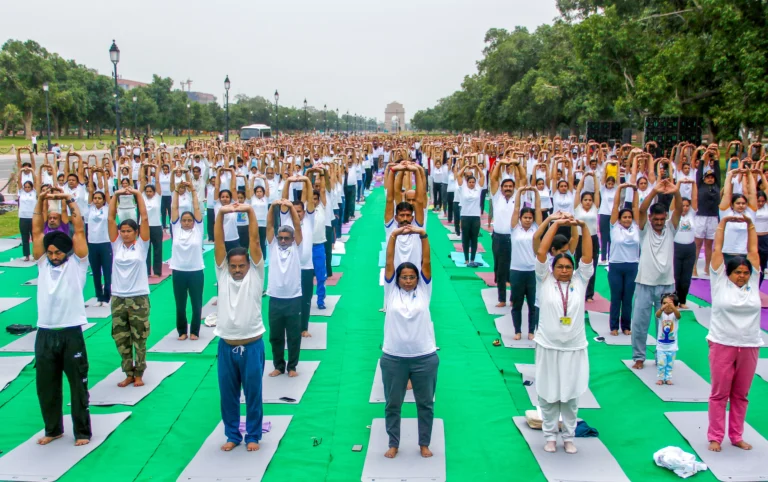
On the occasion of the 12th International Yoga Day, Chief Minister Adityanath expanded this development agenda into the Bundelkhand region, launching 88 separate projects valued above Rs 697 crore in Mahoba’s Modi Gram.
Prior to this event, the leader joined an International Yoga Day session overseen by Prime Minister Modi at the historic Rani Lakshmibai Fort grounds in Jhansi, noting that yoga events spanned across 57,000 Gram Panchayats and 75 districts.
During his address, the Chief Minister emphasized that physical and mental wellness directly fuels public welfare, contrasting this mindset with past administrations whose corrupt actions brought disinvestment and disrepute to Bundelkhand.
Marking his first return to Gorakhgiri Mountain in over a decade, the leader announced the installation of a new ropeway system and designated the historic area for specialized adventure tourism.
CM Yogi On Water Infrastructure
Addressing long-term resource scarcity, Adityanath confirmed that the ongoing Ken-Betwa Canal Project will permanently resolve Bundelkhand’s historic water deficits upon final completion.
He highlighted the successful activation of the Arjun Sahayak Project, an irrigation network that languished incomplete for decades under past leaders until its 2021 inauguration by Prime Minister Modi, which now services thousands of hectares across Mahoba and Banda.
The Chief Minister concluded by noting that advanced BrahMos missiles are now actively manufactured within Uttar Pradesh’s expanding Defense Manufacturing Corridor, showcasing the state’s advanced industrial evolution.
Future Outlook
The strategic focus of Uttar Pradesh shifts toward completing megaprojects like the Ken-Betwa Canal link and expanding high-tech manufacturing inside the Defense Industrial Corridor. With expressways linking rural sectors to urban centers, the state is positioning itself to attract long-term foreign direct investment. The ongoing development of the Jewar International Airport and modern data centers underscores a formal transition from a traditional agrarian base into a primary technological and logistical hub in India.
FAQs
When did Yogi Adityanath first take office as Chief Minister?
Chief Minister Yogi Adityanath assumes office in 2017, securing a second consecutive term following another decisive electoral victory in 2022.
What major infrastructure projects have been completed under his tenure?
Key infrastructure developments include the construction of the Ganga, Purvanchal, and Bundelkhand Expressways, alongside the creation of the Jewar International Airport and the Defense Industrial Corridor.
What was the total value of the projects inaugurated in Mahoba in 2026?
The Chief Minister launched 88 developmental initiatives worth over Rs 697 crore in Mahoba on International Yoga Day in 2026.
How is the water scarcity issue in Bundelkhand being addressed?
The water crisis is being managed via the newly completed Arjun Sahayak Project and the ongoing Ken-Betwa Canal Project, which will provide widespread irrigation across Mahoba and Banda.