Vance Reveals Family Reaction to Indian Heritage of Wife Usha
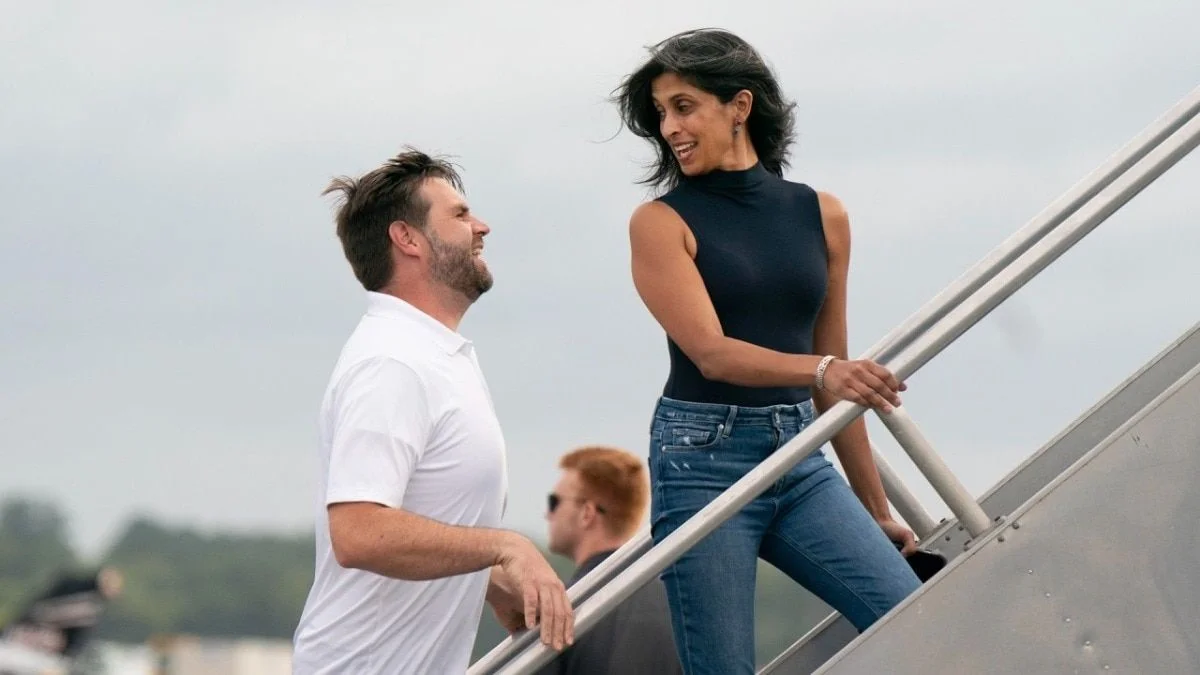
US Vice President JD Vance recently disclosed a personal family conversation regarding his wife Usha Vance’s Indian background. The anecdote highlighted his mother’s initial unfamiliarity with diverse international cultures. The revelation has triggered widespread discussions regarding cultural awareness and interfaith dynamics within high-profile American political families.
Key Highlights
- US Vice President JD Vance shared a candid story about his mother asking which “tribe” his wife Usha belonged to after learning of her Indian heritage.
- Vance defended the remark as an example of past cultural unfamiliarity rather than malice, noting his family subsequently embraced Usha completely.
- The couple met at Yale Law School in 2010 and married in 2014 using traditional Hindu rituals, with a fourth child expected soon.
- The disclosure follows past controversies surrounding Vance’s personal faith journey after his 2019 conversion to Catholicism.
US Vice President JD Vance has consistently maintained transparency regarding his 12-year interfaith marriage to Usha Vance. Recently, the Vice President utilized a podcast appearance to detail a private historical conversation with his mother. The dialogue occurred immediately after he first informed her about Usha’s ancestral connection to India. Vance revealed that upon learning of her ethnic background, his mother enquired about her specific tribe.
Vance clarified that the query stemmed entirely from a historical absence of exposure to international populations. He emphasized that the question carried no malicious intent to demean or dismiss his partner’s lineage. Usha Vance was born in California to an immigrant household that relocated to the United States from Andhra Pradesh approximately 40 years ago.
The Vice President recalled his mother asking about Usha’s specific ethnicity. He responded by stating she was Indian, prompting the follow-up question regarding her tribe.
Vance observed that his mother and his wife originated from vastly distinct social environments. He stated that the interaction highlighted how limited his family’s geographical and cultural knowledge was during that period.
JD VANCE ON FAMILY, USHA, AND PERSONAL LIFE
Vance has engaged in a comprehensive series of media appearances following the publication of his book, Communion: Finding My Way Back to Faith. The text explores his personal journey toward Catholicism and the subsequent impact of conversion on his political ideology and domestic life.
The podcast revelation generated significant engagement across social media channels, with multiple commentators labeling the comment as a demonstration of deep cultural ignorance. Various critics also expressed disapproval of Vance for sharing details they argued could compromise his wife’s public standing.
Nevertheless, the overarching narrative framework presented by Vance indicates the query was devoid of derogatory intentions.
Within the United States, the term “Indian” possesses dual definitions, referencing both citizens of India and indigenous Native Americans who belong to sovereign tribal nations. Historically, indigenous populations have been referred to colloquially as American Indians. It remains highly probable that Vance’s mother initially assumed he was referring to an indigenous American demographic.
The Vice President explicitly categorized the historical interaction as a transparent baseline of his family’s early lack of global familiarity. However, Vance verified that this initial disconnect did not impede his relatives from fully accepting Usha into the family structure.
Vance remarked that though his mother, his grandmother, and his wife emerged from completely different backgrounds, they exhibited highly comparable internal strengths.
Reflecting on his life, the Vice President cited a singular major personal regret involving his late grandmother, known as Mamaw. He expressed deep sadness that she passed away before ever having an opportunity to meet Usha.
Vance asserted that the two women shared a striking intellectual similarity despite their divergent upbringings, describing both as exceptionally intelligent.
The couple initially connected in 2010 during their enrollment at Yale Law School. They finalized their legal union 4 years later in 2014 through an interfaith ceremony incorporating traditional Hindu marriage rites. The household currently includes 3 children, with a 4th child anticipated in the near future.
Vance noted that he was initially drawn to Usha because of her direct communication style.
He praised her unfiltered honesty, labeling it an immediate point of attraction during their courtship. Vance noted that she consistently voiced her exact thoughts regardless of potential social friction, adding that his grandmother would have been captivated by her persona.
WHEN VANCE SPOKE ABOUT USHA’S FAITH
In 2023, Vance generated considerable public debate after asserting at a collegiate gathering that he hoped his Hindu spouse would eventually adopt Christianity. Vance formally converted to the Catholic faith in 2019.
The declaration drew substantial criticism from the Indian-American community, with numerous advocacy groups characterizing the statement as disrespectful toward Hinduism amid broader national debates over immigration.
Usha Vance, who remains a dedicated practicing Hindu, later publicly clarified that their marital dynamic is regularly misconstrued by external observers.
She affirmed that her husband does not actively attempt to change her religious beliefs on a daily basis. She explicitly stated she is not Catholic and maintains no objective to pursue a Christian conversion.
Future Outlook
As the 2026 political landscape intensifies, the public profiling of interfaith and second-generation immigrant households within the executive branch will remain under close scrutiny. The demographic growth of Indian-Americans represents a vital voting bloc, making the cultural messaging from the Vice President’s office highly consequential for future electoral coalitions. Analysts suggest that open dialogues about cultural assimilation and family evolution will continue to serve as a bridge—or a point of friction—with diverse voting populations moving toward the next legislative cycle.
FAQs
What did JD Vance’s mother ask about his wife Usha?
When JD Vance initially informed his mother that Usha was Indian, his mother asked, “Which tribe?” Vance explained this was due to a lack of familiarity with international cultures, as his mother likely confused the term with Native American tribes.
What is Usha Vance’s ethnic and family background?
Usha Vance was born in California to Indian immigrant parents. Her family moved to the United States from the state of Andhra Pradesh, India, approximately 40 years ago.
When did JD Vance and Usha marry, and what were their wedding rites?
The couple married in 2014, 4 years after meeting at Yale Law School in 2010. Their wedding was an interfaith ceremony that featured traditional Hindu marriage rituals.
Has Usha Vance converted to Catholicism?
No, Usha Vance is a practicing Hindu and has explicitly stated that she has no intention of converting to Catholicism, despite JD Vance’s personal conversion to the Catholic faith in 2019.