US Senate Votes to Halt Trump’s Iran War Actions
The United States Senate narrowly approved a concurrent resolution on Tuesday demanding an immediate halt to President Donald Trump’s military operations against Iran. This legislative rebuke arrives as the White House attempts to conclude a highly controversial peace agreement with Tehran over the next 60 days.
Key Highlights
- The Senate voted 50-48 to curb the president’s unauthorized military actions against Iran.
- Four Republicans broke ranks to support the measure, while one Democrat voted against it.
- The vote occurred just prior to Trump’s high-stakes meeting with GOP lawmakers on Capitol Hill.
- The conflict has caused significant global economic shocks, disrupting critical energy and agricultural trade routes.
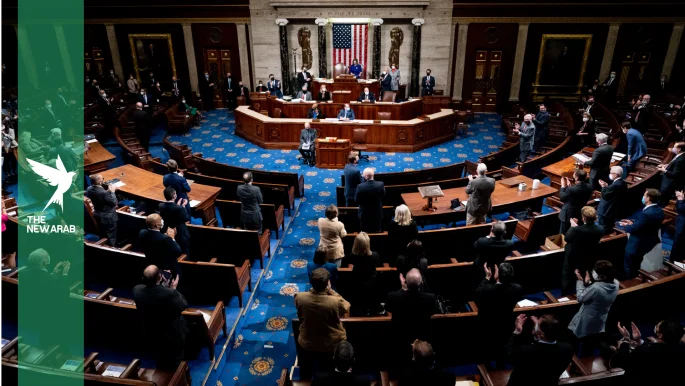
The congressional measure, which previously cleared the House of Representatives, passed the upper chamber in a 50-48 vote. The resolution instructs Trump to withdraw American forces from active hostilities against Iran unless Congress grants explicit military authorization.
Because lawmakers utilized a concurrent resolution, the measure does not travel to the president’s desk for an official signature. Consequently, its ultimate legal enforcement remains a point of intense dispute between both branches of government.
Nevertheless, the vote establishes a formal congressional record against a conflict that erupted after American and Israeli airstrikes hit Iran in late February. The ensuing warfare disrupted international energy markets and triggered a wider regional conflict drawing in Lebanon and several Gulf states.
The legislative push materialized as administration officials conduct a 60-day diplomatic effort to finalize a tentative memorandum of understanding with Tehran. This broader negotiation aims to address the Iranian nuclear program, international sanctions relief, and security within the strategic Strait of Hormuz.
Senate Democratic Leader Chuck Schumer engineered the vote to compel Senate Republicans to state their positions publicly. The maneuver followed private expressions of alarm from multiple Trump allies regarding the execution of the war and the subsequent peace framework.
Schumer declared in a floor speech that while Republicans frequently criticize Trump’s secrecy and the proposed Iranian agreement privately, legislative action represents the sole method to terminate the conflict. He urged his colleagues to demand transparency from the administration.
The resolution secured its path through the House after four Republican lawmakers joined a unified Democratic caucus. This crossover represented a rare defiance of the executive branch on critical matters of national security and wartime authorities.
‘Dangerous prospect’
Under the strict provisions of the 1973 War Powers Act, executives must secure explicit congressional approval within 60 days of deploying military forces into active hostilities. However, successive administrations from both political parties have routinely challenged the legal scope of the statute.
The White House maintains that congressional efforts to restrict Trump’s wartime authorities are fundamentally unconstitutional. Furthermore, administration officials argue the armed conflict technically concluded under an April ceasefire directive issued by the president.
Executive officials also cautioned that legislative constraints could severely diminish American diplomatic leverage. Negotiators are currently working rapidly to cement a permanent deal with Iranian representatives.
House Speaker Mike Johnson, a prominent congressional ally of the president, strongly criticized the legislation prior to its passage. Johnson stated that restricting the powers of the commander-in-chief during delicate international negotiations constitutes a highly dangerous prospect.
Conversely, Democrats and dissenting Republicans counter that active combat persisted well past the statutory timeline. Critics also emphasized that the president has repeatedly issued public threats to initiate fresh military strikes.
The legislative push additionally underscores deep congressional anxieties regarding the economic fallout of the war. The hostilities blocked vital trade routes, inflated global energy prices, and strained domestic voters navigating high inflation ahead of the November midterm elections.
Diplomatic tracks between Washington and Tehran have accelerated since Trump and Iranian President Masoud Pezeshkian signed the initial framework. That preliminary memorandum sought to freeze regional proxy warfare and restore commercial shipping access to the Strait of Hormuz.
Significant geopolitical hurdles still block a final pact. Iranian officials announced on Tuesday that United Nations inspectors will be barred from visiting nuclear sites damaged by US and Israeli bombing runs last year, contradicting assertions made by Vice President JD Vance.
Trump later contradicted the Iranian statements via social media, asserting that Tehran had consented to the highest tier of international nuclear inspections.
Concurrently, Tehran’s chief diplomatic negotiator, Mohammad Bagher Ghalibaf, stated that the Strait of Hormuz would never return to pre-war free navigation standards, despite the installation of new communication hotlines designed to manage commercial shipping traffic.
Impact on Global Markets and Regional Security
The military conflict generated severe economic shocks across global networks, causing sudden spikes in oil and gasoline prices worldwide. The disruptions heavily impacted US agricultural sectors, which rely extensively on fertilizer shipments that normally transit the contested Strait of Hormuz.
Beyond maritime shipping disruptions, the warfare triggered weeks of sustained missile and drone strikes targeting multiple countries across the Persian Gulf region. Retaliatory strikes repeatedly impacted infrastructure within the United Arab Emirates, Qatar, and Jordan.
In response to these disruptions, the White House recently unveiled a 14-point peace blueprint centered on a $300 billion reconstruction and economic development fund. Under the proposed terms, the fund would be deployed in exchange for Tehran reopening the Strait of Hormuz to international commercial vessels.
The proposed peace framework mandates that Iran reaffirm its commitment against acquiring nuclear weapons, though the text lacks explicit verification protocols. Some Senate Republicans expressed concern that the $300 billion fund undermines original US wartime objectives, while others, such as Senator John Kennedy, urged patience during the 60-day negotiating window.
The legislative showdown marks the second time this year Congress has attempted to invoke the War Powers Resolution. Earlier in 2026, lawmakers sought to block military operations in Venezuela following a special forces operation that captured former President Nicolas Maduro, an effort that failed only after Vice President JD Vance cast a tie-breaking vote.
FAQs
What is the purpose of the war powers resolution passed by the Senate?
The resolution directs the president to withdraw US military forces from active hostilities against Iran unless Congress issues a specific authorization for military force.
Does the resolution carry the force of law?
Because it was passed as a concurrent resolution, it does not travel to the president’s desk for a signature, leaving its ultimate legal authority and enforcement highly disputed between Congress and the White House.
Which Republican senators voted in favor of the measure?
Republican Senators Rand Paul of Kentucky, Susan Collins of Maine, Lisa Murkowski of Alaska, and Bill Cassidy of Louisiana crossed party lines to vote in favor of the resolution.
What are the key terms of the proposed Iran peace framework?
The administration’s 14-point memorandum proposes a $300 billion reconstruction and economic development fund for Iran in exchange for reopening the Strait of Hormuz to commercial shipping and a reaffirmation that Tehran will not seek nuclear weapons.