US Lawmakers Pledge Support For Taiwan Amid Arms Sale Review
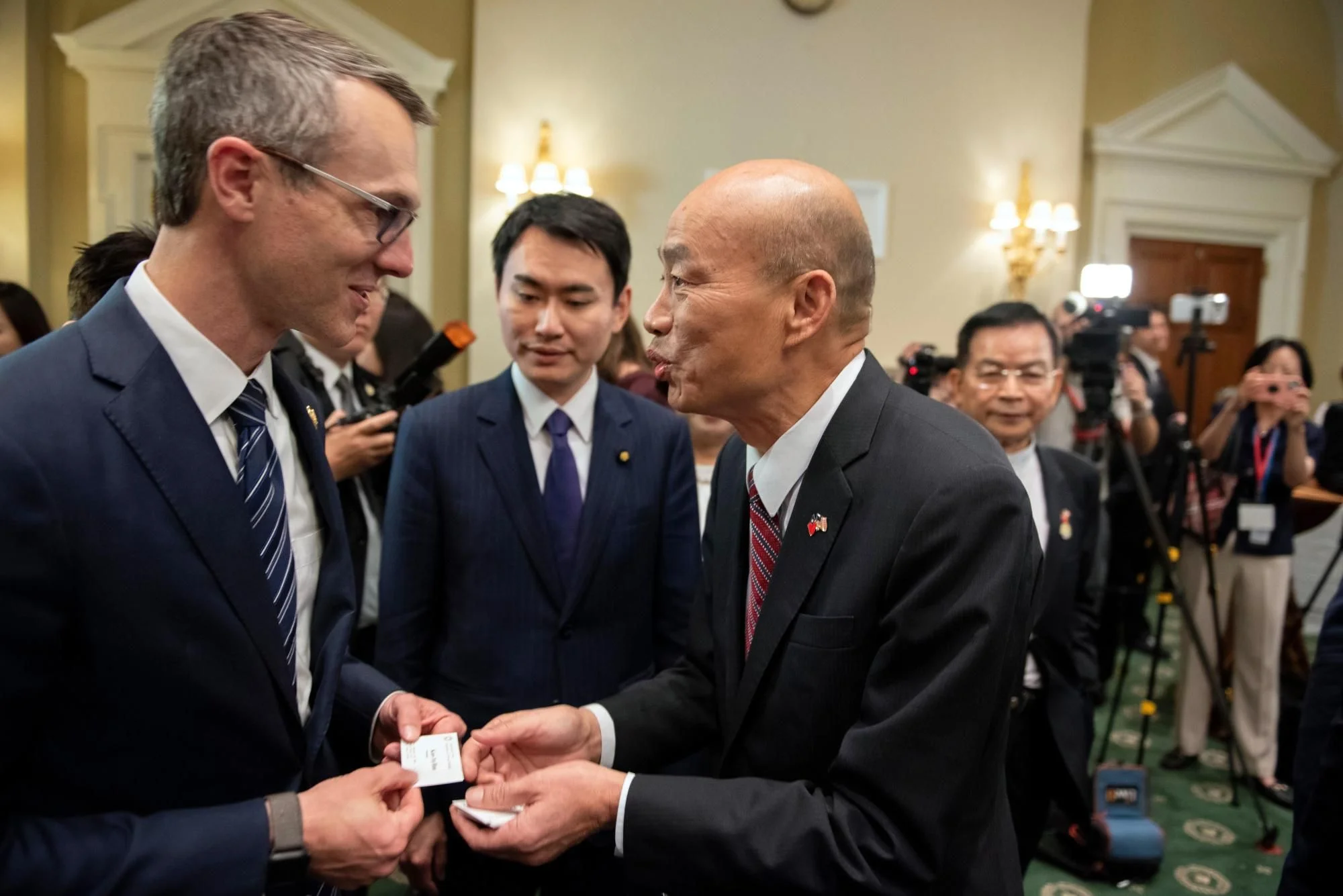
Members of the U.S. House of Representatives pledged steadfast backing for self-governed Taiwan on Wednesday, greeting Han Kuo-yu, president of the island’s Legislative Yuan, in Washington. This high-profile reception occurs while the Trump administration evaluates a $14 billion arms sales package that previously secured preliminary congressional approval.
Key Highlights
- More than 30 bipartisan House representatives attended the Capitol Hill reception to demonstrate solidarity with Taiwan.
- Lawmakers urged the current administration to expedite the delayed $14 billion defensive weapons package without further hesitation.
- Han Kuo-yu highlighted escalating trade ties, noting Taiwan has overtaken Germany as the fourth-largest commercial partner of the United States.
- The Taiwanese delegation requested expanded international support to counter geopolitical isolation enforced by the People’s Republic of China.
More than 30 House representatives, spanning both Democratic and Republican parties, filed into the reception at the Longworth House Office Building. Attendees showing solidarity included Speaker Emerita Nancy Pelosi, D-California, and Representative Michael McCaul, a Texas Republican and former leader of the House Foreign Affairs Committee.
Representative Ted Lieu, a California Democrat serving as the vice chair of the House Democratic Caucus, also attended. McCaul expressed deep personal affection for the island when greeting Han. The Texas representative declared that the United States firmly stands behind the legislative leader.
Pelosi emphasized that legislative backing for Taiwan remains entirely bipartisan and bicameral across both chambers and political parties. She stated that the relationship centers on regional peace. Pelosi added that commerce remains a priority to ensure shipping vessels navigate global waters safely.
Han leads an eight-person parliamentary delegation that reached the capital on Tuesday night following a stop in Phoenix, Arizona. In Phoenix, Taiwan Semiconductor Manufacturing Co. constructs new fabrication facilities. These factories manufacture highly advanced microchips required to power the global artificial intelligence expansion.
TSMC serves as the primary symbol demonstrating Taiwan’s critical importance to the American economy. The visiting delegation also met with seven Democratic senators earlier on Wednesday. This group included New Hampshire Senator Jeanne Shaheen, the leading Democrat on the Senate Foreign Relations Committee.
It remained unconfirmed if Republican senators held meetings with the visiting Taiwanese lawmakers. The Senate Democrats called upon the Trump administration to execute the $14 billion military hardware transfer immediately. They issued a statement reaffirming commitments to maintain close, amicable bilateral relations.
The senators noted the U.S. obligation to provide defensive weaponry. They added that these arms support vital deterrence against intensifying coercion from the People’s Republic of China. Beijing views the island of 23 million citizens as part of Chinese territory, vowing reunification by military force if deemed necessary.
This territorial dispute remains a highly sensitive friction point within U.S.-China bilateral diplomacy. Washington remains legally mandated by domestic legislation to supply Taiwan with adequate defense hardware to resist mainland aggression. President Donald Trump indicated a re-evaluation of the package following his May diplomatic trip to Beijing.
The Chinese government stringently opposes the military transfer. Trump previously implied that the pending defensive arms package could serve as leverage in broader negotiations. Conversely, Secretary of State Marco Rubio affirmed that foundational U.S. policy regarding Taiwan continues without modification.
On Wednesday, multiple American lawmakers vocalized public support for completing the pending weapons transfer. Representative Lloyd Doggett, a Texas Democrat, affirmed that Taiwan must never be treated as a negotiating chip. Doggett described the island as an outpost of freedom requiring maximum preservation efforts.
The Texas lawmaker stated that Washington must supply every defensive weapon required as rapidly as manufacturing permits. Lieu explicitly critiqued the executive branch for pausing the $14 billion package. The California representative requested the administration reverse its stance and permit the arms transfer to move forward.
Han represents Taiwan’s opposition KMT political party. During his address, he praised American national achievements spanning the past 250 years. The legislative leader stated that Taiwan shares American ideals regarding freedom and democracy. He noted both democracies shoulder duties to preserve global stability.
Han emphasized the expanding commercial relationship connecting Taiwan and the United States. The island nation has officially surpassed Germany to become the fourth-largest trading partner of the U.S. This economic surge is heavily propelled by American demand for advanced semiconductor hardware.
The legislative leader requested American assistance to help Taiwan secure expanded international recognition. Current diplomatic protocols prevent foreign governments from maintaining official relationships with both Beijing and Taipei simultaneously. Consequently, only 12 sovereign nations, including the Holy See, maintain formal ties with Taiwan.
Beijing systematically blocks Taiwan from participating in various global institutions, including the World Health Organization. Han observed that Taiwan experiences profound isolation on the global stage. He petitioned congressional allies to assist the island in securing participation within global initiatives.
Han finishes his capital visit on Friday, departing on a inaugural direct flight operated by EVA Air. The route establishes non-stop travel between Washington Dulles International Airport and Taiwan Taoyuan International Airport. Officials highlighted the new flight path as tangible proof of deepening bilateral connections.
Future Outlook
Geopolitical analysts project that U.S.-Taiwan relations will face heightened volatility throughout 2026 as Washington balances defensive mandates with broader trade negotiations involving Beijing. The implementation timeline for the $14 billion arms package will serve as a critical indicator of regional policy. Meanwhile, the completion of TSMC semiconductor facilities in Arizona by 2027 is expected to permanently intertwine American technological infrastructure with Taiwanese supply chain stability.
FAQs
Why is the United States reviewing a $14 billion arms sale to Taiwan?
The current administration is evaluating the pre-approved defensive weapons package following high-level diplomatic discussions in Beijing. The package is being scrutinized to assess its impact on broader trade negotiations and bilateral relations with the People’s Republic of China.
What is the legal basis for the United States providing weapons to Taiwan?
The United States is bound by domestic legislation, specifically the Taiwan Relations Act of 1979, which legally obligates Washington to provide the island with sufficient defensive hardware and services to maintain a self-defense capability against external coercion.
How important is Taiwan to the United States economy?
Taiwan is the fourth-largest trading partner of the United States, having recently surpassed Germany. The economic relationship is anchored by the semiconductor industry, as Taiwanese companies manufacture the advanced microchips necessary to drive American technological innovation and the artificial intelligence sector.